

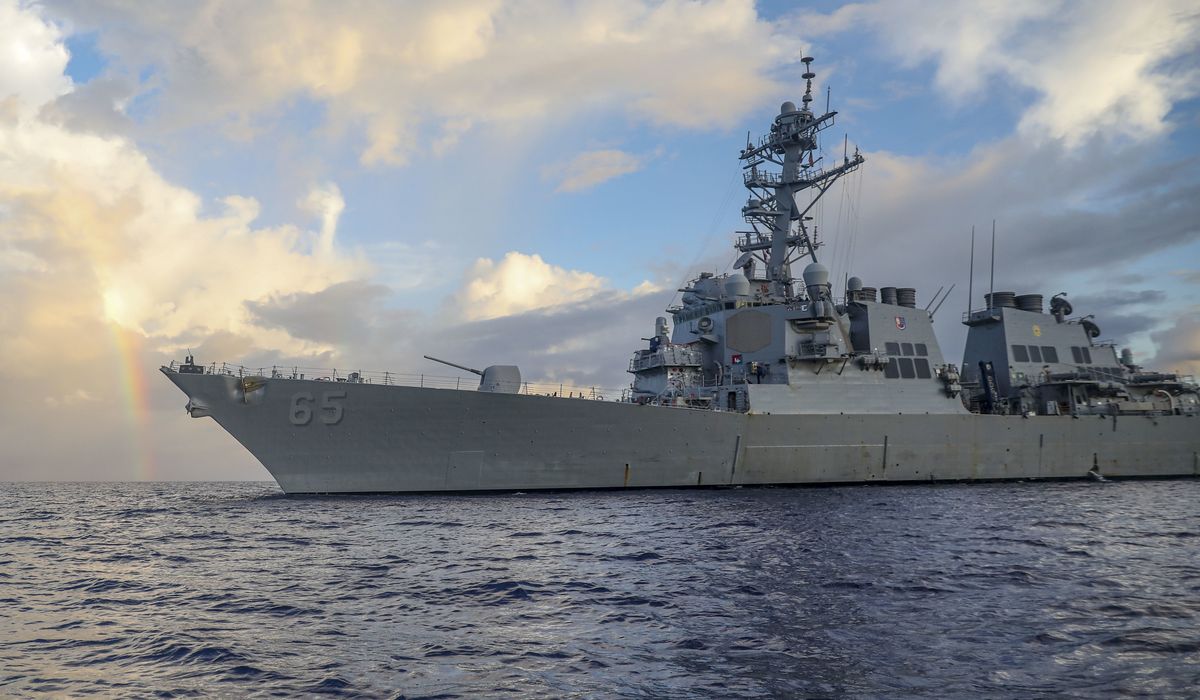
The Navy reported a guided-missile destroyer stalled in the South China Sea for four days due to a system failure, drawing attention to shipboard resilience, regional risk, and fleet readiness. This incident underscores how even well-equipped ships can face prolonged outages while operating in tense waters, and it prompts questions about maintenance, contingency planning, and immediate response options.
A Navy guided-missile destroyer sailing in the tension-filled South China Sea was dead in the water for four days after a system failure, according to the Navy’s 7th Fleet. That single sentence frames a complex operational problem: a modern warship lost its primary ability to maneuver at sea for an extended period. For sailors and commanders, losing propulsion or critical systems in contested waters is never a minor inconvenience.
Being “dead in the water” typically means propulsion and steering are unavailable or unreliable, and that leaves the ship dependent on external help or slow, on-board fixes. In peacetime scenarios the Navy has established repair teams and protocols, but those options look different when a vessel is operating in a hotspot. Repair timelines can stretch when dockside facilities or immediate support are limited by distance, weather, or political constraints.
Crew procedures focus first on safety: damage assessment, power management, and preserving essential systems for life support and communications. Sailors are trained to isolate failed systems and improvise temporary solutions while technicians work through fault trees. Prolonged outages test not just mechanical resilience but also crew endurance, supply status, and the ability to maintain situational awareness in a vulnerable state.
The South China Sea is one of the world’s busiest and most disputed maritime regions, and any disabled Navy ship there raises strategic questions. Even a single unit out of action can change local operational patterns and create short-term gaps in presence or deterrence. That risk is magnified because nearby surface, air, and undersea assets must adapt quickly to fill patrols and secure sea lines of communication.
From a maintenance and readiness perspective, incidents like this expose the thin line between routine wear and mission-impacting failures. Naval engineering teams will examine maintenance records, spare parts inventories, and the timing of scheduled overhauls to determine whether this was an acute breakdown or a longer-term degradation problem. Identifying root causes is essential if commanders want to avoid similar multi-day disruptions in the future.
The Navy’s immediate priorities after restoring basic function are restoration, investigation, and reassurance to allies and partners in the region. Restoration often includes at-sea repairs, ad hoc substitutions, or temporary tows to the nearest safe harbor, each with its own risks. An investigation follows to trace the sequence of failure, inform fleet-wide advisories, and update procedures for managing similar failures under operational pressure.
When ships operate where tensions run high, contingency planning needs to be practical and robust, covering everything from spare parts logistics to mutual-assistance agreements with friendly ports. A prolonged outage is a real-world stress test of logistics chains and command decision-making under pressure. Fixes can be technical, procedural, or organizational, but the goal is the same: keep ships mission-capable while protecting the crew and maintaining credible presence and deterrence.

