

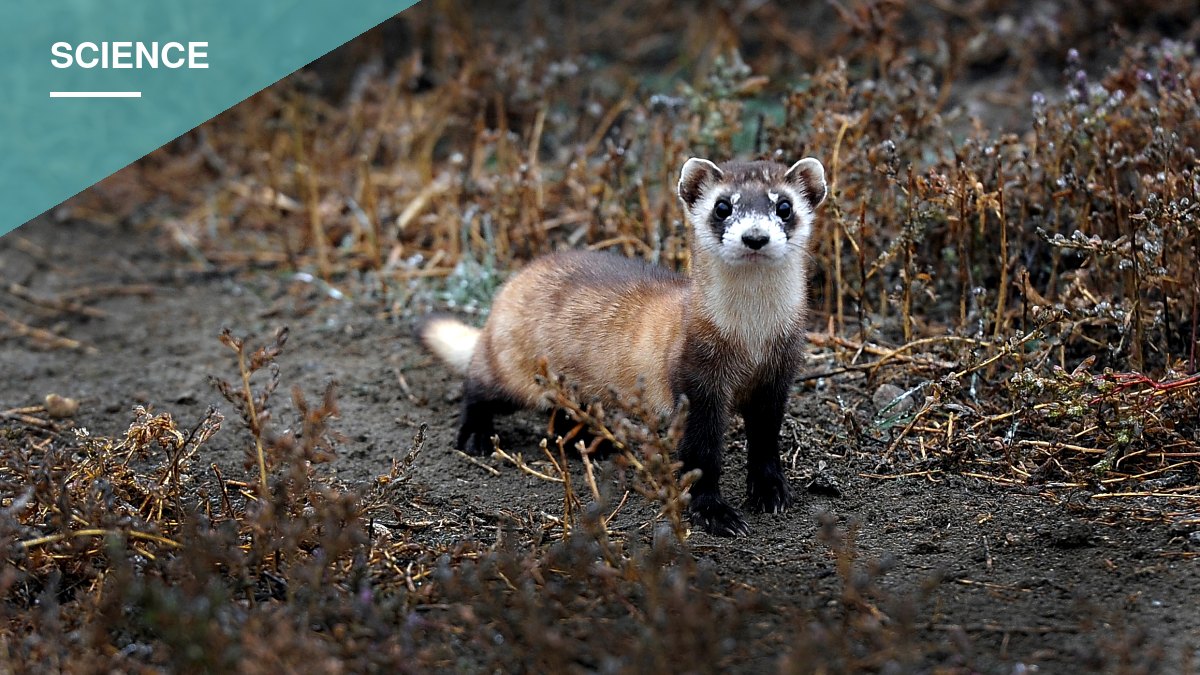
The black-footed ferret, declared extinct in the wild in 1974 and written off entirely as a species by 1980, is now reproducing on its own in South Dakota’s Badlands National Park, according to the National Park Service.
The turnaround traces back to a single dog in Wyoming. In 1981, a farm dog named Shep killed an animal and brought it home to his owners, who had it taxidermied. The taxidermist recognized it as a black-footed ferret and alerted biologists, leading to the discovery of a relic population of 130 ferrets living on the Wyoming farm.
That population didn’t last. Disease cut the group down to just 18 ferrets by 1987. Scientists captured the survivors and brought them into captivity, and those 18 animals became the breeding foundation for every black-footed ferret alive today.
Over the following two decades, wildlife agencies reintroduced captive-bred ferrets across eight U.S. states, plus Canada and Mexico. In Badlands National Park, 147 ferrets were released between 1996 and 1999 at a site called Conata Basin. The reintroduction succeeded well enough that in 2007, biologists transplanted 33 ferrets from the Badlands to Wind Cave National Park, where the National Park Service says roughly 60 now live.
The Badlands population today is estimated at about 120 ferrets, with roughly 80 concentrated in Conata Basin. Badlands remains one of the only black-footed ferret populations in the country that is self-sustaining, meaning it no longer needs new animals from captive breeding programs to maintain its numbers.
Disease remains the biggest threat
The recovery has not come without setbacks. In 2008, sylvatic plague — a flea-borne disease — was detected in Conata Basin. The plague poses a double threat to ferrets, since it can kill both the ferrets directly and the prairie dogs that make up most of their diet. Prairie dog populations had already been reduced by decades of extermination efforts by ranchers and farmers before plague became a factor.
Researchers responded by vaccinating some ferrets and dusting prairie dog burrows with insecticide to curb the spread of plague-carrying fleas. Biologists continue to monitor the Badlands population closely because of how vulnerable the species remains to disease.
Black-footed ferrets are nocturnal, sleeping as much as 21 hours a day before waking at night to hunt, eat and tend to their young, according to the Park Service.
Still a long way from recovery
The National Park Service estimates about 280 black-footed ferrets currently live in captivity, with another 200 to 300 in the wild. Full recovery of the species would require around 3,000 ferrets — roughly five times the current total wild and captive population combined.
The species remains one of the most endangered mammals in North America, still threatened by disease, habitat loss and declines in the prairie dog populations it depends on for food.

