

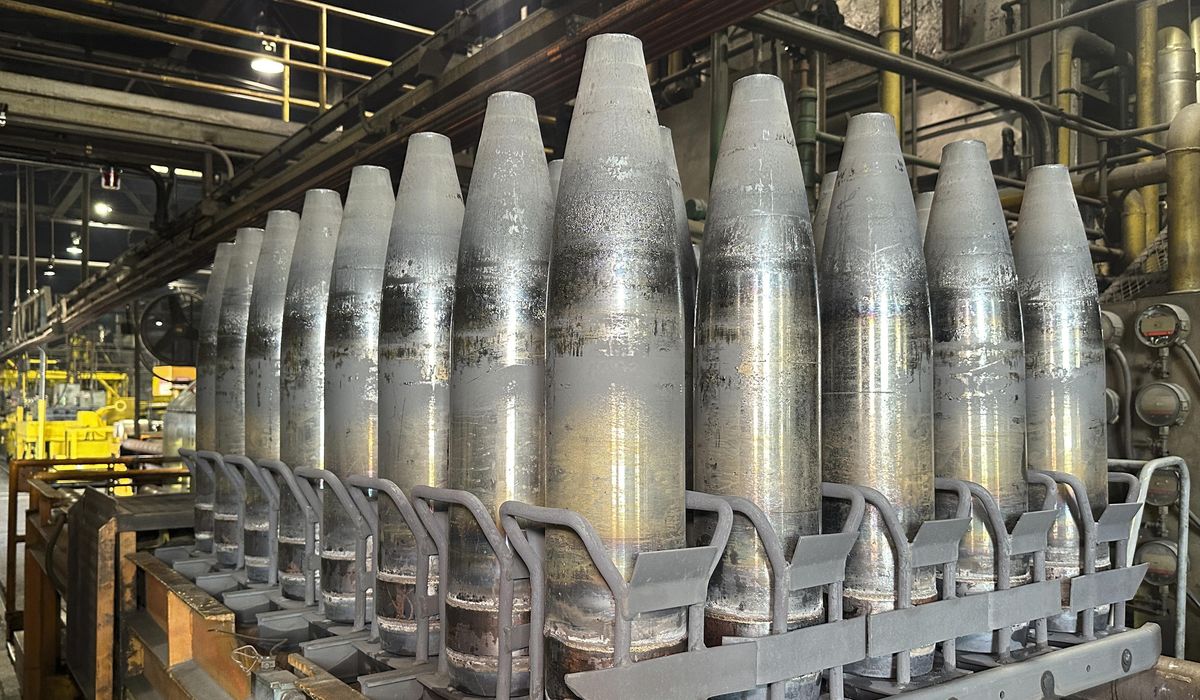
The Army is falling short on 155 millimeter artillery ammunition production, and that gap could affect U.S. forces and allied partners in future conflicts according to Pentagon oversight.
Recent oversight findings show the Army is not meeting its planned production levels for 155 millimeter artillery rounds, a key munition for modern ground combat. This shortfall erodes stockpiles that commanders expect to rely on in high-intensity fights. The gap matters because 155 millimeter shells are central to both U.S. doctrine and the defenses of many allied armies.
Manufacturing capacity for heavy artillery rounds is not something you turn on overnight, and the report points to a mismatch between demand signals and industrial output. Facilities, tooling, and trained labor are all part of a fragile supply chain that needs steady investment and clear production runs. When demand spikes, that fragility shows up as delayed deliveries and missed target quantities.
Part of the problem is predictable: years of lower demand reduced incentives for private firms to expand capacity, leaving the Pentagon dependent on a narrow base of suppliers. Those vendors face long lead times for specialized components and must balance military contracts with commercial work. The result is a system that struggles to surge while maintaining quality control.
Another factor is the scale of consumption seen in recent conflicts, which has rapidly drawn down stockpiles and exposed planning shortfalls. The increased use of precision-guided and conventional 155 millimeter rounds has outpaced assumptions baked into earlier production plans. That dynamic forces military planners to rethink how much reserve ammo they should hold and how quickly industry can rebuild it.
The risks extend beyond ammunition counts to operational planning and deterrence. Commanders prepare for scenarios that assume a flow of munitions to the front lines, and shortfalls constrain options at the moment of truth. Allies that rely on American production or logistics support could also face reduced access in a crisis, changing alliance calculations.
Fixes require both near-term action and long-term industrial strategy. Near-term moves include prioritizing production lines, incentivizing overtime, and simplifying contract requirements to accelerate deliveries. For the long term, investments in additional plants, workforce training, and predictable procurement profiles will be necessary to stabilize supply.
Policy decisions also play a role: setting realistic production targets, funding surge capacity, and coordinating with allies who can share industrial burdens. NATO partners already collaborate on certain munitions, but gaps remain where national policies diverge. A clear, sustained demand signal from defense buyers will help companies justify capacity expansion.
Testing and quality assurance cannot be shortchanged in the rush to increase output, since faulty rounds create new operational risks. Modern shells include sensitive components that require precise manufacturing and inspection. Any acceleration plan has to balance speed with the safeguards that keep troops and missions safe.
Budgeting and procurement rules matter too, because multi-year contracts and predictable budgets reduce uncertainty for manufacturers. Flexibility in contract vehicles can allow rapid scaling in response to crises, while stable funding attracts more industrial partners into the defense supply chain. Without those mechanisms, capacity will remain constrained by financial and administrative friction.
Practically speaking, the Army and Pentagon oversight recommend clearer metrics and more aggressive planning to close the production gap. That includes tracking not just total rounds produced but the health of the supply chain for components, workforce readiness, and surge timelines. Transparent benchmarks let leaders know whether mitigation steps are working or if policy changes are needed.
Strengthening the ammunition industrial base is a long-term endeavor that touches procurement, policy, and geopolitics. Aligning production with strategic needs, while maintaining quality and alliance commitments, will determine how well the United States and its partners can sustain fires in future conflicts. The choices made now will shape readiness for years to come.

