

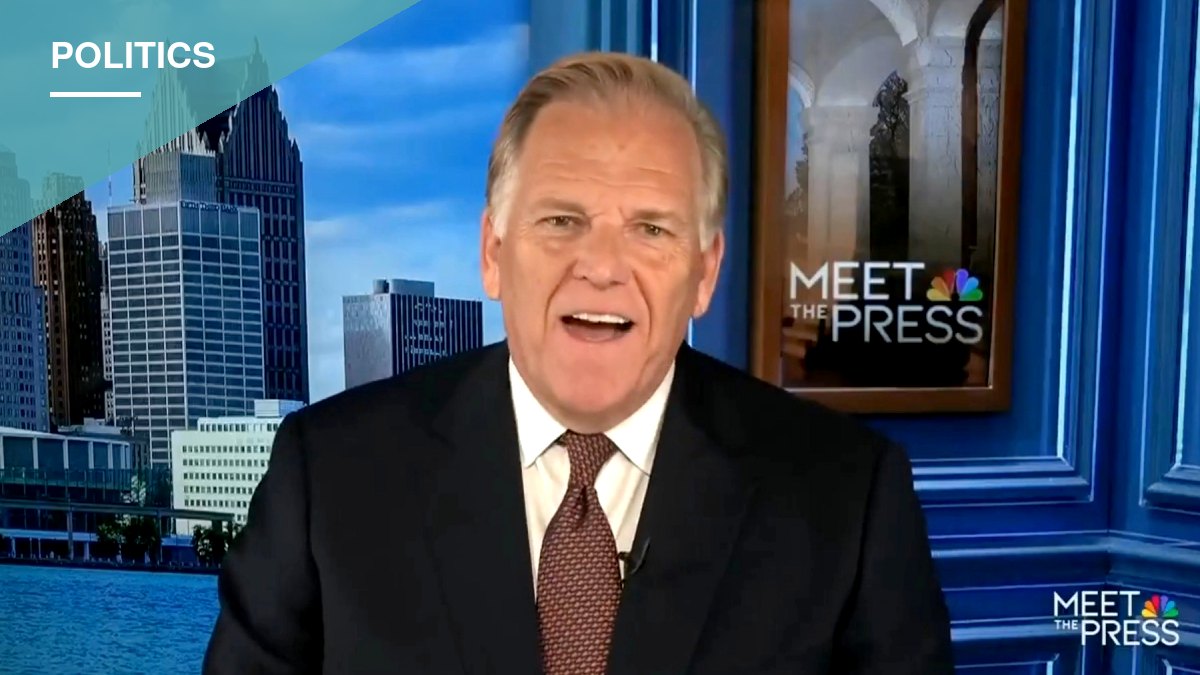
Republican Senate candidate Mike Rogers declined to say whether he considers himself a “MAGA Republican” during an appearance Sunday on NBC News’ “Meet the Press,” pivoting instead to criticize what he called a lack of coverage of defections away from his Democratic opponent, Abdul El-Sayed.
“I get you guys on the national press, but this is a little bit disgusting to me,” Rogers said when pressed on the MAGA question.
Rogers redirected attention to cracks in the Democratic coalition. “The Democrat coalitions that we have are the fastest-growing coalitions we have,” he said. “Jewish Democrats say we can’t vote for [El-Sayed]. African Americans in Detroit and Pontiac and Flint say, ‘We can’t vote him.'”
The exchange reflects the balancing act Rogers has tried to maintain throughout the campaign, working to hold onto supporters of President Trump without alienating the swing voters Michigan’s closely divided electorate demands. He has called for an end to the war in Iran and has pointed to his relationship with Trump as leverage he could use to push the president to roll back tariffs on Canada, which have hit Michigan’s economy hard.
At the same time, Rogers has leaned into Democratic unease over El-Sayed, actively courting black and Jewish voters who have historically backed Democratic candidates.
Democrats Note Rogers’ Detroit Push
Rep. Haley Stevens (D-Mich.), who ran against El-Sayed in the Aug. 4 primary, acknowledged Rogers’ effort on CNN Sunday: “Mike Rogers is also campaigning rigorously in Detroit. I mean, every time you turn around, the guy’s in Detroit.”
Stevens and other Michigan Democrats have expressed concern over Rogers’ inroads with black voters, a constituency that has long anchored the party’s coalition in the state. Lon Johnson, who chaired the Michigan Democratic Party from 2013 to 2015, has said publicly he will not vote for El-Sayed.
Attacks Over Family Ties and Associations
Rogers has repeatedly criticized El-Sayed over ties between his family and radical Islamic groups, as well as El-Sayed’s own association with figures including far-left Twitch streamer Hasan Piker. A particular focus has been connections between members of El-Sayed’s family and the Muslim Brotherhood, an organization whose radical offshoots critics say provided ideological inspiration for Hamas.
In 2012, El-Sayed publicly expressed support for then-Egyptian President Mohamed Morsi, a Muslim Brotherhood figure, and urged him to “purge” the media and police. The Muslim Brotherhood has been designated a terrorist organization by several countries, including Saudi Arabia and the United Arab Emirates.
When “Meet the Press” anchor Kristen Welker asked whether this line of attack risked alienating moderate Muslim voters, Rogers responded: “Remember, the Muslim Brotherhood is banned in five Muslim countries. This is not about Islam. It’s not about how he prays. It is about his adherence to this radical Islamic agenda.”
He added, “A lot of the Muslims here are part of our community and an important part of our fabric here. And what happens with that is they understand that they don’t want to bring that hate, that division.”
El-Sayed has publicly disavowed the Muslim Brotherhood. Following the candidates’ final debate last week, he accused Rogers of focusing on his religion rather than policy. “We had a little debate. Or I had a debate, and he just pointed at me and said, ‘He’s Muslim,'” El-Sayed said afterward.
The race remains extremely close. The latest RealClearPolitics polling average shows El-Sayed ahead of Rogers by 1.9 percentage points.

