

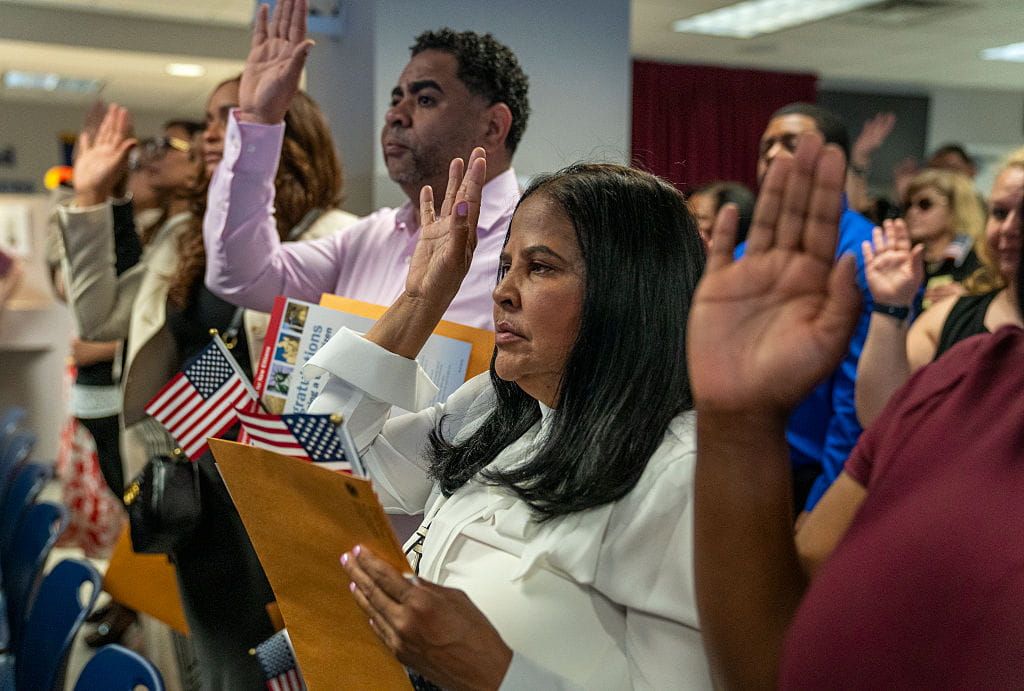
Revived public charge rules are tightening the path to citizenship, returning the focus to self-reliance and taxpayer protection while reviving a long-standing legal principle rooted in early American law.
Immigration policy flips with administrations, and the public charge rule is the latest example of that pendulum swing. Under President Donald Trump the rule was tightened, reversing Biden-era changes and signaling a tougher line on benefits use. The shift is framed as a defense of law and of American taxpayers.
Federal law requires those seeking permanent residency to show they will not become a public charge, but how that standard is applied moves with political winds. The Trump-era approach broadens the factors that can count against an applicant and restores discretion to officers evaluating cases. Officials argue this restores consistent enforcement after the prior administration had relaxed standards.
“The Trump administration is upholding the rule of law and protecting American taxpayers from subsidizing aliens who may become dependent on public benefits,” Zach Kahler, a spokesperson for US Citizenship and Immigration Services (USCIS), said in a statement. “USCIS is committed to safeguarding the safety, security, and financial well-being of Americans.”
The final rule explains that rescinding the Biden changes “aligns with long-standing policy that aliens in the United States should be self-reliant and government benefits should not incentivize immigration.” It does not list a fixed menu of programs that count as public charge, instead allowing case-by-case evaluations. The rule explicitly permits “individualized, fact-specific public charge inadmissible determinations, based on a totality of the alien’s circumstances.”
The language gives officers latitude to weigh work history, age, health, assets, and benefit use, and it adds that “using good judgment and discretion, officers will more accurately assess an alien’s likelihood at any time of becoming a public charge.” Supporters say this discretion is necessary to prevent automatic qualification for residency when long-term dependence on public support is likely.
Critics see broader consequences and warn of chilling effects in mixed-status families. “The reach of this rule extends far beyond immigrants coming into the United States. It is designed to punish the citizens this administration dislikes: those in mixed-status families,” American Immigration Lawyers Association Executive Director Benjamin Johnson said in a statement. He argued that eligible citizens might avoid health care and nutrition assistance out of fear their family members could be harmed.
Other opponents adopt a more charged tone. Sarah Krieger, the senior policy counsel at the National Immigration Law Center, said, “With this new rule, they are sowing fear and chaos to ultimately reshape America into a country where only the few who are white and ultra-wealthy are welcome.” Those words reflect the sharp political divide over whether the rule protects taxpayers or needlessly scares vulnerable people away from essential services.
The public charge idea long predates modern immigration law, tracing back to colonial poor laws designed to prevent town coffers from being overrun. On August 3, 1882, President Chester A. Arthur signed the Immigration Act of 1882, the first federal law to include a public charge provision. “The 1882 Immigration Act adopted as federal law policies and practices already enacted by the states of New York and Massachusetts that targeted poor immigrants for exclusion and removal,” Immigration History explained.
Early statutes used blunt, now-archaic language to describe who might be excluded, listing “any convict, lunatic, idiot, or any person unable to take care of himself or herself without becoming a public charge.” That list later expanded to include “all idiots, insane persons, paupers or persons likely to become a public charge, persons suffering from a loathsome or a dangerous contagious disease, persons who have been convicted of a felony or other infamous crime or misdemeanor involving moral turpitude, polygamists, and also any persons whose ticket or passage is paid for with the money of another or who is assisted by others to come.”
Americans broadly agree on helping neighbors, but the debate is about who pays and how to avoid perverse incentives. The revived rule aims to protect public resources and encourage self-sufficiency, while critics warn of real human costs for families caught between benefit rules and immigration consequences. That tension — between enforcing borders and preserving empathy — is exactly what keeps this issue at the center of immigration politics.

