

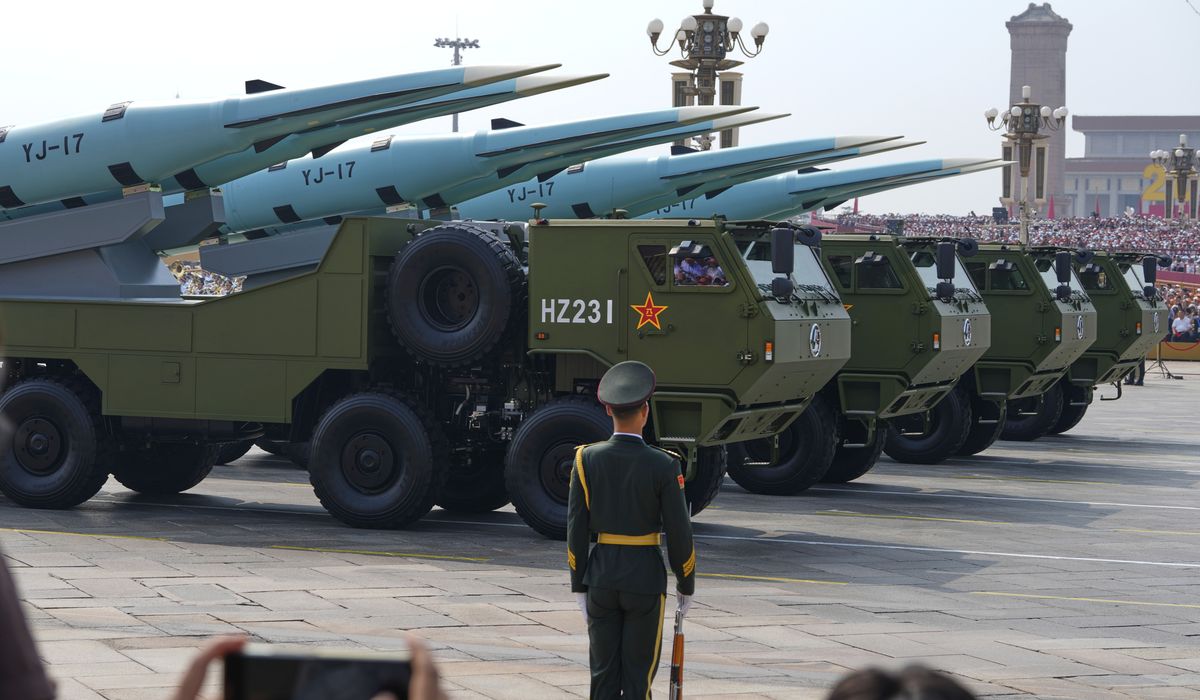
The Chinese military is studying the use of artificial intelligence to boost the capabilities of its hypersonic missiles in defeating U.S. missile defenses, according to an Air Force think tank report.
China’s push to pair artificial intelligence with hypersonic weapons is a wake-up call for anyone who cares about American deterrence and defense. This is not a distant experiment; the Air Force think tank flagged active study of AI to help hypersonics evade U.S. missile defenses, and that changes the strategic picture. Republican policymakers should treat this as a clear national security challenge demanding sharp, practical responses.
The report’s basic fact is straightforward and worrying: “The Chinese military is studying the use of artificial intelligence to boost the capabilities of its hypersonic missiles in defeating U.S. missile defenses, according to an Air Force think tank report.” That sentence captures the core of the threat without spin. AI could give hypersonic systems faster adaptation and smarter targeting, which undermines assumptions built into our current layered missile defense architecture.
Hypersonics already complicate interception because of their speed and maneuverability, but adding AI layers on autonomy and decision-making that operate faster than human controllers. An AI-enabled hypersonic vehicle can change course, mask signatures, or coordinate with other systems in seconds, squeezing the timeline for defenders. Republicans need to stress the urgency of upgrading sensors, command systems, and interceptors to restore credible margins of response.
There’s also the worry about proliferation. When China moves a capability forward, others watch and follow, often more quickly than anyone expects. That means the U.S. must accelerate efforts to deny critical technologies and choke points that enable AI-guided hypersonic platforms. Policy tools include tighter export controls, targeted sanctions, and cooperation with allies to control dual-use components.
On the defensive side, modernizing detection and tracking is non-negotiable. Boosting space-based sensors, investing in resilient networks, and hardening command-and-control will make it harder for hybrid AI-hypersonic tactics to succeed. Republicans should press for clear, funded plans in the Pentagon budget that prioritize these capabilities now, not years from now.
Intelligence and counterintelligence work matter even more in this environment. Knowing the algorithms, the training data, and the test scenarios gives defenders an edge in modeling likely behaviors. That requires a blend of technical expertise and policy levers to disrupt adversary development, including offensive cyber options and tighter scrutiny of technology transfers.
We also need stronger partnerships with allies in Asia, Europe, and beyond. Defence is a shared effort, and integrated sensor networks and data-sharing agreements can blunt asymmetric advantages. Republicans should advocate for pragmatic burden-sharing that leverages allied capabilities without creating dependencies that Washington cannot sustain under pressure.
Research and procurement timelines cannot lag behind the pace of innovation. Rapid prototyping, flexible acquisition pathways, and frequent fielding of new countermeasures will let the U.S. adapt faster than rigid procurement cycles allow. Lawmakers should favor reforms that reward speed and practical results over endless studies.
At the same time, civilian oversight and rules of engagement need updating for an age of semi-autonomous weapons and AI-driven targeting. Clear doctrines about how autonomous decision aids are used in offensive and defensive scenarios will prevent dangerous escalation and ensure accountability. Republicans can lead on responsible, realistic policies that protect lives while keeping strategic advantage.
Economic levers are part of the toolbox. Limiting access to advanced chips, specialized sensors, and software tools that accelerate AI-enabled weapons development will raise costs for any competitor. A focused industrial policy can secure supply chains and prioritize critical components for defense production without unnecessary bureaucracy.
Finally, public communication matters. Citizens should understand the stakes: technological advances in weapons are not abstract academic problems, they reshape real risk to American forces and allies. Honest, direct messaging from leaders reassures the public while building support for the investments and policies needed to stay ahead.
These developments are a clear national security challenge that requires coherent, aggressive response across defense, diplomacy, and industry. The combination of hypersonics and AI is the strategic problem of the moment, and a practical, no-nonsense approach is what will protect American interests.

