

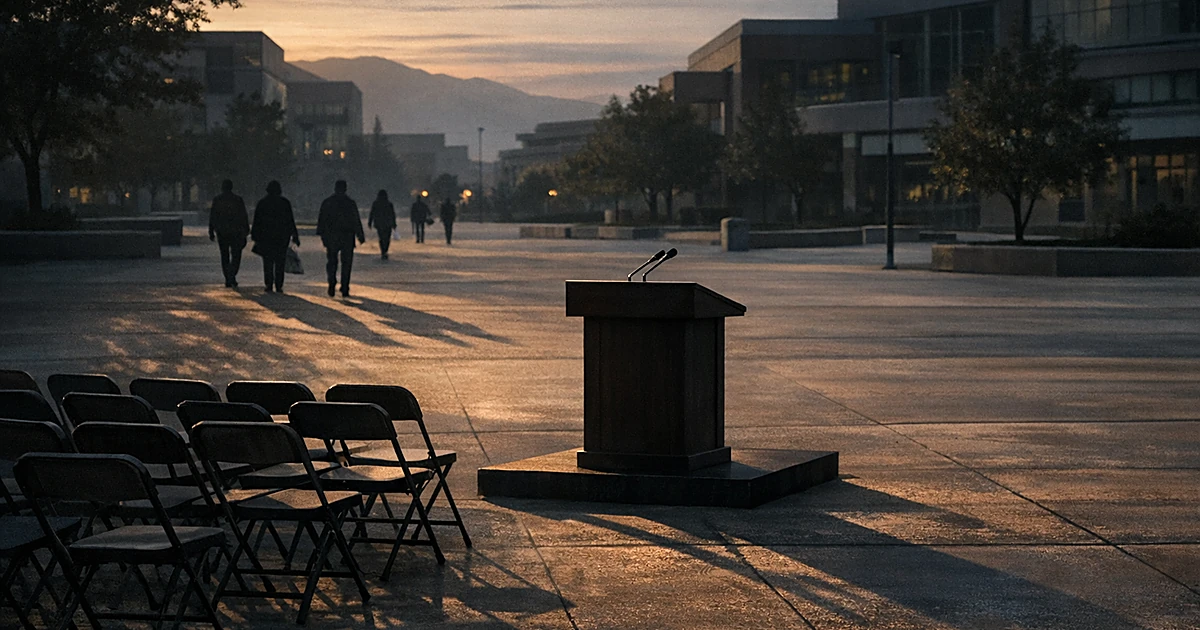
Utah Valley University’s reported pullback from a joint memorial with Turning Point USA has left questions about priorities, communication, and whether the campus will truly recognize the man killed there as the one-year anniversary approaches.
Utah Valley University reportedly backed out of plans to co-host a memorial with Turning Point USA for the first anniversary of Charlie Kirk’s death, instead scheduling a campus closure and a volunteer “Day of Caring” on September 10, 2026. The move surprised Turning Point USA and triggered a search for an alternative venue. University officials did not publicly explain the change and campus sources say the decision came late in the planning process.
The university’s August 7 email to students and staff referenced the date without naming Kirk directly, saying, “Healing continues in different ways for each member of our university community as we approach September 10, the one-year anniversary of the tragic events surrounding Charlie Kirk’s death.” It added, “To provide time and space for reflection, service, and connection, UVU will close operations” that day. The tone and the choice of a service event instead of a named memorial left many on the right feeling the loss was being minimized.
Charlie Kirk, 31, was shot and killed on September 10, 2025, while taking questions from students at UVU in Orem, Utah. Authorities arrested 22-year-old Tyler Robinson after a 33-hour manhunt and charged him in the killing. Investigators recovered a bolt-action rifle wrapped in a towel in a wooded area on the northeast end of campus.
A student who witnessed the attack, Afton Miller, told reporters she had been five to ten feet from Kirk when it happened. The immediacy of that proximity has haunted classmates and raised hard questions about campus safety and the response that followed. Survivors and allies expect the university to be straightforward about honoring the victim by name.
“No one should ever be able to say I’ve witnessed a school shooting, let alone the assassination of one of your greatest heroes.”
The Day of Caring event organized with United Way of Utah County is framed as a broad volunteer effort to improve classrooms, parks, and gardens across the area. That kind of community service is respectable, but it is not the same as a public remembrance for a conservative leader killed while speaking on campus. Turning Point USA, which had been working with the school, is reportedly scrambling to find a new site and has previously planned large-scale tributes, including a proposed memorial at State Farm Stadium with capacity for 63,400.
UVU’s public handling of the anniversary echoes earlier choices the school made after the shooting. The university hosted a vigil nine days after the homicide, but campus reporting said speakers mostly avoided saying Kirk’s name and relied on phrases like “the tragedy on campus.” That reticence to name the victim struck many as an institutional dodge rather than an act of delicate care.
Court testimony from a federal agent indicated the accused attacker allegedly confessed in text messages and described his motive, adding another layer of factual detail to a case already mired in national attention. Those reported messages and the legal record matter for understanding what happened and why. They also complicate attempts to recast the event as merely an abstract campus tragedy.
Weeks before Kirk’s appearance, student activists circulated a petition attempting to block him from campus, which drew hostile comments online including: “No tolerance for Nazi f***s like Kirk. Stop the speaking or someone else will.” The petition failed to stop the event and the university declined to cancel Kirk’s appearance, standing by free speech despite the pressure. The organizer framed the effort as a moral stance, saying neutrality in the face of harm conflicted with their values.
Kirk spoke as planned on campus on September 10, 2025. He was murdered afterward. That stark sequence—invitation, appearance, assassination—has fueled anger among conservatives who expect institutions to honor the actual victim and to be transparent about their decisions.
In March 2026, UVU tapped Sharon McMahon as its commencement speaker, a choice that touched raw nerves after the killing because she had posted an Instagram image captioned “Charlie Kirk, In His Own Words.” That image included the text: “To many Americans, especially if you are black, LGBTQ, or Muslim, Charlie Kirk was not a person who simply engaged in good faith debates on college campuses.” The post was later deleted amid backlash.
UVU then removed McMahon, citing security concerns, and her spokesperson said she “unequivocally condemned the murder of Charlie Kirk, repeatedly and publicly calling his death a tragedy and stressing that public debate must never be met with violence.” The reversal made clear the campus was trying to manage optics and threats rather than offer a clear public stance. Critics said the swap exposed institutional reluctance to face the political dimensions of what occurred.
Taxpayer anger has also surfaced over reports that Utah may face a $10 million defense tab for the accused shooter, a cost that troubles residents watching legal fees mount while families grieve. Those reports add yet another public-policy angle to a case that touches security, justice, and fiscal responsibility. The combination of legal costs and institutional hedging has amplified conservative frustration.
Vice President JD Vance canceled a planned 9/11 memorial appearance to travel to Utah and meet with Kirk’s family, an act that signaled how seriously national leaders treated the death. Vance described Kirk as “a true friend” and stressed the personal bonds and trust that connected him to influential figures. The White House visit made clear the killing resonated at the highest levels of conservative politics.
“Charlie Kirk was a true friend. The kind of guy you could say something to and know it would always stay with him… These group chats include people at the very highest level of our government. They trusted him, loved him, and knew he’d always have their backs.”
Students who were there continue to speak plainly about the cost of violent intolerance. Ryder Warner, who was on campus that day, said, “I don’t think anybody should be killed over their opinion.” Observers in conservative media have cautioned that any account of the murder that ignores the victim, the perpetrator, and the motive is incomplete and unsatisfying, arguing factual clarity matters to justice.
Erika Kirk, Charlie’s widow, has kept a public profile in the year since his death, and the family now watches the university’s decisions with pain and bewilderment. Seeing the institution where her husband was killed treat the anniversary as a scheduling question feels like another indignity to those close to him. Many supporters say they will keep pressing for a memorial that names the victim and recognizes what happened on that campus.
Key facts remain unresolved as September 10 approaches: the university has not explained whether it formally withdrew from a joint memorial agreement, who made that call, or why the change was communicated when it was. Turning Point USA has not confirmed a replacement site, and organizing a meaningful tribute on short notice is a difficult logistical task. The paths forward are uncertain and tensions on campus and beyond are likely to persist.

