

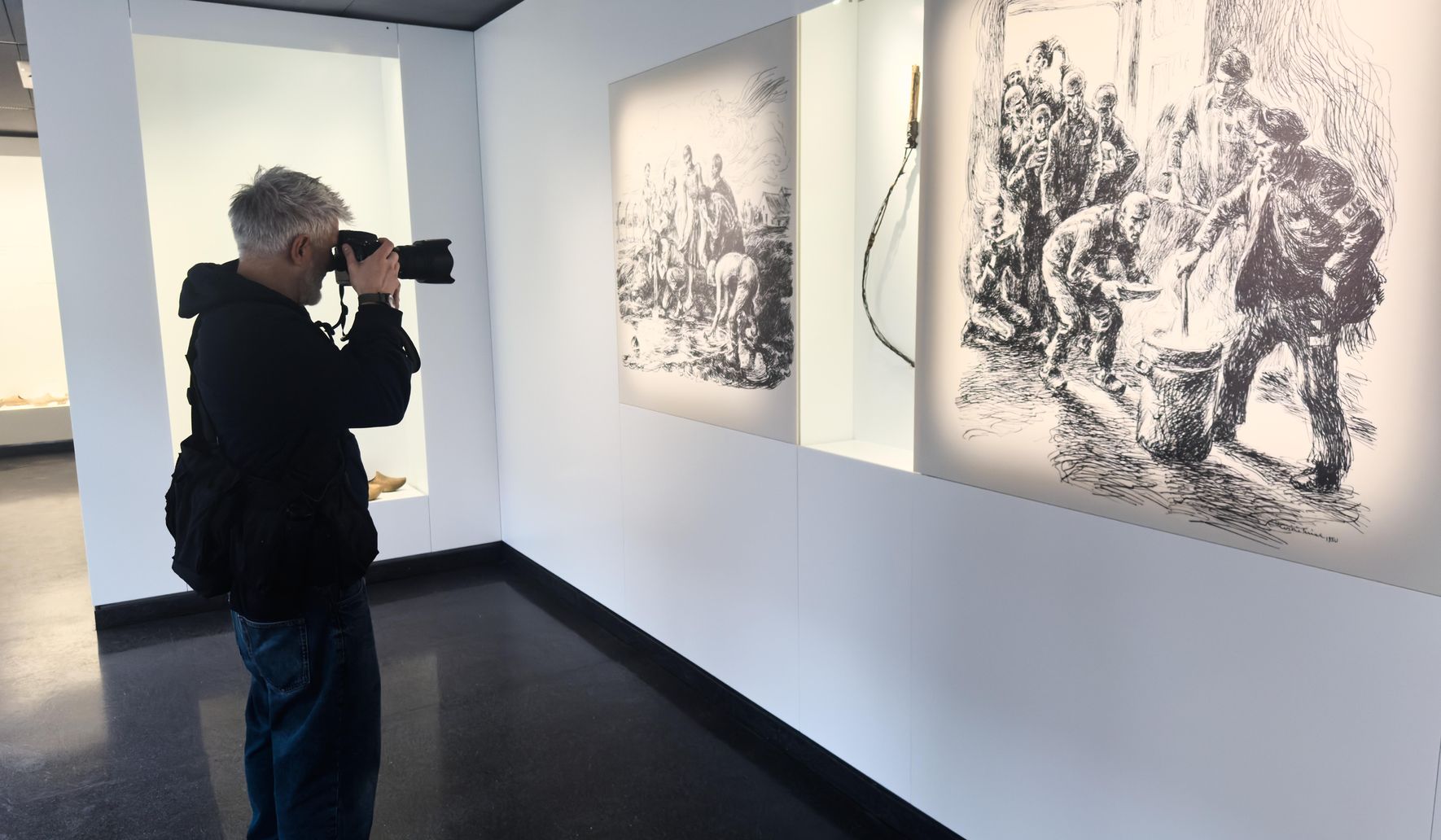
The new permanent exhibition at the Auschwitz museum includes personal objects that link family memory to the site, among them animal-shaped stencils a mother made from a concentration camp shoe and gave to her son for Christmas, underscoring how intimate artifacts carry heavy histories into public display.
The exhibition brings together small, deeply personal items that survived terrible conditions and later became heirlooms. Visitors encounter objects that once belonged to individuals and families, each item carrying a private story that now lives in a public place. Those stories reshape how people understand the scale of loss and the stubborn persistence of personal memory.
Among the pieces is a set of whimsical, animal-shaped stencils a mother fashioned from a concentration camp shoe and gave to her son for Christmas. That single line of craftwork compresses a world: hardship, creativity, tenderness, and an effort to preserve normalcy for a child. The object is simple, but it prompts big questions about survival, resilience, and the ways people held onto hope.
The museum sits on the site of the former Auschwitz-Birkenau complex, a place where official records and personal artifacts meet. Displaying everyday items alongside documents and photographs helps visitors connect bureaucratic atrocity to human lives. The permanent exhibition aims to present these layers without flattening the personal stories into generic history.
Museums face a tightrope: how to show objects that are at once intimate and emblematic of mass violence. This collection tries to respect that tension by keeping provenance and family context visible. Labels and curatorial choices emphasize who owned something, how it was used, and how it came to be preserved, rather than letting artifacts float as abstract evidence.
Curators chose items that represent daily existence as much as the exceptional horrors, because everyday life was where people resisted defeat. A child’s toy, a patched garment, or a handmade stencil tells us how people tried to keep identity and dignity intact. These small items make historical brutality tangible in a way that statistics alone never can.
For many visitors, seeing a personal object linked to a named family is an emotional encounter that changes how they feel about history. The museum’s layout encourages slow looking and reflection, not just a march past sensational displays. That pacing helps viewers absorb the particular human choices behind each artifact.
Conservators and historians have worked to preserve fragile items while maintaining their patina and traces of use. That work is delicate; cleaning or restoring too aggressively can erase the very marks that tell a story. So conservators balance stabilization with restraint, preserving wear, repair, and personal alterations like the animal shapes cut from a worn shoe.
The exhibition also tries to guard against turning suffering into spectacle. Contextual text and careful placement avoid sensational framing and instead invite thought about continuity, loss, and recovery. By anchoring artifacts to named people and specific circumstances, the museum resists abstraction and fosters a grounded response.
Families who donate objects often see the museum as a partner in keeping memory alive for future generations. Donor voices are sometimes preserved in recorded testimonies, handwritten notes, or accompanying documentation that accompanies the physical items. Those contributions create a feedback loop where public display honors personal legacies and families help inform public understanding.
Educators use the exhibition to teach about ethics, memory, and civic responsibility, focusing on human choices rather than distant inevitabilities. The objects provide concrete starting points for lessons about how communities remember and how museums act as custodians of painful pasts. Visitors leave with questions as much as facts, guided by the tangible evidence of lived experience.
Visitors confront the reality that ordinary acts—making a stencil from a shoe, stitching a tear, hiding a photograph—become extraordinary under extreme conditions. The exhibition keeps those acts visible and audible by foregrounding the human scale of history. In doing so, it asks visitors to consider how memory is made, kept, and passed on in families and institutions.

