

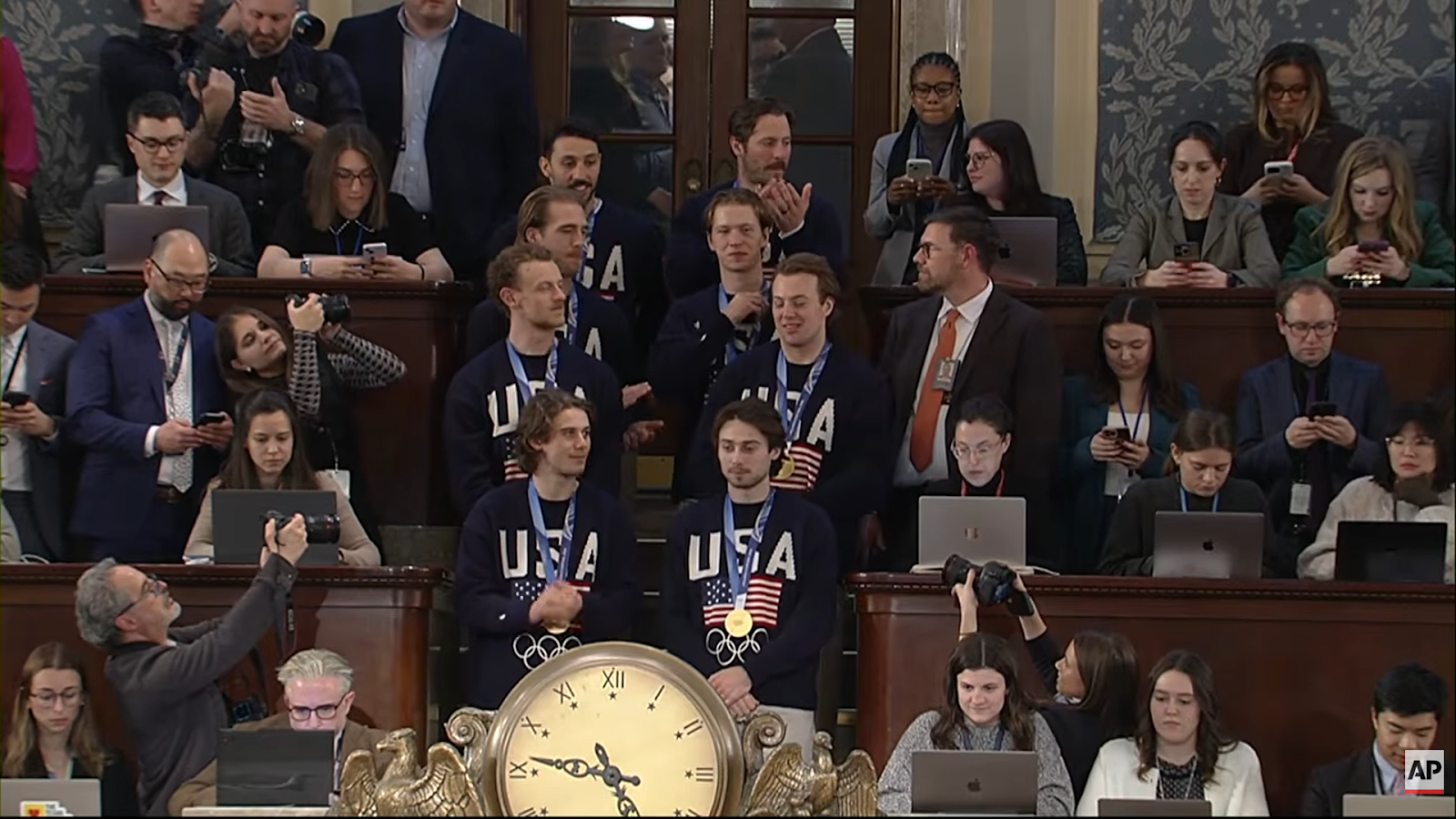
The U.S. men’s hockey team beat Canada to take gold at the 2026 Winter Olympics, a moment of national pride that was met with uneven reactions in Congress during President Trump’s recent State of the Union.
The gold medal win over Canada at the 2026 Winter Olympics was a clear high point for Team USA and a deserved celebration of athletic excellence. Fans across the country cheered the players who skated, blocked, and scored to claim the top spot. That victory stood out as a unifying moment for many Americans tuned into winter sports.
Yet the mood in Washington was noticeably different when the president recognized that achievement during his State of the Union. “During President Trump’s Tuesday State of the Union address, numerous Democrats were spotted sitting during the president’s recognition […]” That reaction did not go unnoticed by Republicans who expected bipartisan acknowledgment of American success.
Many on the right saw the sitting as deliberate and symbolic, a small display that reflected larger partisan friction in Congress. To critics it appeared disrespectful to athletes who had represented the country on the world stage. Supporters of the president argued that standing for American champions is the least Congress can do, regardless of political disagreement.
Television clips of the moment spread quickly across social media and conservative feeds, sharpening the narrative that Democrats prioritize partisan signaling over national unity. Commentators on the right framed the image as emblematic of a broader refusal to celebrate American accomplishments when tied to a Republican president. That framing energized conservative audiences already frustrated with perceived double standards in Washington.
Republican lawmakers and commentators used the incident to press a point about decorum and respect. They argued that honoring athletes should be above politics and that Congress should set an example for the country. The criticism extended beyond the sitting itself to questions about whether such gestures have become performative rather than sincere.
For many conservatives, the optics of the sitting Democrats reinforced a distrust of political theater and media narratives. They pushed back against press coverage that treated the lapse as a minor detail, insisting it reflected deeper partisan divide. In conservative circles, the incident became another anecdote in a long list of examples used to critique the current Democratic approach to governance and public rituals.
Athletes who win on the world stage rarely ask for political recognition, but when it is offered the expectation is simple: dignity and unity. Republicans made that point bluntly, saying elected officials should stand together to honor national achievement. That line of argument resonated with voters who prioritize patriotism and public respect.
At the same time, some on the right cautioned against overplaying the moment, acknowledging that not every visible response in the chamber equates to deep hostility. Still, they maintained that routine courtesies—like standing for gold-medal athletes—should not be sacrificed for partisan show. The debate over the incident quickly folded into larger cultural fights about symbols and allegiance.
Media outlets on both sides debated the significance, but the conservative takeaway stayed consistent: honoring success is a basic civic duty that should rise above party lines. Republicans used the moment to reiterate themes of respect for service and achievement, pointing out that athletes put national pride on display long before any politician did. That messaging fit neatly into a broader narrative about American exceptionalism and the need for common decency in public life.
Ultimately the hockey team’s victory remains the result that matters most on the ice, while the reaction in the chamber revealed how politicized even moments of national pride have become. For Republicans, the takeaway was as much about tone and expectation as it was about partisan politics. The episode left many on the right calling for a simple restoration of respect for American accomplishments in public forums.

