

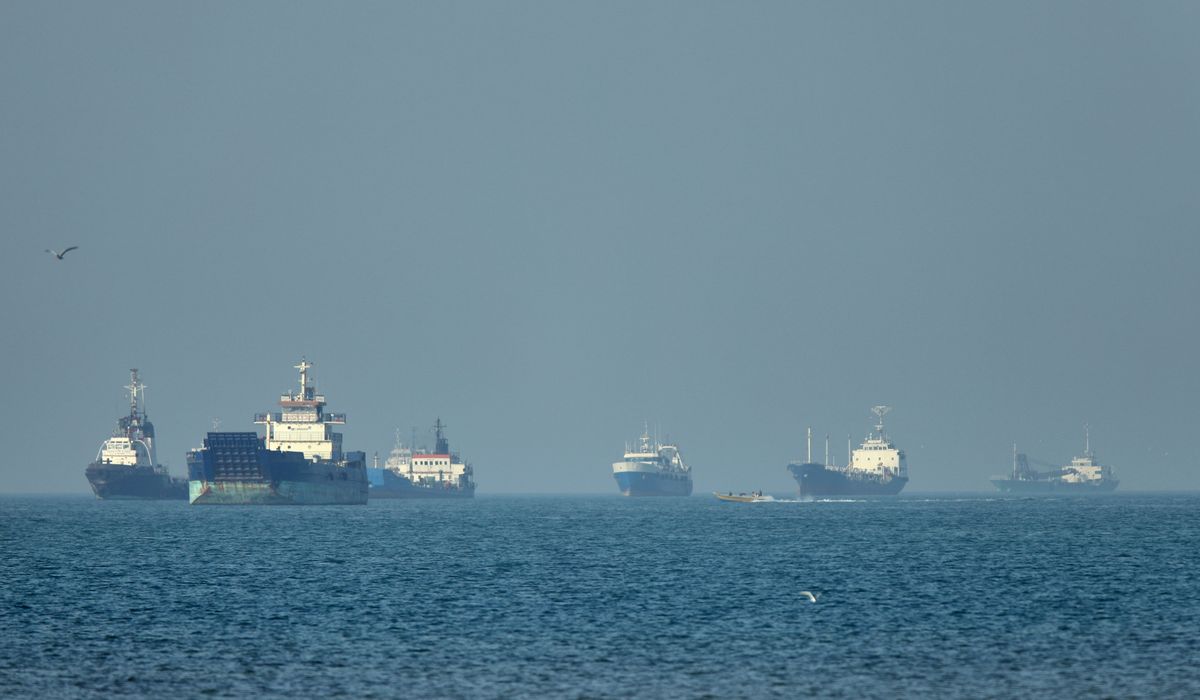
Iran said it shot down a U.S. drone on Sunday, an event that came just hours after American forces struck the engine room of a commercial vessel with a Hellfire missile while that ship tried to avoid a U.S.-led blockade. The incidents unfolded in tense waters where patrols, commercial traffic, and military assets now intersect more often than they did a year ago.
The reported drone shootdown and the Hellfire strike are not isolated moments but part of a pattern of confrontations around critical sea lanes. U.S. forces are operating to stop ships they see as working around coalition restrictions, and Tehran is pushing back with asymmetric strikes and risky signaling. That combination creates a pressure cooker where miscalculation can lead quickly to wider hostilities.
From a plain, direct Republican perspective, the facts point to a nation testing limits and probing resolve. When American assets are targeted or when commercial vessels try to flout enforcement, the response has to be clear and forceful. Deterrence only works when adversaries see consequences that matter and are sustained over time.
Operationally, firing a Hellfire into an engine room is a precise act meant to immobilize a vessel without sinking it, but it also raises legal and tactical questions about force against civilian shipping. Iran’s claim to have downed a U.S. drone signals a willingness to escalate in the aerial domain as well. Those moves are calculated to impose costs on U.S. and allied activity while complicating rules of engagement for commanders on the scene.
Washington faces a basic choice: tolerate an expanding gray-zone campaign that disrupts trade and emboldens Iran, or demonstrate resolve by protecting navigation and enforcing sanctions robustly. From the Republican viewpoint, toleration invites more aggression. That means backing forward-deployed forces with clear authority, adequate resources, and the political will to respond proportionally and quickly.
Regional partners also matter. Coalitions, intelligence sharing, and maritime patrols multiply the effect of U.S. power without forcing a unilateral commitment of American ground troops. Republicans typically favor strong alliances that share burden and increase legitimacy for interdiction efforts. The goal is to make risky behavior costlier for Tehran while keeping commercial traffic safer and open.
There is also a strategic messaging component. Public restraint can be wise, but public weakness is a strategic error. Iran’s leaders are sensitive to signals of resolve, and they calculate whether international patience will hold. Clear, credible deterrence — backed by sanctions that bite and military options that are usable — stops escalation before it becomes uncontrollable.
At the tactical level, commanders must refine rules of engagement and improve identification methods to avoid friendly-fire incidents or mistakes that trigger unnecessary conflict. At the political level, lawmakers should provide the legal and budgetary tools needed to sustain presence and pressure. A durable posture reduces the likelihood that a single downed drone or disabled ship turns into a regional conflagration.
History shows that ambiguous responses encourage adversaries to keep testing limits. The recent incidents around the blockade and the reported drone shootdown are warnings that deterrence has to be maintained, not improvised. The hard reality is that when adversaries see determination, they retreat; when they see hesitation, they press forward.
Looking ahead, the situation will hinge on whether the United States and its partners can hold a steady line without falling into a spiral of tit-for-tat strikes. The risk is real, but so is the path to preventing wider war: consistent enforcement, credible escalation options, and alliances that share both costs and consequences. In the meantime, commanders at sea and in the air must operate with clarity and a strong sense of mission.

