

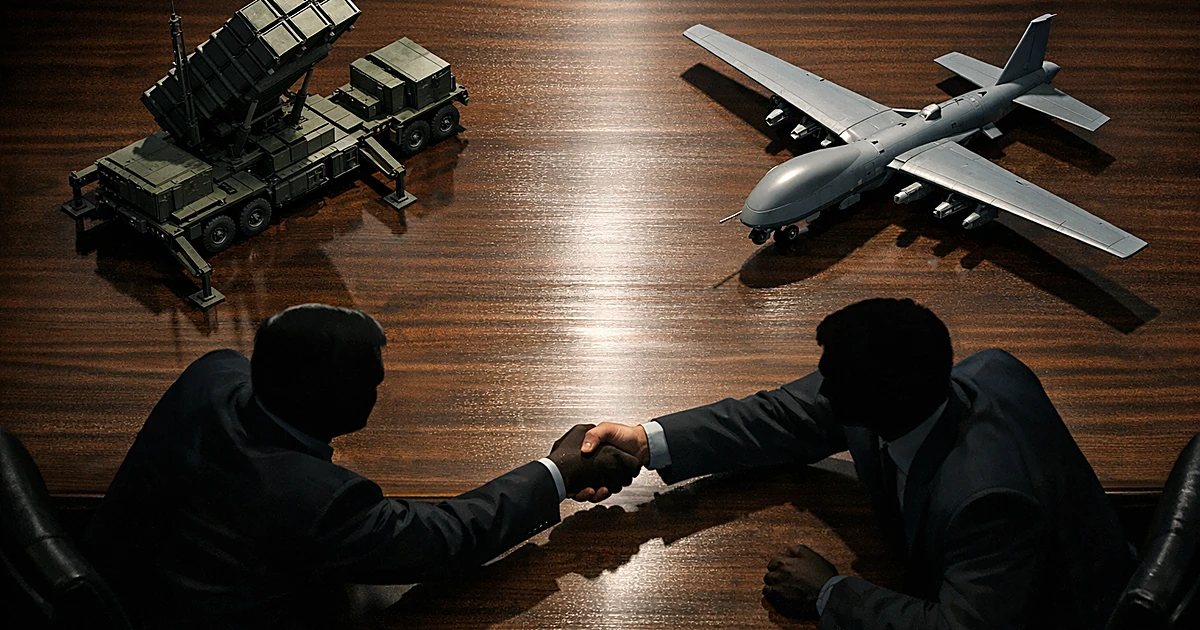
President Trump and Ukraine’s Volodymyr Zelensky met at the NATO summit in Turkey, and the U.S. announced two concrete moves: it will buy Ukrainian-made drones and grant Ukraine a license to co-produce Patriot interceptors domestically, shifting long-running uncertainty about American support for Kyiv.
The meeting on the sidelines of the NATO gathering produced announcements that change the practical support picture for Ukraine. After months of back-and-forth and a public low point in the Oval Office in February 2025, the tone between the two leaders now looks markedly different. Trump framed the thaw as unexpected but real.
Trump told reporters Wednesday: “We’ve actually developed a good relationship. It’s hard to believe, right? From the Oval Office to now, I think we’ve developed a very good relationship.” Those words came with two headline-grabbing commitments that Ukraine has pursued for years. One is a Patriot co-production license, the other a purchase of Ukrainian drones.
“We’re going to give a license to you to make Patriots. That’s pretty cool, right? This way you can’t complain that we’re not giving them enough.”
The Patriot license is the bigger operational prize. Ukraine has long lobbied to produce interceptors at home after being denied by the previous administration, and the decision immediately changes the supply conversation. Lockheed Martin manages a heavy global backlog, and the Pentagon has been the arbiter of priorities for years.
A critical shortage of Patriots has left Ukraine vulnerable to Russian ballistic missile salvos at a time when Moscow has increased their intensity. A recent Russian barrage struck Ukraine with 23 missiles that went entirely unintercepted, killing at least 22 people and injuring 56, underscoring the urgency behind Kyiv’s push for local production. Trump acknowledged the U.S. also faces limits on available interceptors, partly because of other regional conflicts.
Trump estimated Ukraine could begin producing interceptors within two to three months, a brisk timeline that industry and independent analysts have not confirmed. If the license becomes concrete, Ukraine would join a small group of nations authorized to make Patriots. That prospect reshapes how Kyiv could defend cities and infrastructure in the short term.
“Expanding cooperation on Patriot missile capabilities reflects a shared understanding that Ukraine must have the means to protect its people and critical infrastructure.”
The drone purchase announcement is quieter but strategically meaningful. Buying Ukrainian-made drones signals confidence in Kyiv’s defense industry and injects cash and credibility into domestic production lines. It also responds to a long-running request from Kyiv for tangible, deployable systems that can affect battlefield dynamics now.
Trump described Ukraine’s cross-border operations into Russia as an escalation with purpose, arguing these moves could increase pressure on Moscow. “It’s an escalation, but it’s also an escalation that could help lead to an end,” he said. “I don’t think he likes what’s going on. I don’t think he’s thrilled with what’s happening. There’s a lot of pressure on President Putin to get it done.”
Bipartisan congressional figures traveled to the summit and met separately with Zelensky, signaling unusual cross-party alignment on practical measures. Their joint statement put it plainly: “Putin is at his weakest position in years and real sustained pressure can finally bring this war to a close.” That kind of blunt assessment helps frame the decisions in Ankara as both strategic and political.
“Many suspected that Ukraine would remain in the background because it could be a divisive issue within the alliance. Instead, several impactful and concrete announcements were made that will have an effect on the battlefield.”
The NATO summit in Ankara produced other big moves that fed into the moment, from signaling a reset in ties with Turkey to threats about troop posture in Europe tied to burden-sharing. The Iran situation also flared during the meetings, with Trump declaring the U.S. ceasefire with Iran “over” after Iranian attacks prompted retaliatory strikes, adding urgency to an already crowded diplomatic calendar.
Despite momentum, key details are missing and matter a great deal. The Patriot co-production license was announced without public terms, duration, or implementation steps, and Lockheed Martin has not provided a public response. The drone purchase lacks specifics on models, quantities, and costs, leaving room between headlines and actual deliveries.
Announcements from the summit now face the hard work of turning words into contracts and production lines. Kyiv publicly urged that these signals become firm decisions, and U.S. officials will need to coordinate with industry to close the gap. For a nation under missile threat, speed and clarity are not just bureaucratic concerns, they are lifesaving ones.

