

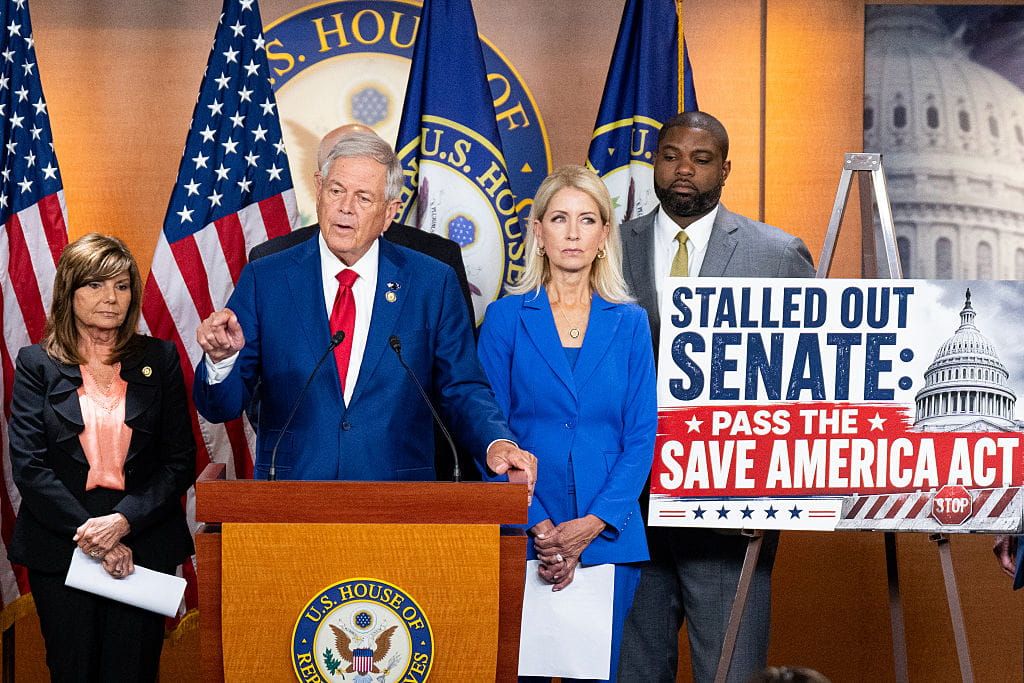
An insuragraphic look at the SAVE America Act shows broad public support colliding with political reality, a stalled Senate, and a handful of strategic objections that keep a simple voter ID reform from becoming law.
An insurmountable problem with a simple solution has become an ugly example of Washington dysfunction. The SAVE America Act, aimed at making voter ID the law of the land, enjoyed clear backing from most voters but ran headlong into Senate obstruction. That mismatch between public sentiment and congressional behavior is the story here.
President Donald Trump has been explicit and relentless in backing the bill, even pausing other legislative progress to push the point. In the House it squeaked through 218-to-213, with Rep. Henry Cuellar of Texas the sole Democrat to join the majority. For Republicans and voters who want election integrity, that result looked like momentum.
The measure itself is straightforward: it would require valid identification to cast a ballot and to register to vote. Those provisions are framed as common-sense reforms meant to protect ballot integrity without wholesale upheaval. Supporters point to the simplicity as proof the law should be noncontroversial.
But the Senate has slammed the brakes. Majority Leader John Thune has said the bill does not have the votes to pass, and with just 53 Republican senators the 60-vote threshold for overcoming a filibuster is a formidable barrier. Even stripping the filibuster, critics note, might not earn a simple majority, so the legislative path is anything but clear.
The public reaction adds salt to the wound for lawmakers. Voter ID is frequently described as an 80-20 issue, with polling showing broad backing across racial, economic, and sex demographics. That kind of cross-cutting popularity makes the bill’s stall feel less like policy debate and more like political avoidance.
A recent Wall Street Journal/NORC poll underscores the larger problem: Congress ranks near the bottom of institutions Americans trust, with only 6% expressing strong confidence in its leadership. That lack of faith amplifies the disconnect when an issue with wide public support fails to move forward. Partisanship explains some of it, but not all; institutional distrust plays a real role.
One practical reason for the bill’s failure is the inevitable temptation to turn clean reforms into vehicles for pork. When lawmakers expect a bill will pass, they begin loading it with local projects, riders, and favors that complicate compromise. What could have been a straightforward voter ID statute becomes a bargaining chip and then a dead letter.
Electoral math also haunts Democratic calculations. Backing a voter ID law ahead of the November midterms risks appearing to concede that fraud exists, which many in the party have long resisted acknowledging. The ideological edge of the progressive wing, where the sentiment “no human is illegal” aligns with protecting marginal votes, makes voting against the bill politically safer for some Democrats in tight races.
There is also a personal and political calculus tied to Donald Trump. Even among Republicans, some on Capitol Hill worry about delivering a signature win that would cement his legacy. The expectation that Trump will remain a defining force through Jan. 20, 2029, makes a few senators hesitant to hand him an unambiguous victory, even when policy and public opinion are on their side.
The timing matters. With the November midterms looming, there’s little appetite in the Senate for the risky maneuvering required to secure the bill’s approval. Changing filibuster rules or persuading holdout senators to flip would be a heavy lift in a compressed calendar and a hyper-charged political environment.
So the SAVE Act sits in legislative limbo, a case study in how public consensus can be defeated by political incentives, institutional rules, and human calculation. Unless key figures alter their positions or the Senate’s procedural norms shift, the bill’s odds before the midterms look grim and the promise of straightforward election reform remains unfulfilled.

