

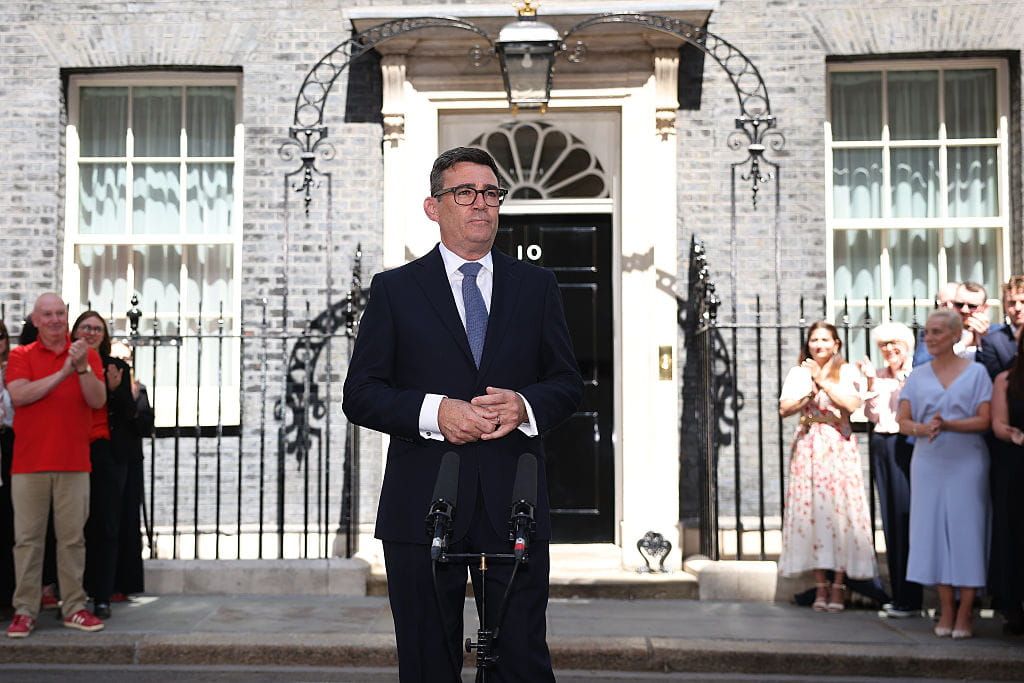
Andy Burnham’s sudden rise to Number 10 has left a hole where a clear democratic mandate should be, and that gap is fueling political fights over legitimacy and strategy.
Britain’s conventions tie a government’s authority to the party and manifesto that won the election rather than to any single individual. When a prime minister steps down, the usual route has been for a successor from the winning party—someone who stood on that manifesto or was inside Parliament—to take over. That continuity is the reason replacement leaders typically inherit what passes for a mandate in the UK system.
Andy Burnham breaks that pattern in a way that matters. He was not a member of Parliament during the 2024 election and did not campaign under the manifesto Labour used to win. That absence raises a simple, uncomfortable question: on what basis does he claim the authority to deliver a new national agenda?
Burnham’s first public remarks after visiting King Charles III and asking to form a government sketched a sweeping, ten-year plan he says will reshape British politics. He presented it outside 10 Downing Street in confident tones, arguing for a long-term programme of change and reform. To many voters, that rhetoric sounded familiar—big promises, familiar language, and a demand for trust without a fresh electoral endorsement.
Critics have not been subtle. Nigel Farage has called loudly for an immediate general election and set out a blunt diagnosis of the situation. “The only certainty with Burnham is we’re going to get more of the same, but they’ll go further to the left than they already are,” railed Reform Party leader Nigel Farage, who called for an immediate general election.
Farage went further, insisting Burnham lacks any broad national mandate. Burnham “says he wants to have the biggest change of direction in politics in 40 years, outside of 25,000 voters in Makerfield [the constituency he represents] he has literally no mandate for this at all,” Farage added. That exact point—one MP’s local backing versus a national endorsement—lies at the heart of the row.
Why aren’t Conservatives joining the chorus for a ballot? The short political arithmetic is brutal: current polling suggests Reform UK under Farage would win the next general election, a result that would oust Burnham but also hand the Tories a humiliation worse than their 2024 defeat. Given that calculation, the opposition has chosen silence over spectacle.
Polls matter here in a way that is both practical and strategic. Reform has topped the last 350 consecutive polls – that’s not an outlier; that’s a warning shot. If those numbers hold, any attempt to force a quick election risks replacing Labour with a party that would punish the Conservatives even more severely.
That reality fuels what looks like a careful, almost tacit agreement between mainstream parties: avoid the gamble. The consequence is an uneasy status quo where an unelected—or at least not nationally endorsed—leader can govern while potential challengers weigh the electoral cost of calling voters back to the polls. It is a fragile form of stability built on cold calculations rather than clear democratic consent.
Legal and constitutionalists can point to precedents where replacements were accepted because they had been part of the platform voters endorsed. The difference with Burnham is obvious and procedural—he simply was not part of that earlier public contract. That distinction makes the debate less about personalities and more about what legitimacy actually means in modern British politics.
The public conversation now pivots on accountability and optics. Burnham promises long-term transformation but lacks the electoral fingerprints most people expect when someone claims a fresh mandate. Opponents argue that lofty agendas demand voters’ explicit support, not just the backing of party insiders, and that point resonates with those skeptical of top-down change.
Meanwhile, the Conservative response highlights a practical fear: defeat at a national poll could open the door to a political realignment nobody on the centre-right wants. So the party’s calculation has been to conserve resources and avoid triggering an outcome that would hand a stronger position to a rival on the right. That quiet is a strategic choice, not a sign of acquiescence.
Outside Westminster, pressure is building in a different register. Grassroots groups, regional leaders and vocal movements are pushing for a fresh contest because they view legitimacy as non-negotiable. If enough of that pressure translates into street-level momentum or electoral mobilization, the political math in Parliament could shift fast.
All of this raises a clear tension: the mechanics of government allow a leader to take office without a direct national vote, but political legitimacy still depends on consent. Burnham’s path to power tests how brittle that consent can be when party mechanics, polling signals and strategic calculations collide. The next moves will tell whether Britain corrects course with a ballot or settles for a longer period of uneasy authority.

