

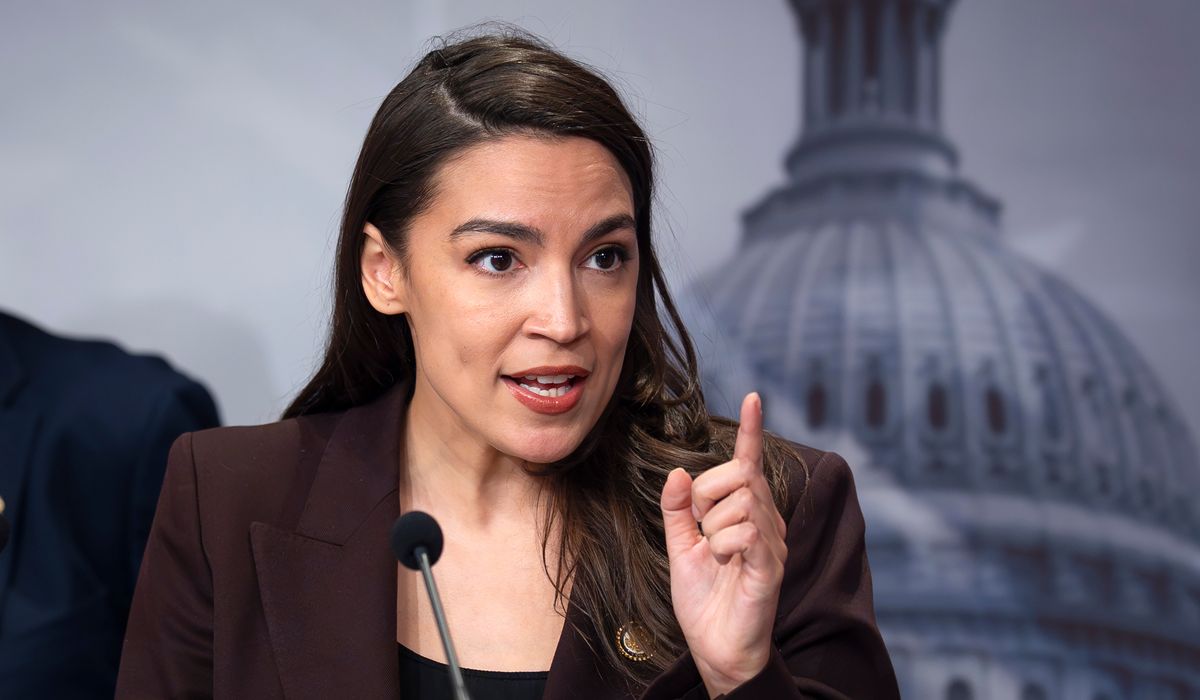
Rep. Alexandria Ocasio-Cortez pushed back Wednesday against GOP claims that democratic socialists plan to impose a communist agenda in Congress, arguing the accusations are politically motivated and mischaracterize her policy goals.
Republicans have spent months warning that democratic socialists will steer Congress toward radical change, and Rep. Alexandria Ocasio-Cortez answered those attacks head-on. She defended the policy priorities she and her allies promote while rejecting labels that equate their proposals with communism. The exchange highlights the partisan tug-of-war over what constitutes mainstream policy versus ideological extremism.
From a Republican perspective, the concern is straightforward: democratic socialist proposals can mean bigger government, higher taxes, and greater control over markets and personal choices. Those outcomes are not abstract; they translate into policy fights over health care, energy, and federal spending. GOP lawmakers frame their resistance as a defense of individual liberty and economic stability against what they see as sweeping, untested experiments in governance.
AOC has pushed back by insisting her agenda centers on tangible reforms like expanded health care access and climate action, not a wholesale abandonment of democratic institutions. She argued that critics are conflating pragmatic policy debates with ideological warfare. In doing so she tried to separate her platform from any comparison to authoritarian systems, even as opponents hammer on ideological language to rally their base.
The rhetoric escalates because both sides find political fuel in stark labels. Republicans point to proposals such as Green New Deal–style regulations and expanded federal programs as proof of an ambitious, centralized agenda. Those proposals alarm conservatives who believe such measures would erode private-sector dynamism and impose burdensome costs on families and businesses. The GOP message taps into voter concerns over inflation, government debt, and the pace of cultural and economic change.
Democratic socialists counter by emphasizing social safety nets and targeted public investments that, in their view, strengthen the economy and public health. They present programs like broad-based health care and climate investment as practical fixes for market failures and inequality. Whether voters accept that framing depends heavily on trust in government competence and the perceived trade-offs between short-term costs and long-term benefits.
Political strategy matters as much as policy details in this fight. Republicans use vivid language to make abstract proposals feel immediate and risky, while progressive lawmakers try to rebrand expansive ideas as necessary corrections to systemic problems. That clash plays out in committee hearings, campaign ads, and social media, and it shapes how swing voters perceive both parties’ ambitions. Each side hopes to make the other’s preferred path look either dangerous or insufficiently bold.
Observers on the right worry that embracing elements of democratic socialism could shift U.S. politics toward a larger, more intrusive state that rewards political insiders and expands entitlement-style programs. They argue that even well-intentioned expansions of federal power tend to concentrate decision-making in Washington, distancing choices from local communities and individual families. This argument is central to GOP messaging, which frames the coming elections as a referendum on the size and scope of government.
Supporters of AOC respond that strong federal action can correct injustices and provide a safety net that fosters real opportunity, not dependency. They point to gaps in the current system—health care access, environmental risks, and economic inequality—as reasons for bold initiatives. The debate then becomes a test of whether voters prefer incremental reforms or sweeping change, and whether they trust the federal government to deliver promised outcomes.
The immediate takeaway is that this is not just a policy clash but a battle over political language and public perception. Republicans “are seeking to usher and that line of attack is being used to mobilize voters ahead of tough votes and competitive races. Expect the conversation to keep heating up as lawmakers translate broad visions into specific legislation that will reveal who gains and who pays for those choices.

