

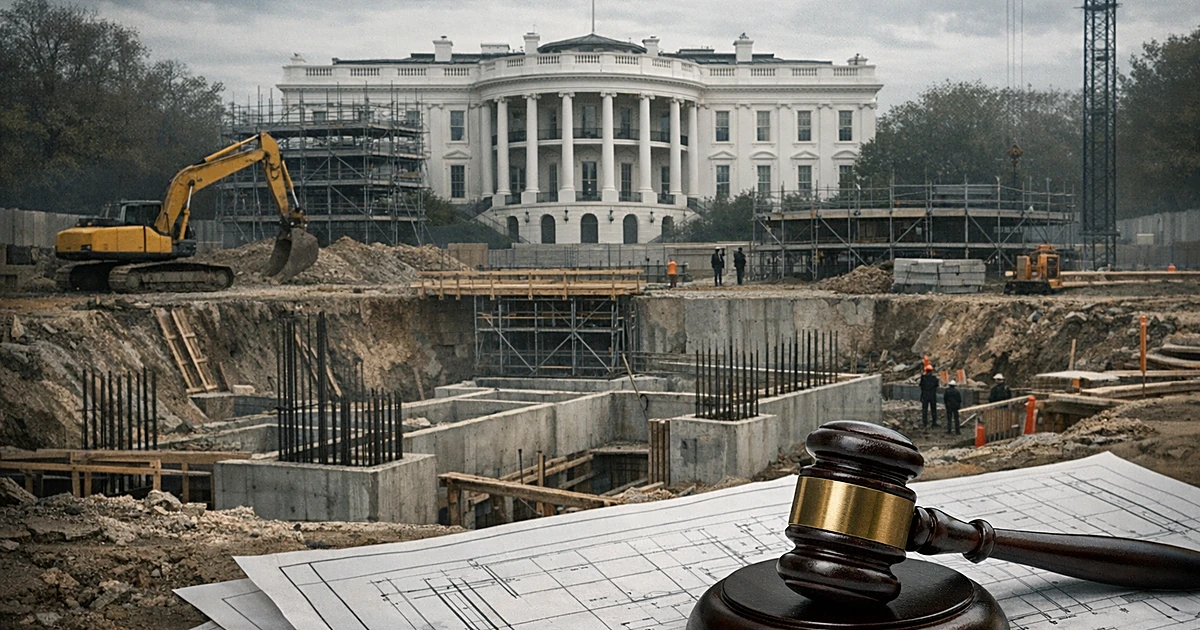
The D.C. Circuit put the brakes on above-ground work for President Trump’s planned White House ballroom, finding that the Constitution gives Congress authority over federal property while a dissenting judge and the president promise appeals up to the Supreme Court.
A divided appeals panel has ordered a stop to above-ground construction on the proposed 90,000-square-foot White House ballroom, endorsing an injunction brought by the National Trust for Historic Preservation. Two judges relied on the Constitution’s Property Clause to say Congress, not the president acting alone, has final control over changes to federal real estate. A Trump-appointed judge dissented, arguing the Trust lacks standing and the president can make improvements to the Executive Residence.
The dispute began after workers demolished parts of the East Wing to prepare for the project, prompting the Trust to sue in December. The nonprofit argued that neither the president nor park officials had authority to remove structures Congress authorized and taxpayers paid for without congressional approval. A lower court paused most work but allowed some underground activity, and the appeals court has now reinforced the restriction on above-ground construction.
The majority opinion, written by Patricia Millet and Bradley Garcia, framed the ballroom as an unprecedented move: a president using privately raised funds to change taxpayer-funded parts of the White House without Congress. They emphasized that “Congress has not ceded unfettered authority to the Executive Branch to dramatically redesign, reshape, and reconstruct the White House, the People’s House, to fit a particular President’s desires.” That reasoning put the court firmly on the side of legislative control over federal property.
“We are aware of no instance in American history in which a President unilaterally and using privately collected funds demolished substantial portions of the White House that Congress authorized to be built and American taxpayers paid for. Until now.”
The appeals court added a 14-day stay, creating a narrow window for the Department of Justice to seek Supreme Court review before the injunction fully takes effect. If the high court declines or misses the deadline, all above-ground work must stop; permitted underground work may continue but the boundaries of that allowance remain unclear. That ticking clock has sharpened the political stakes and made a Supreme Court fight likely.
Judge Neomi Rao delivered a forceful dissent, focusing first on standing and then on presidential authority. She said the district court “had no jurisdiction because the Trust has no standing to stop construction at the White House,” framing the lawsuit as lacking a concrete, personal injury. Rao also argued the ballroom “is also likely within the President’s authority to make improvements to the Executive Residence at the White House.”
“The district court elevated the aesthetic displeasure of a single passerby over the government’s security interests in the ballroom and the security risks of leaving an open construction site at the President’s home and office.”
Rao painted the matter as a lopsided choice between one person’s aesthetic objection and the safety of the president, staff, and visiting leaders, calling the injunction disproportionate. That characterization—that a lone complainant’s visual preference could outweigh security concerns—was central to her refusal to sustain the block. The majority opinion did not squarely address Rao’s framing in the excerpts available.
The president responded quickly, vowing an immediate appeal to the Supreme Court and blasting the ruling as “horrendous, politically motivated, and unlawful.” He warned that “the Military and Secret Service are viewing this horrendous, politically motivated, and unlawful ruling as a National Security threat to our Nation in that the entire Complex is being built for the protection of our Country and, additionally, all future Presidents.” He also repeated the standing challenge in his statement, saying “the Circuit Court’s decision, which is totally wrong on the vital subject of STANDING, of which the plaintiff has none, severely jeopardizes the lives and welfare of the people who work, and will be working, at the White House, including all future Presidents of the United States, and their families.”
The president described the project as security-oriented and aspirational, declaring “It will be magnificent, safe, and secure!” Reported cost estimates vary widely, with figures cited around $400 million on one side and upward of $600 million elsewhere, and the exact mix of private donations versus taxpayer funding is still murky. Legal fights over funding, oversight, and who has the last word on the People’s House are likely to continue as the case moves up the ladder.
The National Trust’s lawyer summed up the lawsuit bluntly: “They just don’t want to go to Congress.” That line captures the administration’s dilemma and the broader constitutional tug-of-war—the limits of executive initiative when a high-profile renovation collides with laws and precedents about federal property and congressional prerogative. With nine justices likely to weigh in, the outcome could redraw the boundary between presidential discretion and congressional control over the executive mansion.

