

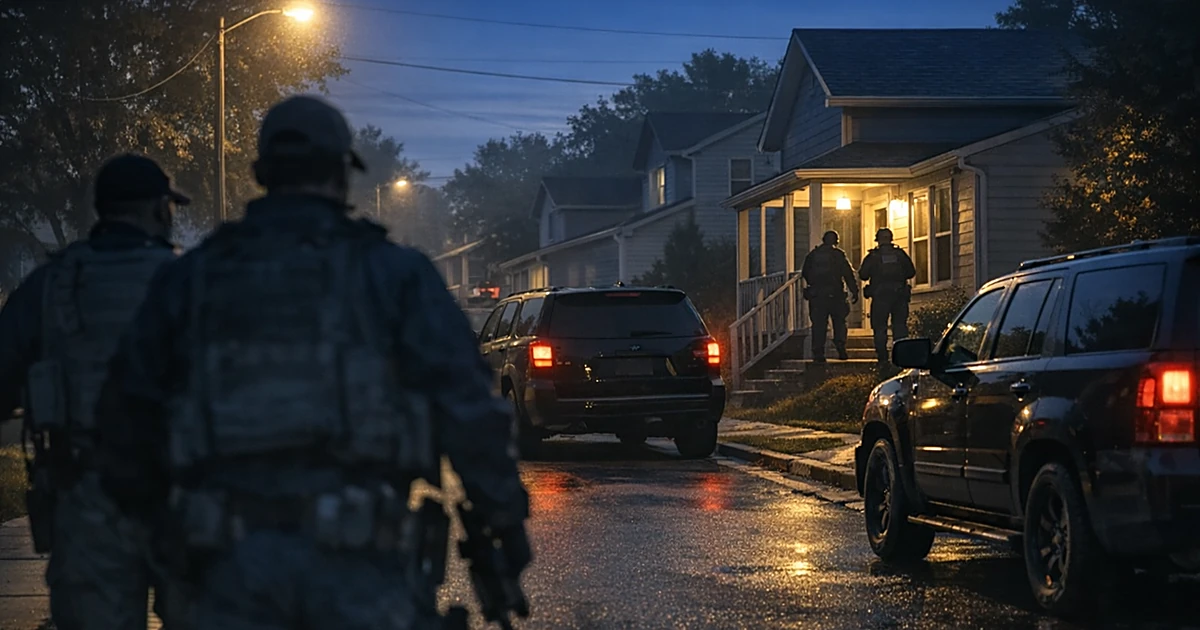
ICE carried out “Operation Safe Community, Washington, D.C.” from August 1 through August 14 and arrested 1,328 illegal immigrants across Virginia and Maryland, with close to 400 of those taken into custody having criminal convictions or pending charges, and the department says all will remain in ICE custody pending removal.
The two-week sweep reached suburbs around the nation’s capital and included arrests beyond routine immigration cases. Federal officials described the action as one of the agency’s most effective enforcement efforts in recent memory. ICE emphasized that many arrests involved significant criminal histories.
Officials named several individuals to illustrate the severity of the cases ICE found. In Richmond, officers arrested Eygner Wilfredo Huezo-Moran, a Salvadoran national wanted on a warrant for murder and use of a firearm in the commission of murder. In Alexandria, agents took Angel Gabriel Ortiz-Hernandez, a Guatemalan national facing charges for rape of a mentally incapacitated victim and two counts of aggravated sexual battery of an incapacitated victim.
The operation did not shy away from arresting convicted offenders with varied criminal records. Rowan Andrew Brown, identified as a Jamaican national, had convictions for identity theft, kidnapping, and illegal reentry along with an arrest for fraud. In Harrisonburg, ICE detained Estrella Reyes-Funez, a Honduran woman with a felony hit-and-run conviction and separate arrests for making a threat to bomb or burn, assault and battery on a family member, and violating a protective order.
Federal sources also flagged gang ties among some detainees, naming MS-13, Tren de Aragua, and the 18th Street Gang as represented in the arrests. Officers arrested German Mejia-Baires, a Salvadoran national and MS-13 member with an arrest for felony malicious wounding and convictions for driving while intoxicated, driving on a suspended license, and illegal reentry. ICE did not publish a precise breakdown of how many gang-affiliated individuals were among the 1,328 arrests.
The Department of Homeland Security confirmed every person arrested will remain in ICE custody pending removal from the United States. That custody status underscores the federal focus on deportation proceedings rather than local case handling. Officials framed the operation as a direct response to local policies they say impeded enforcement.
Homeland Security Secretary Markwayne Mullin put the results in stark terms and singled out local leaders who oppose cooperation as part of the problem. He said the arrests removed a variety of dangerous offenders from neighborhoods around the capital. His remarks stressed a law-and-order approach to secure communities.
“The brave men and women of ICE are hard at work every single day getting these dangerous illegal aliens out of our country. Over the course of just two weeks in Virginia and Maryland, they arrested sexual assailants, kidnappers, drunk drivers, robbers, and gang members.”
Mullin went on to connect enforcement activity with broader political choices at the state and local level. He argued that sanctuary-style policies put immigrants’ needs ahead of American safety and said the administration would prioritize citizens first. That message reinforced the political framing of the operation.
“While sanctuary politicians in Virginia and Maryland keep putting the needs of illegal aliens over the safety of the American people, the Trump Administration will always put American citizens first. By arresting and removing illegal aliens from our communities, we will make America safe again.”
ICE’s acting assistant director for Enforcement and Removal Operations, Patricia Hyde, highlighted operational skill and persistence. She said officers excel at finding individuals who try to avoid detection and that removing criminal alien offenders improves neighborhood safety. Her words emphasized the practical, tactical side of the enforcement work.
“Our officers are the best in the world at finding people who do not want to be located. That’s exactly what we did throughout the course of this operation. Removing these criminal alien offenders from Virginia and Maryland neighborhoods makes for much safer communities, and that is exactly what the men and women of ICE work to accomplish every day across our great nation.”
The arrests included a range of crimes listed by federal sources, from murder and rape to identity theft, kidnapping, and felony hit-and-run. Officials said nearly a third of those arrested had criminal convictions or pending charges. That mix of offenses is the basis for federal officials’ public focus on community safety.
Some details remained unclear in public statements, such as how many arrestees had prior contact with local law enforcement and the precise role local policies played in delaying deportation. ICE did not provide a full breakdown of gang affiliations or reveal any arrests inside Maryland despite the operation covering both states. Questions about timing and coordination with local agencies were not answered in the agency’s disclosures.
The raw figure of 1,328 arrests in two weeks drew attention both for scale and for the criminal component officials highlighted. Nearly 400 arrests with convictions or pending charges sharpened the argument that this was more than routine immigration enforcement. Federal leaders framed the action as necessary to restore safety where they say local policies had failed to act.
While federal agencies continue to coordinate enforcement under political direction, public records around operations still leave gaps that invite scrutiny. Critics will ask for details about information-sharing and prior opportunities to remove dangerous offenders. Supporters will point to the arrests and criminal records as evidence that aggressive, nationwide enforcement can protect communities.

