

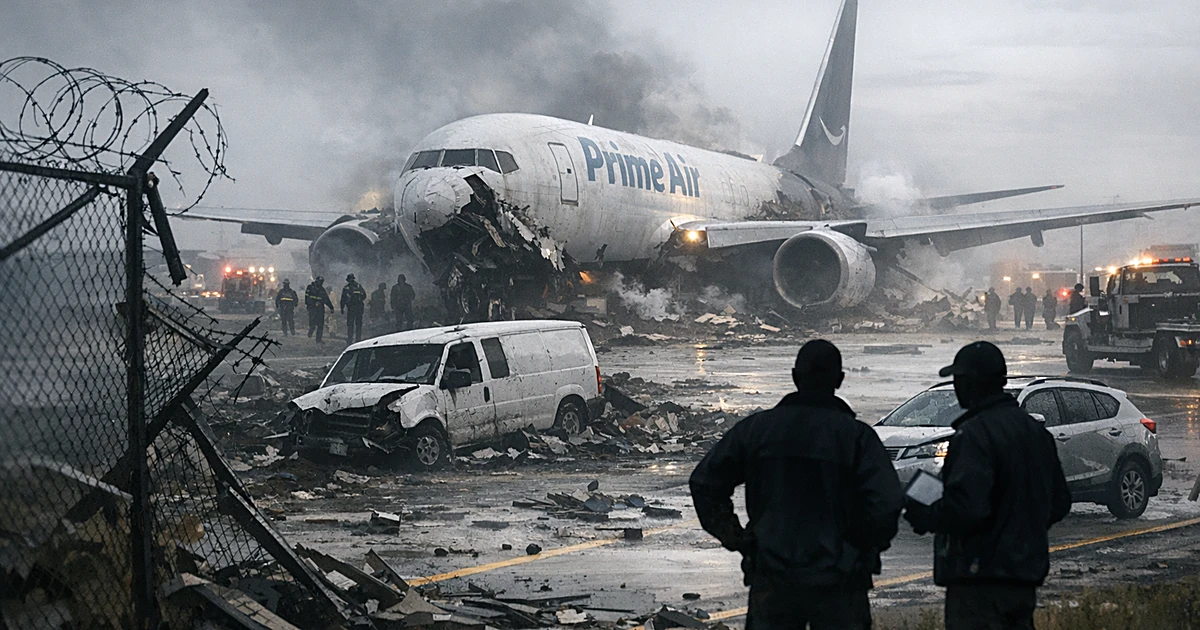
The crash of an Amazon Prime Air cargo Boeing 767 at Miami International Airport killed five people and injured five others after the jet overran a runway, crossed airport property and struck two vehicles before coming to rest about 1,300 feet beyond the paved surface. Federal investigators from the National Transportation Safety Board are examining wreckage, tire marks, fuel spills and recovered recorders as they work to determine how the aircraft left the runway and why a runway arresting system was not in place. Officials say recovery of victims and scene safety are the immediate priorities while evidence is collected for a careful, evidence-driven inquiry.
The flight, operated by cargo carrier 21 Air for Amazon Prime Air, carried two crew members and no passengers. The jet crossed airport grounds, struck navigation aids and airport equipment, and then hit a white Ford Econoline van used by an airline cleaning company before clearing a perimeter fence. It continued onto a public road, struck a Toyota Corolla Cross, crossed more grass and finally struck another fence roughly 1,300 feet past the paved runway.
Authorities confirmed five fatalities and five people injured, with three of the injured reported in critical condition as the NTSB began on-site work. Crews are prioritizing the recovery of victims and ensuring scene safety over immediate access to every part of the aircraft, which the NTSB chair said is the correct, people-first approach during a deadly emergency. The wreckage, vehicle remains and dispersal of debris complicate both recovery and evidence collection.
NTSB Chairwoman Jennifer Homendy walked the wreckage path and described visible tire marks leading from the pavement through grass and into the public right of way. She noted components from the aircraft littered the route and said vehicle parts and airbags were found among aviation debris. Spill of aviation fuel was significant enough that crews began cleanup and the removal of remaining fuel from the aircraft to limit environmental and fire risks.
“I would describe it in one word [as] devastating, utter devastation.”
Homendy also said the Econoline van had been torn apart by the impact and listed the scene conditions as severe, with scattered debris and damaged support equipment. Investigators are working to secure the site so sensitive evidence can be preserved, while coordinating with local responders to manage hazardous materials. That balance between victim care and evidence preservation shapes how the on-site phase progresses.
Teams recovered the flight data recorder and cockpit voice recorder and will send both devices to NTSB laboratories in Washington for detailed analysis. The agency has preliminary machine data about the aircraft’s speed but will not release a verified figure until it is cross-checked with recorder information. That insistence on corroborating hard evidence before public statements reflects standard investigative practice in aviation accidents.
Officials emphasized that the cause of the runway overrun remains undetermined and that basic details are still pending, including the identities and conditions of some victims and the exact condition of the flight crew. Investigators will analyze recorder data, tire marks, wreckage distribution and damaged airport infrastructure to reconstruct the sequence of events. Those physical traces will be critical to determining whether mechanical failure, human factors, weather, runway condition or other issues contributed.
One element under scrutiny is why that runway did not have an engineered materials arresting system, a layout that uses crushable material to slow aircraft that overrun pavement. The NTSB said it is too early to conclude whether such a system would have prevented this particular sequence, given how far the aircraft traveled beyond the runway and across the airport boundary. Still, the lack of a containment or arresting surface raises questions about protecting people and property outside airport fences when aircraft leave the runway.
The NTSB expects to remain at Miami International Airport for at least a week to document wreckage and collect evidence before material disappears or deteriorates. Investigators will map tire marks, recover parts, photograph the scene and evaluate airport infrastructure while coordinating laboratory analysis of the recorders. The path of the aircraft, damaged equipment, and the recovered recorders will all factor into later determinations about cause and recommendations to prevent a repeat occurrence.

