

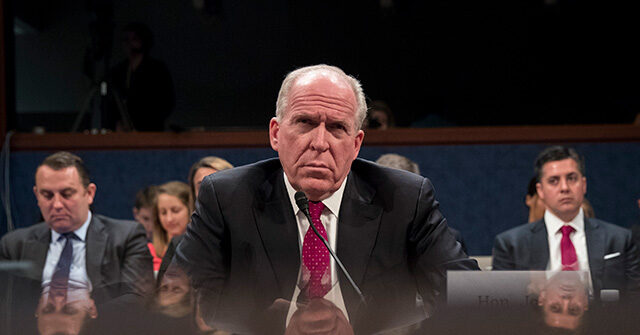
John Brennan, the former CIA Director, finds himself in a challenging position as recent revelations have cast doubt on his past testimonies. Current CIA Director John Ratcliffe has made a bold move by declassifying an internal review that scrutinizes the agency’s handling of the “Intelligence Community Assessment” (ICA) on Russian interference in the 2016 election. This development has reignited discussions around the alleged political motivations behind the intelligence processes during Brennan’s leadership.
The now-public review sheds light on claims that the ICA, conducted under the stewardship of Brennan, was influenced by the controversial Steele Dossier. Republicans and allies of former President Donald Trump have long argued that this dossier was a politically charged document, funded by Hillary Clinton’s campaign, and filled with inaccuracies. The dossier’s inclusion in the ICA has been a point of contention, with Ratcliffe’s release now confirming that career intelligence officials opposed its use.
Ratcliffe’s efforts to bring transparency to this issue have been met with praise from conservative circles. His statement that the ICA was conducted through a “corrupt process” under Brennan and former FBI Director James Comey has resonated strongly with those who have viewed the dossier as a tool to undermine Trump. “All the world can now see the truth,” Ratcliffe tweeted, asserting that intelligence was manipulated to target Trump.
The implications of this review are profound, suggesting that Brennan may have perjured himself during closed-door congressional testimony. The report indicates that Brennan pushed for the inclusion of the Steele Dossier in the ICA despite objections from seasoned intelligence officials. This revelation has left many in shock, as it contradicts Brennan’s previous statements to Congress.
Brennan’s handling of the dossier and its integration into the ICA has become a focal point for those questioning the integrity of the 2016 election investigations. The report highlights instances where Brennan seemingly overrode legitimate concerns from intelligence professionals, favoring political narratives instead. This has fueled criticism of Brennan and his actions during a politically charged era.
Conservative media outlets, including Fox News and Newsmax, have seized upon these findings, emphasizing the potential legal ramifications for Brennan. Some voices have suggested that Brennan’s actions were part of a broader effort to damage Trump’s presidency before it even began. These developments have sparked calls for accountability and legal scrutiny.
The Wall Street Journal previously reported on Brennan’s dismissal of the Steele Dossier, noting his claims of not having read it. However, Ratcliffe’s declassified review challenges these public assertions, suggesting a disconnect between Brennan’s private actions and public statements. Such discrepancies have drawn ire from critics who argue that Brennan misled both Congress and the public.
Former CIA officer Bryan Dean-Wright has been vocal about the implications of Brennan’s actions, suggesting severe consequences. Wright, citing the recent revelations, has argued that Brennan should face imprisonment for his role in these events. This sentiment echoes the frustrations of many who feel justice has been long overdue.
The declassification by Ratcliffe is not an isolated incident. Over the years, he has been persistent in uncovering what he perceives as misconduct during Brennan’s tenure. His efforts to dismantle the politicization of intelligence have been a cornerstone of his leadership, gaining support from those advocating for reform within the intelligence community.
Ratcliffe’s past actions, including the declassification of documents revealing Brennan’s briefings to former President Obama, underscore his commitment to transparency. These documents suggested that Clinton had plans to link Trump to Russia as a diversion from her private email server scandal. This context further complicates Brennan’s legacy and the narratives around the 2016 election.
The recent disclosures have prompted renewed interest from the Department of Justice. Legal experts speculate that Brennan’s contradictory statements may attract further investigation. Should the DOJ choose to pursue this matter, it could lead to significant legal challenges for the former CIA Director.
As the dust settles, the conservative community continues to rally around Ratcliffe’s findings. His actions are seen as pivotal in reaffirming the need for integrity within intelligence operations. The support from Republican lawmakers and conservative media underscores the importance placed on these revelations.
The broader implications for the intelligence community cannot be overstated. Ratcliffe’s commitment to exposing alleged corruption is viewed as a necessary step in restoring public trust. By confronting past missteps, he aims to chart a new course for the CIA and other intelligence agencies.
While the political landscape remains divided, these developments have bolstered conservative claims of bias within the intelligence community. Ratcliffe’s disclosures are celebrated as victories for those who have long suspected foul play. The broader public will be watching closely to see how these revelations impact future intelligence operations.
For now, Brennan’s future remains uncertain as potential legal challenges loom on the horizon. The calls for accountability continue to grow louder, with many seeking resolution to the controversies that have plagued recent years. As the story unfolds, the public remains engaged, eager for clarity and justice.

