

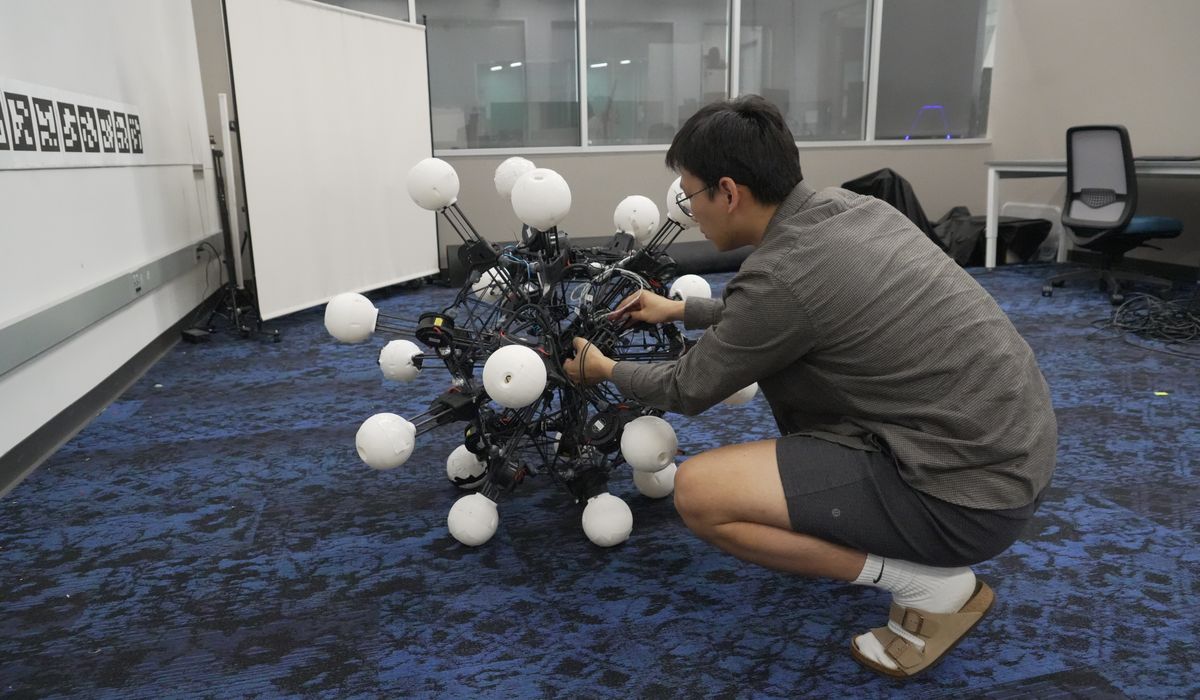
A robot being developed at Duke University is almost ready to face the world, in any direction.
The project at Duke centers on a compact, resilient platform built to remain operational as it moves through complex environments, and the team has pushed it through repeated lab trials to improve reliability. Engineers focused on making the system tolerant of bumps, slopes, and orientation changes so that it can keep working even when conditions are messy. That focus on ruggedness is intended to broaden where the machine can be useful beyond textbook environments.
At the heart of the design is a mobility approach that avoids single-point failures by blending mechanical simplicity with clever internal actuation, allowing the machine to change posture without requiring precise external alignment. The platform uses internal mass shifting and controlled rolling to translate and reorient itself, which reduces the need for exposed joints or delicate linkages. That minimal external hardware helps when the robot encounters rough terrain, tight spaces, or impacts.
Sensing is configured to give continuous awareness while the body rotates or rolls, combining inertial measurement, depth sensing, and compact cameras to maintain a consistent picture of the surroundings. Software stitches together those streams so the robot can track landmarks and obstacles even while its exterior spins or swaps orientation angles. The result is an operational model that prioritizes persistent situational awareness over a strict, top-down view.
On the software side the team relies on navigation stacks that integrate simultaneous localization and mapping techniques with robust state estimation to handle intermittent sensor occlusion and noisy readings. Machine learning models help classify terrain and predict slip or tumble events, which lets the controller adjust commands before a situation becomes critical. Engineers also emphasized modularity so components can be swapped or upgraded without rewriting the whole control architecture.
Testing moved from controlled corridors to irregular test beds that simulate mud, gravel, and debris, exposing how the system responds to real-world disturbances and sensor dropout. Trials included repeated recovery scenarios so the team could iterate on failsafe behaviors that restore operation after a hard knock or a roll. These exercises revealed practical limits in energy management and thermal handling that drove refinements in the battery and cooling subsystems.
Possible deployments include inspection tasks in cramped industrial settings, utility corridor checks, and roles in public-safety operations where small, durable machines can reach places humans cannot, but the design is intentionally general purpose rather than mission-specific. The robustness and orientation-agnostic approach reduce the amount of upfront mapping and preparation needed for many tasks, meaning a single platform can tackle a broader mix of jobs with limited reconfiguration. That versatility can lower logistics overhead for operators who need adaptable robotic assets.
Safety and resilience received careful attention because an untethered mobile machine that rotates and moves unpredictably could easily create hazardous situations if not properly constrained, so the team built in collision detection, soft-contact planning, and conservative power budgets. Cybersecurity and communication redundancy are part of the architecture to limit failure modes tied to signal loss or interference during operations. The engineering tradeoffs aim to keep the platform both dependable in the field and safe for nearby people and equipment.
Despite the progress, several engineering challenges remain, notably extending operational time without dramatically increasing weight and ensuring long-term durability of internal components under repeated impacts and thermal cycles. Material choices and sealing techniques are being refined to balance toughness, cost, and manufacturability for a machine that may be used in abrasive or wet environments. Scaling production from lab prototypes to field-ready units will also require suppliers and test standards that match the design’s unusual constraints.
Research like this often sparks adjacent innovations because solutions built to handle irregular orientations can be applied to drones, inspection crawlers, or planetary probes that face extreme rotation and exposure. Cross-disciplinary collaboration with material scientists and human factors experts is shaping the next rounds of design choices to keep deployment realistic and practical. The work so far demonstrates a clear path from research prototype to systems that can be adopted by field teams with modest training.
As the team prepares for broader field demonstrations, their focus remains on repeatable reliability and predictable behavior when conditions are uncertain, with continued evaluation planned under variable lighting, wet surfaces, and dense clutter. Stakeholders watching the project are particularly interested in how maintenance cycles and repairability will affect real-world use, and those criteria are guiding new mechanical revisions. The next phase will show whether the balance of simplicity and robustness holds up outside the lab.

