

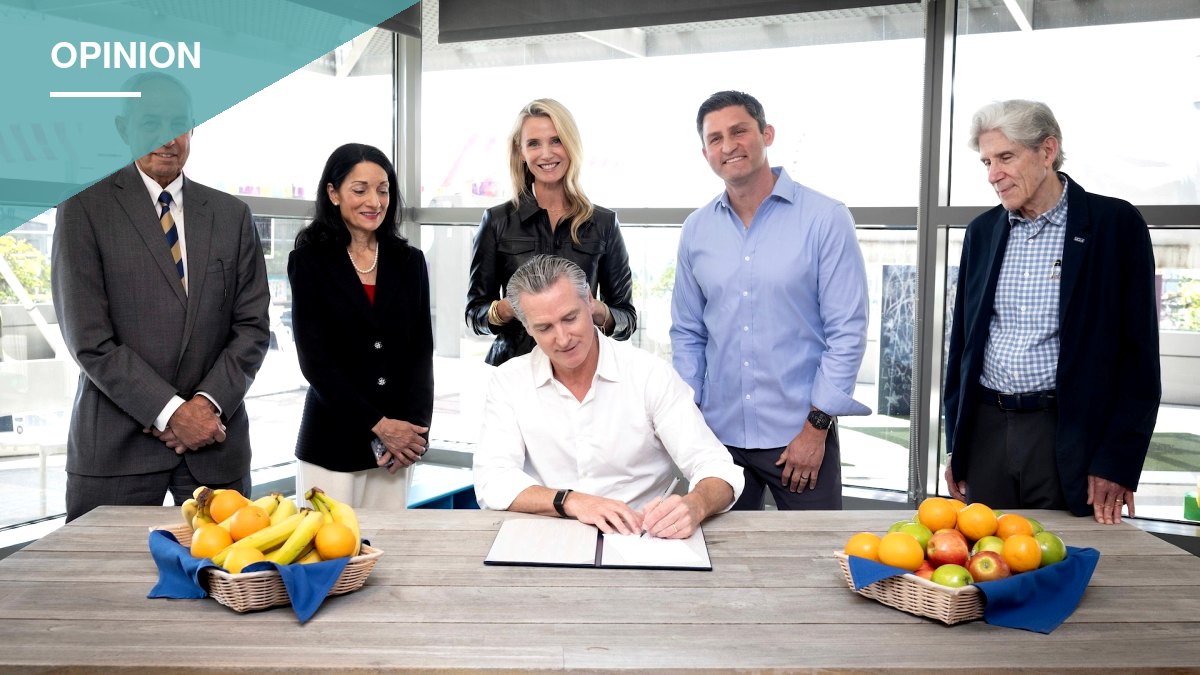
Gov. Gavin Newsom signed two pieces of food-labeling legislation on Monday, prompting pushback from Huntington Beach City Council member and restaurant owner Andrew Gruel, who argues the new rules will burden small businesses without meaningfully changing what Californians eat.
The first law, AB 2244, creates a voluntary “Non-Ultraprocessed Certified” seal that food manufacturers can seek for qualifying products through certification agents accredited under oversight by the California Department of Public Health. Companies are not required to participate; the program simply gives them the option to apply for the label.
The second law, SB 869, requires restaurant chains with at least 20 locations to flag drinks that meet or exceed the federal daily recommended value for added sugar. Under the law, flagged beverages must carry a sugar-cube icon inside a black triangle along with an explanation. Chains have until Jan. 1, 2029 to comply, and drive-through menus must display the disclosures directly, while other restaurants have more flexibility in how they present the information, either physically or digitally.
Gruel, who has run restaurants since 2012 and describes himself as a longtime advocate for healthier eating, says he supports the underlying goal but questions whether the state should be in the business of certifying food quality at all.
“You cannot eat a warning label, and you cannot sauté a certification seal.”
Gruel argues the certification program favors large manufacturers, which can dedicate staff to navigating the application process and redesigning packaging, over small restaurant operators who are simultaneously cooking food, serving customers and running the business themselves. He warns that unless the state keeps certification affordable and simple, the program could end up rewarding companies with the biggest compliance departments rather than the best food.
He also raises doubts about whether the sugar warnings will change consumer behavior. Citing research on how people respond to messages they perceive as restricting their freedom, Gruel points to a documented “boomerang effect” in which such warnings can provoke resistance rather than compliance. He notes that existing studies on sugary-drink warnings generally show only modest reductions in purchases, and says it remains unclear whether California’s specific approach will justify its costs.
Every new requirement, he argues, becomes additional work inside a restaurant — someone has to review recipes, update signage, coordinate menu changes and confirm compliance — expenses that fall on business owners regardless of how well-known their brand name is.
Rather than more labeling mandates, Gruel says the state should focus on making it easier for small food businesses to operate: streamlining permitting, removing barriers that keep local producers from connecting with restaurants and customers, and investing in school kitchens and cooking education so children learn to prepare real food rather than decode government seals.
“A healthy California requires making good food available, appealing, and affordable first,” Gruel writes, “and this can’t be done with a stupid label.”
Gruel says he does not oppose transparency in principle and credits Newsom when policies genuinely help people make better choices. But he argues the state’s standard should be clear information and lower costs — with decisions left to individual consumers rather than steered by state-sanctioned symbols.

