

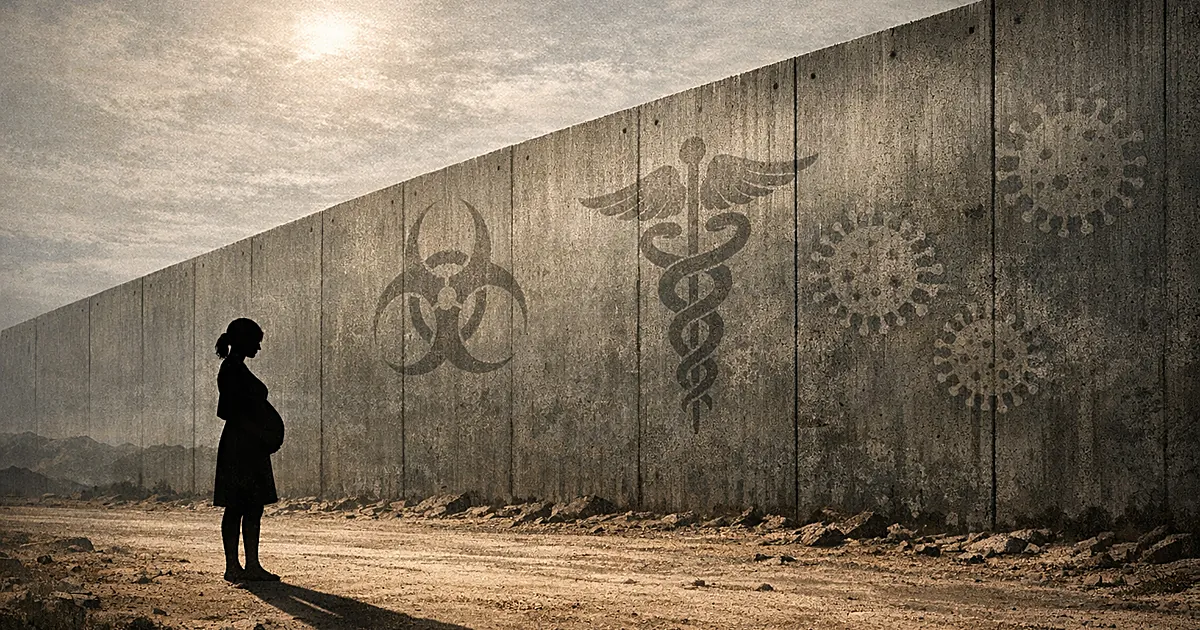
Homeland Security Secretary Markwayne Mullin says he is coordinating with health officials on a policy to block pregnant travelers from entering the United States, a proposal that equates pregnancy with contagious disease and has sparked sharp pushback from legal and civil-rights observers.
Mullin raised the idea during a Fox News interview shortly after a federal judge blocked the administration’s recent executive order on birthright citizenship. Judge Deborah Boardman called the order “certainly unconstitutional,” and that legal rebuke follows a June Supreme Court decision that struck down a prior 2025 executive order on the same subject.
The back-to-back courtroom losses have the administration searching for a different tack, and Mullin suggested restricting who is allowed to physically cross the border might be that next move. He said he is working with the Department of Health and Human Services on a policy concerning pregnant travelers, but he offered no operational details or enforcement plan.
HuffPost reported Mullin framing the restriction as a public-safety issue and citing supposed legal precedent for denying entry in certain cases.
“Maybe you shouldn’t come into the country if you are late in your third term. We don’t allow sick individuals to come here if they are coming from an area that could possibly, come in, that could spread a disease. So there is precedent for us to look into saying it’s not safe for you to travel.”
He followed that line with a family anecdote to justify the comparison.
“I know my grandson was just recently born and her OBGYN didn’t want her flying late into her third trimester.”
The legal distinction matters. Federal immigration law does let the government deny entry to people carrying communicable diseases to prevent outbreaks, but pregnancy is not a communicable condition. Treating pregnancy like an infectious threat mixes quarantine authority with a proposal that would single out women for a biological state unrelated to disease transmission.
That does not mean the concern about birth tourism is baseless. Birth tourism describes cases where foreign nationals enter the country and give birth on U.S. soil, creating a citizen child who may later sponsor relatives for immigration benefits under current law.
After the Supreme Court ruling, the White House argued for tighter screening of inbound travelers to close what it calls a loophole. Stephen Miller explained the administration’s thinking on Fox News, warning that short visits timed around delivery can produce lifetime American citizens and long-term access to public benefits.
“But if you have birthright citizenship, it means if a person comes here nine months pregnant to go look around at some things, in a couple of weeks, that is the mother of a lifetime American citizen and a direct line into American cash and welfare for the rest of that child’s life.”
“Well, what I’m saying, Jesse, is that you have to now think very carefully about who you let into your country, even on a temporary basis, because the possibility, as you said, for birth tourism, right, they do that. People come here just to have babies on American soil, and that baby gets to be a citizen for life.”
Data show birth tourism exists but is small relative to total births. One estimate put birth-tourism cases at roughly 20,000 to 26,000 per year against about 3.61 million U.S. births, which works out to under 1 percent of births nationwide. That gap suggests targeted enforcement is more proportional than sweeping bans.
The administration has already lost two major legal fights on this front. The Supreme Court struck down an executive order in June, and Judge Boardman blocked the next order the following day, citing the same constitutional concerns. The Fourteenth Amendment clause, “All persons born or naturalized in the United States, and subject to the jurisdiction thereof, are citizens of the United States”, remains the foundational barrier to unilaterally rewriting birthright citizenship by executive action.
So the White House has pivoted toward enforcement measures like visa revocations and an effort to crack down on networks that facilitate birth tourism. The State Department has pulled hundreds of visas in a global operation aimed at stampeding the fraud that makes commercial birth tourism possible, a targeted approach that goes after the industry rather than every pregnant woman who arrives at a port of entry.
But policy design matters. Mullin offered no explanation for how officers would reliably determine pregnancy status, how far along a traveler would need to be to trigger denial, or what legal authority supports that sort of exclusion. His disease analogy weakens the administration’s legal posture and gives opponents a clear route to challenge any new policy.
Republicans who want to close the birth-tourism loophole have stronger options than ad hoc executive orders and shaky comparisons to public-health law. Congress can pass narrowly tailored legislation addressing visa fraud, clarify jurisdictional language, or create specific penalties for commercial birth-tourism schemes. Those approaches would carry more constitutional weight and withstand legal scrutiny better than a blanket travel ban aimed at pregnant women.
Mullin’s goal—stopping exploitative birth tourism—wins broad sympathy among conservatives, but the rhetoric and legal theory he used on national TV risk undermining that support. Mixing a valid policy objective with an analogy that does not hold up in law and medicine makes it easier for courts and critics to strike back and harder to build a durable, enforceable solution.

