

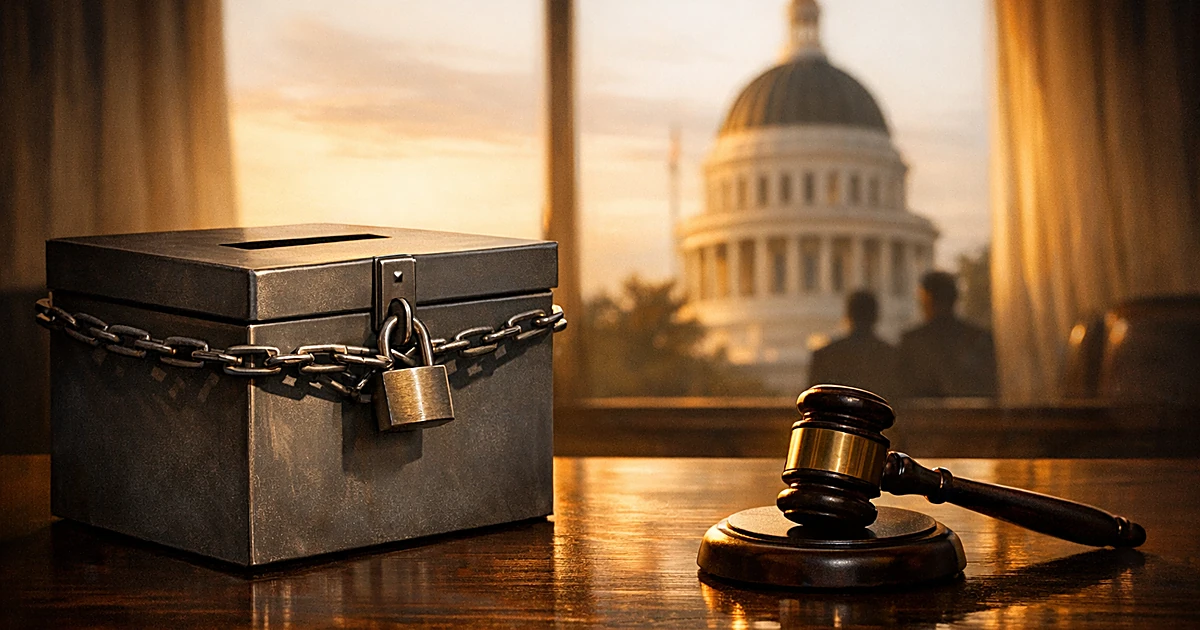
California Governor Gavin Newsom plans a prerecorded Fourth of July address that pushes a proposal to make unauthorized ballot seizures a felony, ties the move to recent election clashes, and frames it as both an election-protection measure and a political moment.
Gov. Gavin Newsom recorded a speech at the governor’s mansion in Sacramento to be released on the nation’s 250th Independence Day. The prerecorded address is built to run on social media and lands at noon on Saturday, a carefully timed move that mixes policy and politics.
The speech zeroes in on repeated claims from President Trump that America’s voting system is vulnerable and introduces a legislative idea to criminalize unauthorized ballot seizures under California law. That proposal would upgrade what has been a lesser offense into a felony, putting new teeth behind Sacramento’s approach to election disputes.
The governor’s office circulated excerpts ahead of the release and framed parts of the remarks in founding-era language before rolling into the policy pitch.
“The core of our democracy, the thing that separates us from a monarchy or a dictatorship, is the fundamental right to vote. If we lose that, we lose everything. On America’s 250th birthday, we need a declaration of election independence, a proclamation of freedom from the manipulators and deniers, from the threat of imprisonment for refusing to go along with Trump’s schemes.”
The rhetoric is high and unapologetic. The political calculation underneath is just as obvious: position Newsom as a defender of elections while sharpening contrasts with Republican critics.
The felony push traces back to a showdown with a local Republican law enforcement official in Riverside County. Sheriff Chad Bianco, who ran for governor and lost, authorized the seizure of roughly 650,000 ballots during a 2024 election probe before the California Supreme Court halted the action.
In response, Newsom signed a law restricting ballot seizures days before the June primary, and now he wants to go further with felony penalties. No formal bill text exists yet, and his office has suggested the change could move through a gut-and-amend or be folded into other election bills already in play.
California lawmakers also approved a budget package last week that funnels money toward faster ballot counting and outreach, including a $29 million allocation to modernize and accelerate counting. The budget adds $5 million for county-level voter outreach, another $5 million for statewide outreach, and a $750,000 line item aimed at combating misinformation and guarding against what Sacramento labels federal interference.
That $750,000 earmark for a misinformation effort raises obvious concerns about who decides what counts as truth. When taxpayers underwrite an office that labels and combats misinformation, it invites questions about oversight and potential political bias.
The timing of the speech comes after California’s extended ballot-counting process drew public complaints and a sharp GOP critique. After the state’s June primary, President Trump labeled the extended count “crooked,” pointing to slow mail-in ballot tallies that can take days or weeks to finish.
Newsom’s team highlighted a perceived contradiction in Trump’s posture: the former president has cast absentee ballots in Florida while disparaging mail voting. The governor acknowledged the slow tally and tied the $29 million to an effort to speed results so there is less fuel for fraud allegations.
The prerecorded remarks also deliver a blunt warning aimed at anyone who might cooperate with federal attempts to intervene in California’s election procedures.
“In California, we have a message for anyone considering helping Trump interfere with our election or our count. If you violate California’s laws, if you interfere with our voters, tamper with our ballots, or meddle in our election, you will be prosecuted. It does not matter who gave the order. In this state, our vote is sacred.”
Newsom is term-limited and widely expected to eye a 2028 presidential bid, so the Fourth of July spot has the feel of a staged national launch packaged as a patriotic defense of democracy. The setting, timing, and rollout are all designed to amplify his standing on election issues.
That positioning sits awkwardly next to expanding legal trouble around his circle. A federal corruption probe has reportedly expanded to touch Newsom himself, with an ally said to be cooperating with investigators, and at least one former top aide has pleaded guilty in a campaign fund theft scheme.
Newsom has dismissed the federal probe as politically motivated and described it as payback for possible presidential ambitions, a framing that turns scrutiny into persecution in the governor’s narrative. Meanwhile, other initiatives tied to his administration, including a $20 million diaper program, have drawn accusations of insider dealing from critics.
All told, Sacramento approved nearly $40 million in new election-related spending in a single budget cycle. Some of that money addresses real operational problems like slow counts, but the misinformation office and the felony proposal are exactly the sort of expansions of state power that conservatives warn could be used to narrow who gets to ask tough questions.
Making unauthorized ballot seizures a felony would hand state leaders a criminal enforcement tool to use against local officials—sheriffs, county officers, and others—who pursue independent election investigations. Sheriff Bianco’s seizure was stopped by the state Supreme Court, showing the judicial branch can intervene, but Newsom appears to want a criminal deterrent in addition to judicial review.
How “unauthorized” is defined will determine whether the proposal protects voters or shields the political class, and there is no bill text yet to answer that. A governor facing a federal corruption probe, surrounded by aides with guilty pleas, asking voters to trust him as the guardian of election integrity is a posture that invites skepticism as much as it does support.

