

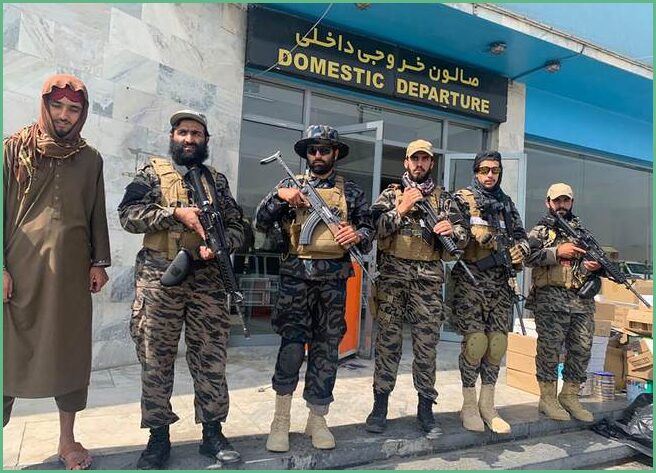
A simmering border feud exploded into open combat after Pakistan launched surprise air strikes across multiple Afghan cities to hit Tehreek-i-Taliban Pakistan leadership and bases. The TTP, a roughly 4,000-strong Pakistani Taliban faction that long cooperated with the Afghan Taliban during America’s two-decade presence, has broader political aims than battlefield survival. Its real objective is control inside Pakistan, not merely refuge across the border.
Pakistan misjudged how Kabul would respond. Afghan forces counterattacked, striking border posts after receiving large sums and hardware under the Biden administration’s aid programs, which critics call an arm-a-terrorist policy. What was a tense frontier suddenly became a theater of cross-border raids and retaliation.
Here, Afghan reinforcements in U.S.-manufactured up-armored HMMWVs move to the front lines.
They are supported by artillery manned by U.S.-trained gun crews.
They even have a small measure of air support provided by the U.S.
Early images of prisoners and damaged positions suggest Pakistan is paying a heavy price for its gamble.
The roots run back to a colonial ink line called the Durand Line, drawn in 1893 to separate British India from Afghanistan and left a divided Pashtun nation straddling two states. That artificial border created enduring gray zones where militants and smugglers flourish. Outsiders have been paying the price ever since.
The Soviet invasion and the Cold War turned Pakistan into a conduit for weapons and training that later helped shape the Afghan Taliban. Pakistan’s intelligence networks and Gulf money steered arms into Pashtun areas, creating a durable infrastructure of fighters and patronage. Those decisions haunt the region today.
The TTP formed in 2007 and quickly pivoted against Islamabad, demanding sharia law and autonomy while using suicide attacks and ambushes to make its point. During America’s long Afghan presence, the TTP used cross-border sanctuaries to rearm and regroup. Now the militants are turning that sanctuary into a platform for striking at Pakistan itself.
Since 2021 attacks have surged, with reports of more than 2,500 TTP strikes and many incidents using abandoned coalition weaponry. Islamabad responded with mass deportations aimed at squeezing militant networks, and over 800,000 Afghans have already left the border regions. Those moves have only added to the humanitarian and political strain.
Pakistan’s strikes in March and December 2024 drew headlines, but the insurgents have logged notable victories as well. The recent Pakistani air campaign aimed to decapitate enemy leadership in a way modeled on other state operations, yet the results were uneven. The clash has slid from punitive raids into a risky, broader confrontation.
This could end up as a strategic self-own for Islamabad if it cannot translate force into stable control, on a scale comparable to other geopolitical blunders. Maps of the region show how border provinces could drift toward insurgent control or autonomy if violence continues. Regional actors will probe for openings as the fight grinds on.
Help from the Muslim world looks limited; two Muslim neighbors fighting undercuts solidarity, and Saudi military support is unlikely to change the balance on the ground. China will almost certainly try to cash in by extending influence where it can. The United States, meanwhile, faces awkward choices about its role and assets in the region.
Talk of reclaiming Bagram as a U.S. foothold is a wild card because any serious presence would rely heavily on Pakistani logistics support. If that idea resurfaces, Islamabad and Kabul would both gain leverage over U.S. options and the calculus of peace. For now, the concept is more geopolitical theater than policy.
On the battlefield the Afghans have shown a tougher profile and parity in weaponry that makes a Pakistani military fix dangerous and unpredictable. A heavy-handed attempt to impose order risks splintering more territory and triggering wider unrest. Whether diplomacy can outpace the guns will determine what happens next.
The Schumer Shutdown is here. Rather than put the American people first, Chuck Schumer and the radical Democrats forced a government shutdown for healthcare for illegals. They own this.
Help us continue to report the truth about the Schumer Shutdown. Use promo code POTUS47 to get 74% off your VIP membership.

