

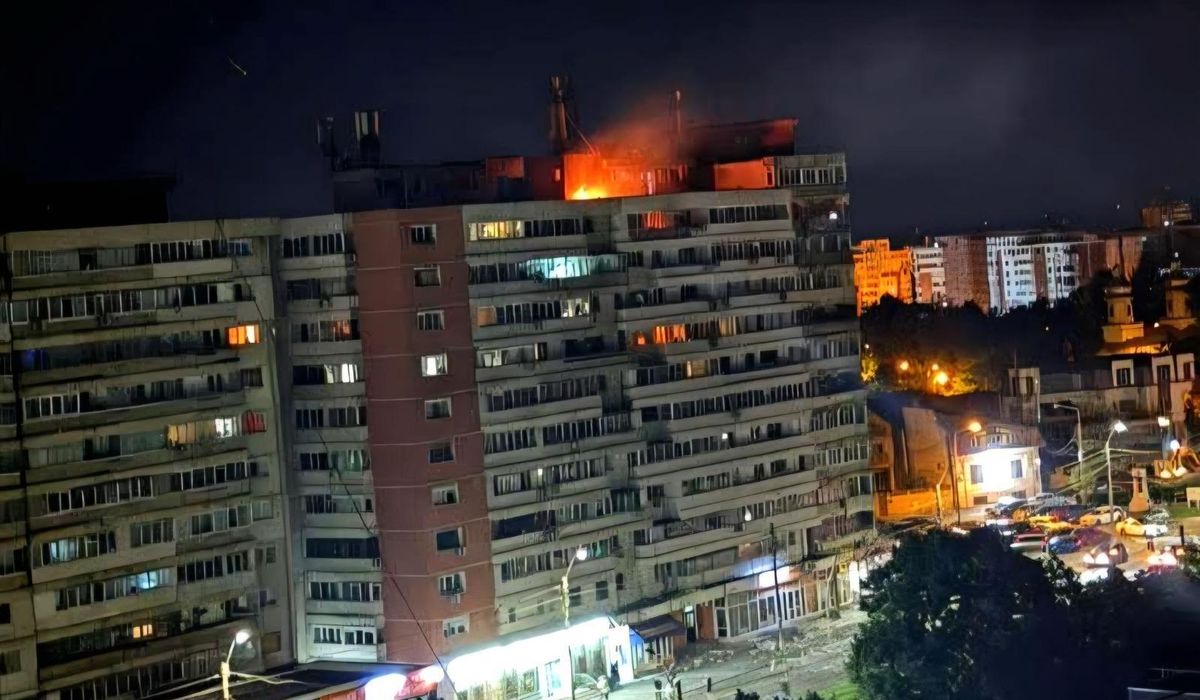
A Russian attack drone struck the roof of an apartment building in southeastern Romania on Friday, Romanian authorities reported, an event that has sharply increased tensions between the NATO member and Moscow.
The strike landed in a residential area in southeastern Romania, and officials quickly confirmed the presence of unexploded ordnance and structural damage to the building’s roof. Local authorities moved to secure the scene while national leaders spoke publicly about the incident. The timing and location added urgency to an already tense regional security picture.
Romania is a NATO member with a long eastern border near Ukraine, and any direct impact on its territory brings alliance obligations and political consequences into focus. The incident prompted immediate statements from Romanian security services noting the origin of the strike. For many in the country and among allies, the presence of a strike inside NATO territory marks a critical escalation.
From a Republican viewpoint, the strike underscores the continuing danger posed by Russian military activity near NATO borders and the need for clear deterrence. Analysts point out that an attack striking civilian infrastructure, even if unintended, demonstrates disregard for international norms. For conservatives who emphasize strong defense, the incident reinforces arguments for robust military posture and intelligence sharing with allies.
On the ground, emergency responders assessed structural damage and checked for potential casualties, while investigators began tracing the drone’s path and payload. Residents reported shock and concern after the explosion and the sudden arrival of security forces. Romanian officials have described the event in stark terms and signaled a desire for transparent international investigation.
The diplomatic fallout was immediate, with capitals across Europe and beyond watching closely for official reactions and next steps. NATO allies have long maintained collective security commitments that become particularly salient when any member’s territory is struck. Even without confirmed intent to target Romania specifically, the incident fuels debate over rules of engagement, air defense coverage, and cross-border risks tied to the conflict next door.
Military experts note that modern conflict increasingly spills beyond front lines through long-range drones and misdirected munitions, complicating traditional defenses. That reality raises practical questions about surveillance, early warning, and civilian protection in border regions. Romania’s geography and airspace management now sit at the center of those technical and policy conversations.
Politically, the episode sharpens partisan and strategic narratives. Republicans, in particular, are likely to frame the strike as proof that adversaries exploit gaps in deterrence and that strong posture deters further aggression. At the same time, there is recognition that rash rhetoric without precise information can escalate tensions, making measured but firm public statements important.
Intelligence and defense communities are expected to coordinate closely with Romanian counterparts to establish the facts, including trajectory analysis and munition identification. Such forensic work aims to determine whether the strike was the result of malfunctions, targeting errors, or deliberate cross-border action. The findings will shape both immediate operational responses and longer-term alliance discussions.
The human side of the story remains vivid: residents coping with damaged homes, disrupted routines, and heightened anxiety as international attention converges on their neighborhood. Local leaders face the dual task of managing emergency needs while conveying situational clarity to the public. That combination of empathy and clarity is central to maintaining trust when security incidents cross into civilian life.
Whatever conclusions investigators reach, the strike on Romanian soil will likely influence military planning and diplomatic posture across NATO. The event serves as a stark reminder that modern conflicts can affect neighboring states, and it renews debate over how best to protect civilians and deter future incursions. For many observers, the hit on an apartment roof is more than a single event; it is a test of alliance cohesion and resolve in a volatile region.

