

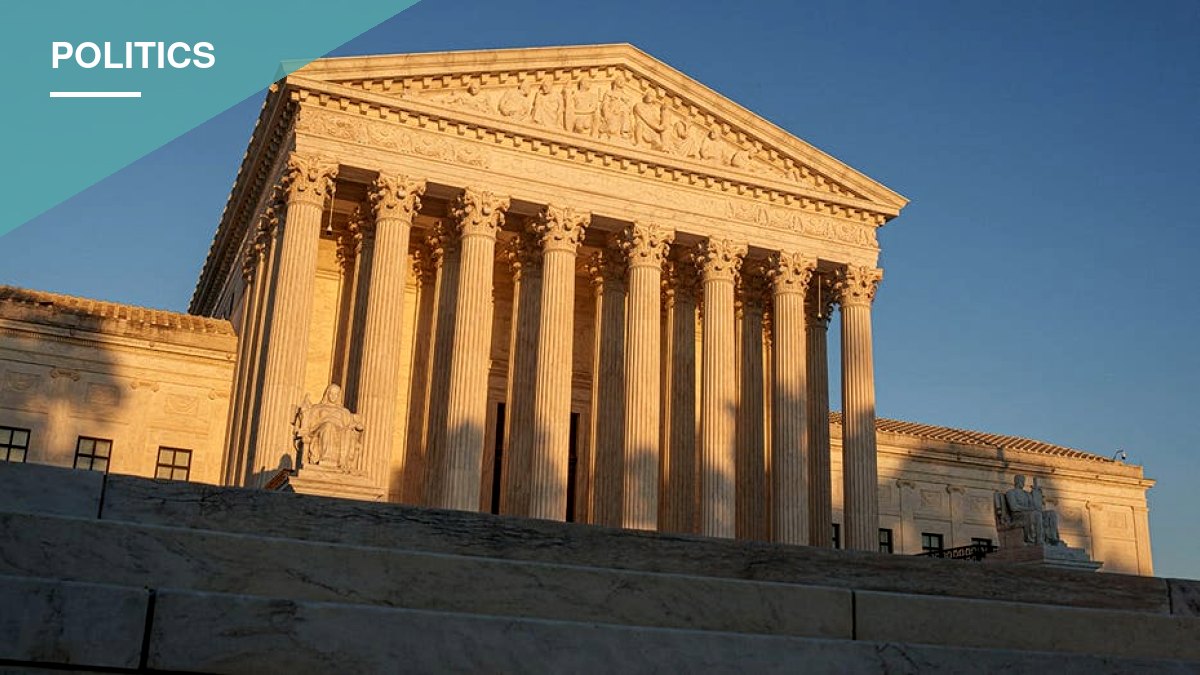
The Supreme Court agreed Tuesday to hear a Trump administration appeal that asks a blunt question with sweeping implications: can a person who cooked meals for a terrorist group’s leaders, under armed guard and threat of violence, be permanently barred from asylum in the United States?
The case centers on Izuchukwu Ozurumba, a Nigerian citizen who says he was coerced into preparing three meals a day for 15 to 17 leaders of a militant group called the Unknown Gunmen, linked to political violence in Nigeria. Ozurumba says armed guards prevented him from leaving the camp, that he cooked for roughly six months, including three months without pay, and that he eventually escaped during a supervised trip into town to buy groceries. He was deported to Nigeria in April 2025 while his appeal was still pending.
At issue is a provision of the Immigration and Nationality Act barring immigrants who provide ‘material support’ to terrorist organizations from receiving asylum. The statute lists examples such as transportation, communications, housing, money, weapons and training, but it does not spell out whether routine services like cooking qualify.
A Fourth Circuit Reversal
An immigration judge had ruled against Ozurumba, and the Board of Immigration Appeals agreed, finding his cooking violated the material-support bar. The judge also found the Unknown Gunmen qualified as a ‘Tier III’ terrorist organization under federal immigration law, even though the State Department had not formally designated the group as such.
But the Fourth Circuit Court of Appeals reversed that decision in a 2-1 ruling, sending the case back to the Board of Immigration Appeals. Judge James Wynn Jr., joined by Judge Nicole Berner, concluded that although Ozurumba prepared thousands of meals, his cooking did not provide resources that could be directly used or readily redirected toward terrorist operations. The majority did not resolve a separate question of whether the law excuses assistance given under duress.
Judge Julius Richardson dissented, arguing that cooking thousands of meals for terrorist leaders freed them to focus on the group’s violent aims.
“Ozurumba did not run a hot dog stand that the Unknown Gunmen happened to stop by once or twice. Rather, he acted as a private chef, providing three meals a day for over a dozen leaders of a terrorist organization—for months,” Richardson wrote.
The Administration’s Argument
The Trump administration argues the Fourth Circuit read the law too narrowly, contending that even ordinary services like cooking can sustain a terrorist organization by freeing up other members for attacks.
Bryce Poole, a senior legal fellow with Advancing American Freedom, told Fox News Digital the case is fundamentally about who controls the meaning of a national-security statute. “Congress wrote a broad rule, and the court interpreted it narrowly,” Poole said. He added: “Because he’s cooking the meals, one of the armed guards doesn’t have to cook the meals and can be an armed guard. That’s one guard who doesn’t have to come in off guard duty to cook meals, or that’s one bomb maker who doesn’t have to stop making bombs to go cook meals, because all this stuff is fungible.”
Hans von Spakovsky, another legal expert with Advancing American Freedom, said the majority’s reasoning defies common sense. “The idea that providing over 8,000 meals for the leaders of a terrorist organization and its members is not ‘material’ defies common sense,” von Spakovsky told Fox News Digital, adding that Judge Richardson “correctly cites Napoleon’s famous quote that an ‘army marches on its stomach.'” He also noted that other federal appeals courts have held that providing food and shelter, even unconnected to a specific terrorist act, constitutes material support, and that acting under duress is not a legal excuse under the statute.
Why It Matters Beyond One Case
The dispute arrives two years after the Supreme Court overturned Chevron deference, the doctrine that once required judges to defer to federal agencies’ reasonable interpretations of ambiguous statutes. That 2024 ruling shifted more interpretive authority to courts rather than agencies like the Board of Immigration Appeals, raising the stakes for how broadly judges — rather than immigration officials — define terms like ‘material support.’
Ozurumba crossed the southern border without valid entry documents in July 2023, during the Biden administration, and surrendered to Border Patrol agents. He says members of the Unknown Gunmen continued to threaten and attack him after his escape from the camp, driving him first to Venezuela and then to the United States.
Even a win at the Supreme Court would not automatically restore his asylum claim or bring him back to the country. His case would still return to immigration authorities for further review, and the Fourth Circuit previously declined to order the government to return him, leaving that decision to officials.

