

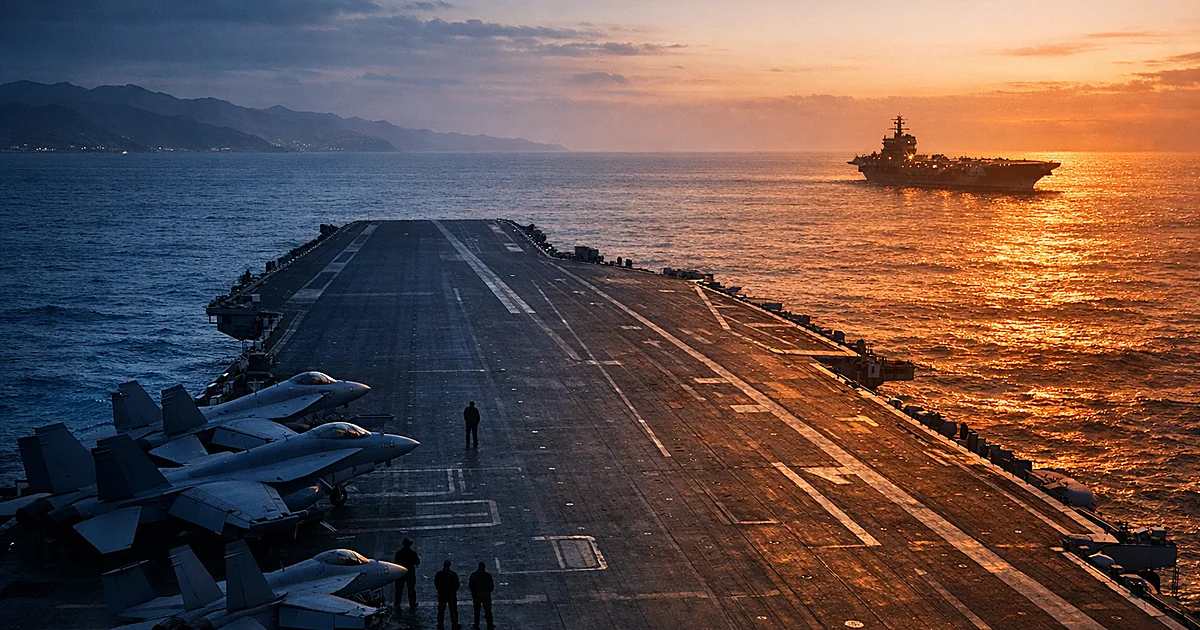
The Navy is shifting its only carrier from the western Pacific to the Middle East, leaving a gap as China steps up drills and allies watch nervously.
The Navy is sending the USS George Washington out of the western Pacific to replace the USS Abraham Lincoln in the Middle East, where the Lincoln has spent more than 240 consecutive days at sea supporting operations against Iran. That swap means, for the moment, no U.S. aircraft carrier will be routinely present in the western Pacific while Beijing conducts live-fire drills near Japan and exercises off the Philippines. This is not a minor scheduling issue; it is a visible gap at precisely the time allies expect American presence.
The western Pacific holds the flashpoints defense planners have warned about for years: Taiwan, the South China Sea, and the contested waters around Japan’s southern islands. Beijing’s recent activity shows it understands the opportunity when U.S. resources are stretched. The pattern of operations near Scarborough Shoal, exercises with Indonesia, and live-fire drills off Okinotori sends a clear message to regional governments.
Bryan Clark, a defense analyst at the Hudson Institute and a former Navy submariner, said China is deliberately exploiting the opening and using it in its narrative with regional partners. His view reflects a hard reality: perception shapes behavior as much as actual capability, and absence of a carrier changes calculations. That strategic gap plays straight into Beijing’s long game of influence.
“They’re using this as part of the narrative to demonstrate to the Philippines, to Japan, to Indonesia, and others that the U.S. is not the big dog in the western Pacific anymore.”
Clark added a sharper formulation of Beijing’s aim that Republicans and defense hawks find unnerving, because it points to long-term shifts in regional alignment if left unchecked. The worry is not just temporary imbalance but a losing of credibility with friends. Once partners doubt U.S. resolve, backfilling that trust gets much harder.
“They would just prefer that countries in the region decide that China is the bigger power and the U.S. is not able to guarantee their security anymore.”
The human toll on sailors has been steep. The Lincoln’s 240-plus days at sea without a port call set a record none of the crew wanted, and reports have surfaced about mental health and supply strains aboard the ship. Those problems are not hypothetical; extended deployments degrade readiness and morale in measurable ways.
“People don’t get enough rest. It’s psychologically exhausting. And R&R is part of keeping the crew healthy.”
Experts stress this is about operational limits, not just time off. “Sometimes it’s framed as, ‘These people haven’t had a vacation,'” one analyst said, “But we are dealing with well-known limits on the capacity of a crew to operate at top efficiency over time. And that just declines.” The practical result is a force that performs below its best the longer the tempo continues.
The stress is fleet-wide. The USS Gerald R. Ford returned after an 11-month deployment, the longest since Vietnam, and faced significant onboard issues that required repairs and disrupted sailor living spaces. When multiple carriers are pushed past scheduled maintenance, the Navy runs into a maintenance debt that reverberates for years. That deferred work reduces available carrier presence even after immediate crises cool off.
“We’ll end up with a maintenance debt that needs to be paid for the next few years. We’ll probably have less carrier presence than we’ve had in the previous years because carriers will be lined up to get into the shipyard.”
The fleet count itself underscores the squeeze: the U.S. operates 11 carriers and normally deploys two or three at a time, but commitments to the Middle East have driven an unusual surge in deployments. The country also has only two shipyards capable of servicing carriers, meaning extended missions create a backlog that no quick fix can erase. The result is a Navy improvising on the fly instead of following a deliberate, sustainable schedule.
Diplomatic moves follow the hardware, with senior commanders visiting Manila and Tokyo to reassure partners while carriers are absent. Special operations and joint exercises help, but they are not a replacement for the deterrent signal a carrier off a contested coast provides. Allies notice the difference, and that difference affects everything from force posture to political alignment.
Some argue the Navy should shift to smaller ships, submarines, and stand-off technologies that are harder to target, but doctrine debates do not change today’s theater. Carriers remain the clearest signal of American commitment and capability, and when none are present, rival powers take note. The core question now is whether this Pacific absence is a brief operational hiccup or the start of a deeper, longer-term posture change driven by maintenance backlogs and stretched resources.

