

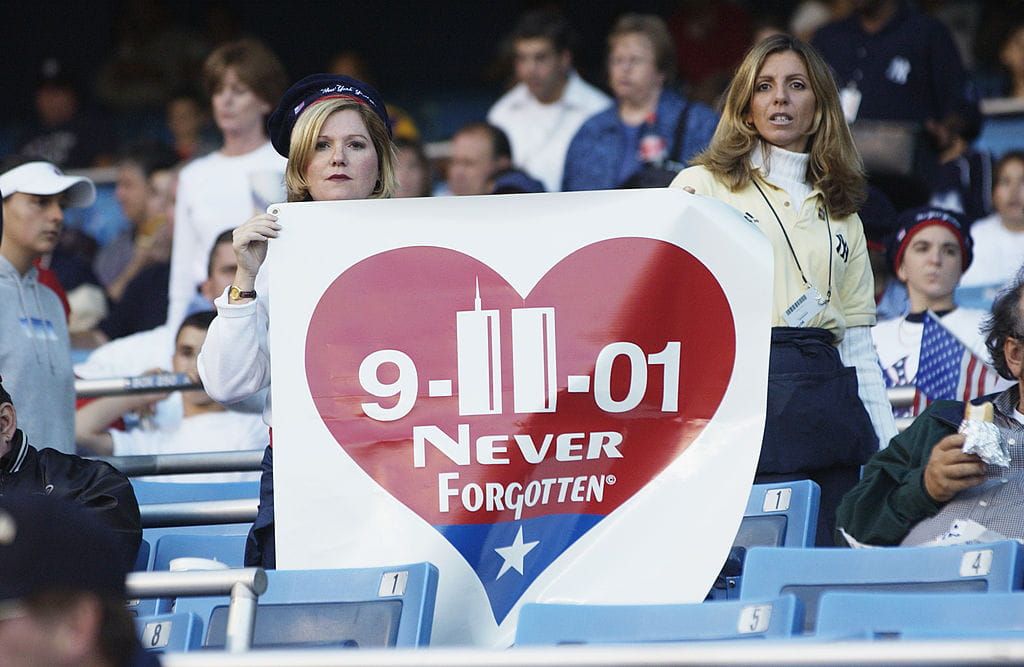
As the years pass, 9/11 shifts from lived shock to taught history, and the way younger Americans know that day is changing as firsthand witnesses age and memories fade.
“The past is a foreign country: they do things differently there.” That line from L.P. Hartley sits oddly with a generation that never lived through Sept. 11, 2001. Whatever happened to “Never forget”? The phrase is meant to anchor collective memory, but memory needs mouths to speak it forward.
With the attacks approaching their 25th anniversary, an entire cohort has only books, videos, and other people’s stories to explain what it felt like. Grace Doerfler captured that position plainly when she wrote, “While I cannot remember 9/11 itself, it has deeply shaped my generation. The day is woven into the fabric of my life and the lives of everyone I know. I have no memories of a United States unmarked by terrorism, and I have grown up in a world struggling to come to terms with the scale of such violence.” Those words show how experience and history diverge for younger Americans.
This drift is similar to how Pearl Harbor became history rather than memory for later generations. We can visit memorials and read eyewitness accounts, but the number of people who can answer with lived detail dwindles every year. When firsthand witnesses are gone, the raw feeling of a moment tends to flatten into a chapter in a textbook.
Somewhere between 70% and 75% of the current US population was alive on Sept. 11, 2001, which means roughly 30% of Americans were born afterward. Add people who were alive but too young to understand what was happening, and you get a large slice of the country that treats the attacks as an abstract fact. Without the emotional memory attached, the event becomes information rather than an experience.
The difference shows up in how people describe the day. A widespread thread asked Americans, “Do you remember 9/11?” and the replies read like the kind of testimonials that once defined national conversation. The attacks involved four hijacked passenger jetliners: Two took down the Twin Towers in New York; another hit the Pentagon in Arlington, VA; the fourth went down in rural Shanksville, PA. The scale and randomness of it left Americans asking whether more strikes were coming and whether the country would feel different forever.
- “Yes, it was a turning point in my life, marking the boundary between childhood and adulthood.”
- “I remember how quiet everything felt outside that evening.”
- “My dad actually WAS in the air that morning, flying to New York for work. His flight was rerouted to somewhere like Baltimore, where he had to rent a car to drive back to Atlanta. He obviously didn’t know what was happening while he was in the air, but to hear him tell it — he looked out the window at one point of the flight, and there were two F-16s on either side of the plane. He’s convinced they were instructed to shoot down any plane where the pilot didn’t respond.”
- “It was absolutely terrifying.”
- “I don’t think about it much, but that day is permanently burned into my memory.”
Alongside those memories sits a minority that questions the accepted narrative, the so-called 9/11 truthers who claim explosives or missiles were involved or that officials had foreknowledge. Those ideas remain fringe and are not embraced by mainstream historians or the public at large. The existence of conspiracy theories is part of why firsthand testimony matters: it provides texture that simple skepticism lacks.
There’s a practical consequence to letting memory fade. As survivors, witnesses, rescuers, and first responders pass on, the raw testimony that carried nuance and emotional truth will be gone. That loss matters because collective memory shapes civic instincts and policy choices; how a nation remembers trauma affects how it prepares for the future and how it honors those who suffered.
That obligation to pass on the truth is why older generations still have a role beyond private grief. As Richelle Mead put it in a novel character’s line, “History is important because it teaches us about the past. And by learning about the past, you come to understand the present, so that you may make educated decisions about the future.” Those words explain why retelling matters: not to freeze grief, but to fuel understanding and sensible choices ahead.
Memory without witnesses will become a different thing entirely: a learned chapter instead of an emotional landmark. If the goal behind “Never forget” is to keep consequences real and lessons sharp, then passing memory along is not sentimental—it’s civic work. The question now is whether we treat that work as optional or essential.

