

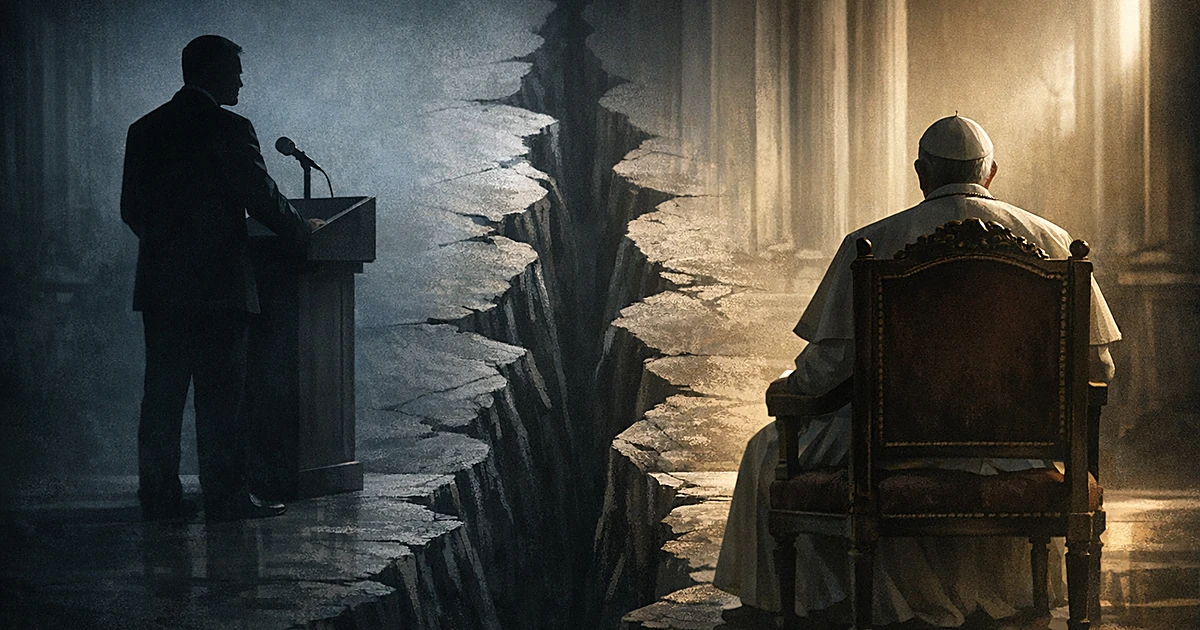
Vice President JD Vance drew a sharp line between Vatican moral teaching and American foreign policy, and several Catholic theologians pushed back, arguing that war is inherently a moral issue and the Church has a legitimate role in weighing it.
On April 13, Vice President JD Vance told Fox News that the Vatican should limit itself to “matters of morality” while the president handles American policy, a stance that immediately ran into public theological pushback. The remarks came as the U.S. and Iran were under a temporary ceasefire and Pope Leo XIV had publicly called for peace. That timing made the exchange more than theoretical: it placed a Catholic vice president between the Church’s teaching voice and the demands of national security politics.
Vance framed the pope as an advocate for peace but insisted on a boundary between moral guidance and policy-making. He said the Vatican should “stick to matters of morality” and let the president “stick to dictating American public policy.” That line was meant to protect presidential prerogative, but it also invited a direct response from Catholic scholars who see Church teaching as inseparable from questions of justice and war.
“In some cases it would be best for the Vatican to stick to matters of morality, to stick to matters of what’s going on in the Catholic Church, and let the president of the United States stick to dictating American public policy.”
The exchange escalated when Vance, at a Turning Point event, challenged a post the pope had made and asked pointed historical questions: “Was God on the side of the Americans who liberated France from the Nazis?” and “Was God on the side of the Americans who liberated Holocaust camps and liberated those innocent people…?” He answered, “I certainly think the answer is yes,” and warned the pope to be “careful when he talks about matters of theology.” That public back-and-forth underscored the tension between pastoral teaching and policy defense.
“God does not bless any conflict. Anyone who is a disciple of Christ, the Prince of Peace, is never on the side of those who once wielded the sword and today drop bombs.”
Three Catholic theologians stepped into the breach to rebut Vance’s neat separation of church and state. Joseph Capizzi, Taylor Patrick O’Neill, and Ron Bolster agreed that you cannot cordon off morality from politics, especially when lives and international law are at stake. Their point was simple: questions of war and peace are moral questions by definition, and the Church’s centuries of thought on just war and human dignity matter.
“For people to be moral, they need a good, healthy, stable political community. All of us, men, women, children, priest and religious, lay, and so on have a stake in the moral good of the political communities we inhabit.”
Capizzi was blunt in rejecting the idea that the Church should stay out of political life. He warned that the same logic used to silence the Vatican on war could be used to hush it on immigration, abortion, or poverty. “The overlap of politics and morality is expansive,” he said, emphasizing that faith informing policy is not a selective privilege to be invoked only when it suits a political agenda.
“It’s what many relied on in the past to try to quiet Catholics about immigration, abortion, poverty, and many other issues. The overlap of politics and morality is expansive.”
O’Neill echoed that there is “no amoral arena” and argued the papacy’s teaching role naturally touches politics. He clarified that the pope is not directing tactical military decisions but is asserting that some policies are “intrinsically contrary to human flourishing and dignity.” For O’Neill, assessing whether a conflict meets just war criteria is a moral task the Church is both qualified and obliged to perform.
“There is no amoral arena. There’s no aspect to our… life where moral aspects don’t come into play.”
On the question of posture and spirit, O’Neill noted that even when force is necessary it should be treated as tragic rather than triumphant. “Even when a Christian has to take up the sword, he doesn’t live by the sword. He does so as if it’s a tragedy,” he said, stressing that a sober moral posture should guide policy and public rhetoric. That distinction matters to how leaders justify and conduct military action.
“Even when a Christian has to take up the sword, he doesn’t live by the sword. He does so as if it’s a tragedy.”
Bolster offered the most sympathetic critique of Vance while still disagreeing with the separation he proposed. He acknowledged the operational risks a vice president faces in publicly questioning troop legitimacy but insisted the Gospel must shape policy. “The Gospel and morality [should] drive all policy and any action that we would take,” he said, pushing back on the idea that the Church should silence moral judgments on the use of force.
“The Gospel and morality [should] drive all policy and any action that we would take.”
The relationship between Vance and the Vatican is still forming and already strained in places. A private meeting where Vance left a presidential letter prompted a measured papal reply of “at some point,” and that tone matched broader Vatican caution about current U.S. foreign-policy choices. Criticism over ceremony and protocol has surfaced, but the academic objections from theologians are more consequential than symbolic snubs.
An unanswered question hangs over the exchange: when asked whether entering or conducting war involves moral judgment, Vance’s office did not respond. Capizzi reminded readers that those who pursue just wars “pray in the hope that they are doing God’s will… with humility and even a fear of God that they have rightly judged [the] situation.” That kind of humility, theologians say, is part of both moral leadership and faithful public service.


1 Comment
Then why doesn’t their sanctimonious pope “weigh in” on mostly Muslim terrorism, illegal immigration undermining freedom and Christian values, and the horrendous brutality of the Iranian regime toward its own citizens? I was raised a Catholic, but once I learned the history of the papacy I could not in good conscience remain one. Still, it’s better than being a Muslim.