

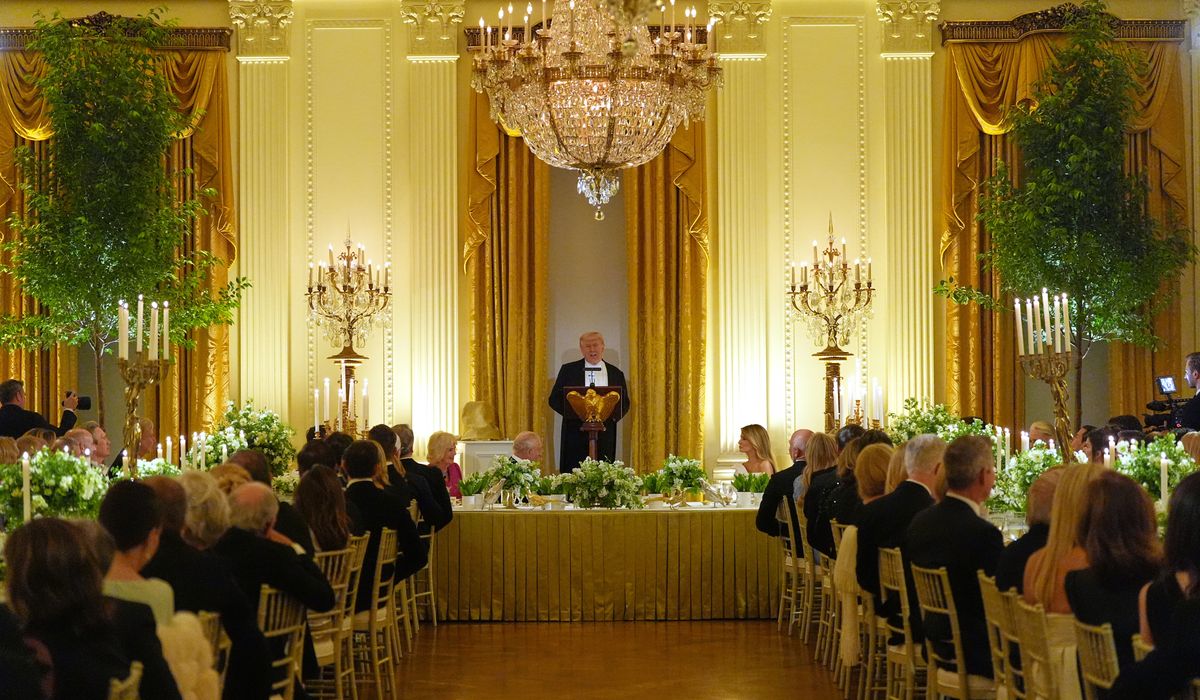
The White House state dinner for King Charles III and Queen Camilla featured a heavy presence of Fox News hosts among the invited guests.
The guest list for Tuesday night’s state dinner at the White House leaned heavily toward Fox News personalities, a detail that caught attention in media circles. This gathering, meant to honor King Charles III and Queen Camilla, put conservative commentators shoulder to shoulder with political and cultural figures. For many, the lineup signaled a deliberate choice about which media voices were given prominence.
The selection of so many Fox hosts felt like a statement about who the administration wants in the room when historic ceremonial moments happen. Republicans will note it as an acknowledgment of conservative perspectives that often feel sidelined. It also raised questions about balance and whether other networks were overlooked in favor of political alignment.
State dinners are ceremonial but also strategic, and the guest list speaks to priorities as much as protocol. Inviting a roster dominated by one network highlights the influence that outlet holds over public conversation. That influence is precisely why conservatives care about being represented in national events that shape the story of the day.
Some will see this as a welcome correction of past slights where conservative media had less access. Others will argue the White House should diversify its media table and show impartiality. Both positions revolve around a basic point: who gets to narrate national moments matters.
From a Republican perspective, the presence of Fox hosts can be defended as recognition of a major news ecosystem that commands a large audience. Those hosts are not merely pundits; they are cultural touchpoints for millions of Americans. Ignoring that reach would be tone deaf if the goal is to engage broadly with the public.
Critics will suggest that staging a guest list heavy with friendly voices looks like favor trading rather than civic outreach. That criticism is worth hearing because the optics of partisan tilt at official events undercuts claims of unity. Still, politics has always been about relationships and influence, and administrations choose attendees with purpose.
It’s also important to remember state dinners blend diplomacy and domestic theater. Guests are selected for a mix of expertise, celebrity, and media reach so the event sends signals at home and abroad. A lineup of familiar faces from a dominant network ensures the event’s domestic coverage lands in certain corners of the nation quickly.
The royal visit itself carried weight beyond who attended the dinner. Hosting King Charles III and Queen Camilla underscored the U.S.-U.K. alliance and offered a moment for cultural exchange. Media coverage vectors then shape how that moment is remembered, and who reports it plays a big role in framing public perception.
Republicans inclined to defend the guest list will point to the necessity of including voices that speak to a broad conservative base. That base tunes into specific networks nightly, creating pathways for diplomacy to resonate with different audiences. Bringing those voices into the room can be seen as practical politics in action.
Still, the setup invites scrutiny about access and fairness. If one network dominates official events, other outlets and viewpoints may rightly feel excluded. The danger is that ceremonial occasions meant to represent the nation start to look like echo chambers rather than forums for diverse coverage.
Some reporters and commentators noted the number of Fox hosts present and treated it as newsworthy in its own right. Observers debated whether this reflected favoritism or merely recognition of where a large audience lives. The conversation itself shows how media choices at high-profile events feed public debate.
For conservatives, the headline can be framed positively: legitimate representation at a major state occasion. For skeptics, it becomes another example of partisan proximity to power. Either way, the mix of guests at a state dinner is never neutral; it functions as a form of messaging about who matters.
The administration will likely defend its invite decisions as part of broader outreach to varied constituencies. That defense rests on the idea that reaching different audiences requires inviting the people who speak to them. Republicans will insist inclusion of conservative media is a fair move toward balance.
Ultimately, the guest list for this state dinner will be parsed as part of the larger narrative around media access and political alignment. The presence of multiple Fox hosts made that parsing unavoidable and turned a ceremonial night into a conversation about representation. How people react will depend a lot on where they sit on the political spectrum.
Whatever one makes of the choices, the event illustrated how modern statecraft intersects with media influence. When diplomacy meets prime-time personalities, the result is both theater and policy signaling. That reality is something Republicans and others will continue to factor into debates about access and fairness at national events.

