

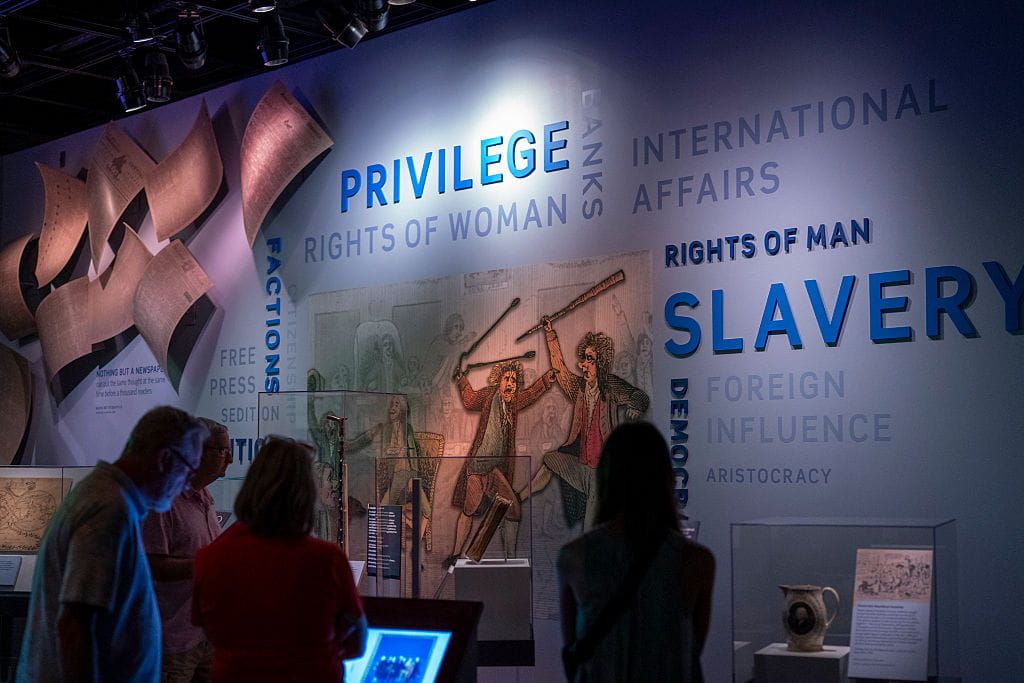
The Smithsonian’s National Museum of American History is under fire for an ideological shift that critics say replaces celebration of the Founders and national unity with political activism and selective storytelling.
The Trump administration’s Domestic Policy Council released an assessment arguing the National Museum of American History has abandoned balanced historical education in favor of activism. The council found leadership at the museum “has explicitly adopted an ideological framework that no longer treats the American story as a shared national inheritance to be taught or celebrated, but as a political instrument to divide, dispirit, and discourage our citizens.” That is a stark charge against an institution meant to preserve common memory.
Inspectors noted the museum lacks a single major exhibit dedicated to the Founding, George Washington, Thomas Jefferson, the Continental Congress, the Pilgrims, the Puritans, or major moments of the American Revolution. When the Founders do appear, their portrayal is often confined to links with slavery while their vital roles in establishing the republic are marginalized. The report says the Founders’ anti-slavery efforts are “minimized or ignored.”
Exhibit labels and interpretive materials, the council reported, selectively quote key documents to “mute their claims about equality, ordered liberty, natural rights, and the divine source of those inalienable rights.” That is not neutral history; it is selective editing that rearranges context to fit a narrative. Visitors deserve the full picture, not curated grievance framed as scholarship.
The museum’s treatment of Christianity and early settlers drew sharp criticism for ignoring the faith’s influence on the founding generation. According to the review, materials created by the NMAH “repeatedly suggest that Christianity functioned principally as an instrument of conquest, exclusion, or cultural erasure” and downplay its role in America’s founding. Even Thanksgiving and the Pilgrims were recast in the report as part of an ideological agenda rather than a balanced account of the past.
Signaling a wider institutional reorientation, the council described the museum as having undergone “ideological capture” that shifted its mission away from straightforward education. Documents reportedly show NMAH leaders wanted the semiquincentennial to be “problematized,” embracing a process that highlights oppressions to discredit prevailing narratives. That approach replaces historical context with political framing and turns a national birthday into a platform for contesting the past.
The report says leadership explicitly sought to remove an “Anglo-centric” emphasis and the “America First mentality” from their presentation of the past, and even eliminated the phrase “American History” from the museum’s mission statement. That decision, the council argues, is evidence the institution has been steered toward activism. Removing core language about American history from a national museum’s mission is unprecedented and unsettling to many who expect civic memory to be defended rather than reworked.
Anthea Hartig, director of the museum since 2019, is singled out by the council for statements that align history with advocacy. The report notes she described history as a “prime tool of social justice” and tied her role to linking “research and scholarship to activism and advocacy.” Those words, taken at face value, suggest a mission aligned with political goals rather than impartial scholarship.
Hartig’s own commentary was cited in the review, including her remark that she had been “propped up…by the cushions of whiteness and the pillows of the bourgeoisie.” The council characterized such statements as the voice of an activist rather than an objective historian, concluding, “These are not the words of an objective historian, but rather those of an activist advancing an ideological agenda contradictory to the Museum’s founding purpose of fostering patriotism.”
The Domestic Policy Council’s conclusion was blunt: under current leadership and interpretive approaches, the museum “cannot be trusted to tell America’s story honestly and in a way that is inspiring, unifying, and worthy of our great republic.” That is a direct challenge to the Smithsonian’s role as a steward of the national narrative. For critics, it signals the urgent need for course correction so public institutions serve the public’s history, not a political project.
Congress and the public are now left to decide whether a national museum should advance a partisan framework or restore a mission that celebrates founding principles and shared heritage. The debate raises a bigger question about how federal cultural institutions balance legitimate inquiry into the past with a responsibility to foster civic unity. Whatever the outcome, the report has pushed museum stewardship and historical integrity into the middle of a national conversation about memory, patriotism, and the public square.

