

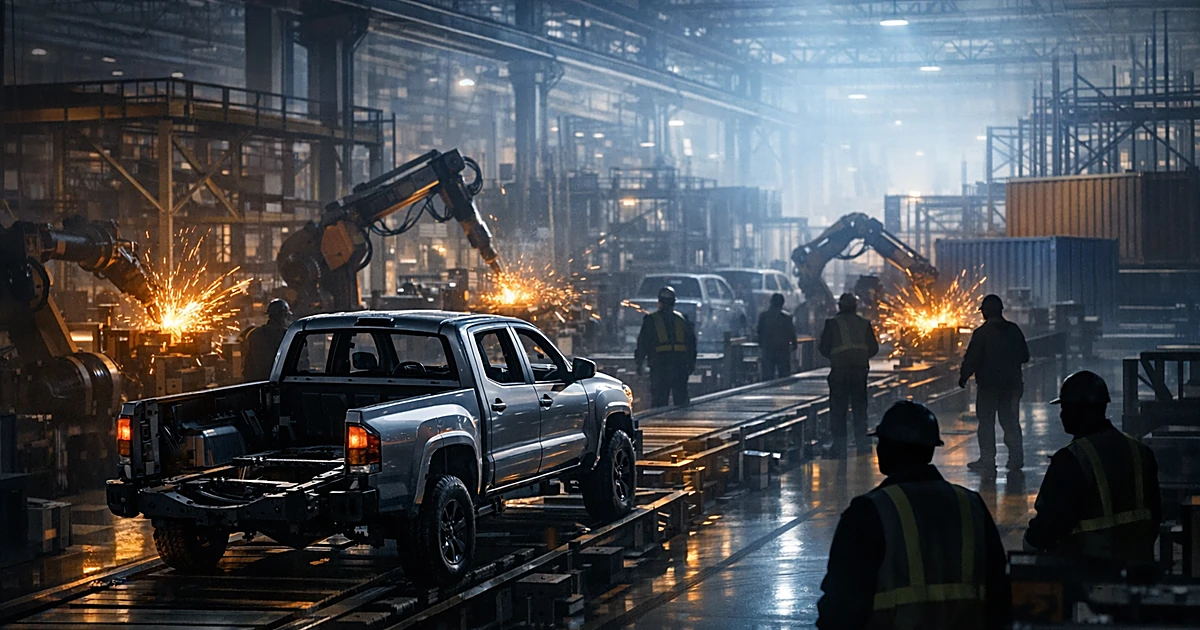
Toyota is putting $3.6 billion into a San Antonio expansion that shifts nearly all Tacoma components from Baja California to the United States, a move that has become a central talking point in the debate over tariffs, trade policy, and American manufacturing.
Toyota announced a $3.6 billion expansion of its San Antonio manufacturing center that will move nearly all production components for the Tacoma pickup from Baja California, Mexico, to Texas. The company estimates the buildout will take about four years and add roughly 2,000 jobs at the plant. That level of capital and payroll is the kind of concrete outcome that changes local economies and political narratives.
President Trump immediately claimed credit for the decision, posting about it on Truth Social and stressing the point while meeting Turkish President Recep Tayyip Erdogan in Ankara before the NATO summit. The timing let the White House present the investment as evidence that trade pressure can reshape corporate decisions. For an administration that has made tariffs a visible tool, this announcement became a headline-friendly validation.
Trump’s Truth Social post was characteristically blunt: “Toyota is moving from Mexico to the United States (Texas!). A really big deal. Tariffs at work!” He then repeated the theme in public remarks overseas, saying, “It came over the wires that Toyota is moving out of Mexico into the United States, and building one of the biggest truck and car plants ever built. It’s amazing, that’s what tariffs do, properly used, and so we’ve never had a more exceptional economy or potential economy.” That message fed directly into a narrative that tariffs are a working lever.
Toyota’s own public statement struck a more cautious tone and did not point to tariffs as the explicit cause. The company said it “remains committed to its operations throughout the U.S., Canada, and Mexico, and encourages a quick resolution to USMCA to make the North American region globally competitive.” That language emphasizes regional stability and trade rules rather than thanking government pressure outright.
The administration’s recent decision not to renew USMCA talks adds a layer of complexity here, and Toyota’s plea for a quick resolution underscores how much corporate planning depends on predictable rules. Uncertainty about trade accords often nudges firms to favor domestic expansion near their largest market, and the U.S. is Toyota’s biggest market. Expanding an existing San Antonio campus reduces exposure to changing cross-border rules.
Companies seldom publicly credit political pressure when it shapes big investments, which makes the gap between the president’s framing and Toyota’s wording unsurprising. What matters to communities and workers is where the money lands, and in this case the capital flow runs north to Texas. A $3.6 billion project is tangible in ways that policy promises sometimes are not.
The Tacoma is a top-selling midsize truck in the U.S., so moving “nearly all” of its production components from Baja California to San Antonio represents a major reshoring step. The roughly 2,000 jobs expected from the expansion include factory floor work, skilled trades, and logistics roles that local leaders have long sought. For a red state that has pitched infrastructure and business climate advantages, landing this kind of manufacturing is a clear win.
Questions remain about the Baja California workforce and whether the Mexican plant will be repurposed or see job losses, and Toyota has not detailed those outcomes. The company’s broader commitment across North America suggests it is not abandoning its presence in Mexico outright, but the move still shifts significant capacity north. That shift has political and economic implications for both countries.
The central policy question is whether tariffs were a cause or a catalyst, and the public record here does not settle that debate. Multiple automakers have announced or accelerated U.S. investments since the administration signaled tougher trade stances, so patterns are beginning to emerge. Critics will point to the risk of higher consumer prices, while supporters will note that factories and payrolls are returning to U.S. soil.
The announcement landed in a political moment when the Republican Party is actively debating its economic playbook and when some leaders are promoting an economic populism that embraces tariffs and industrial policy. Figures on the right see the Texas investment as evidence that a tougher trade posture can persuade firms to invest domestically. Free-market skeptics will keep asking for clearer causal proof, but the headlines are already useful political ammunition.
Key questions to watch are precise tariff actions that may have influenced Toyota, the ultimate job impact in Baja California, the fate of USMCA negotiations after the administration stepped away, and whether the four-year timeline holds under shifting politics. Policy choices, legal fights, and diplomatic negotiations will shape whether this expansion stays on track. For now, the investment is scheduled, the timeline is four years, and roughly 2,000 new jobs are expected in San Antonio.


1 Comment
Thank you President Trump and tariffs you imposed on imports. If you’re going to sell them here, make them here.