

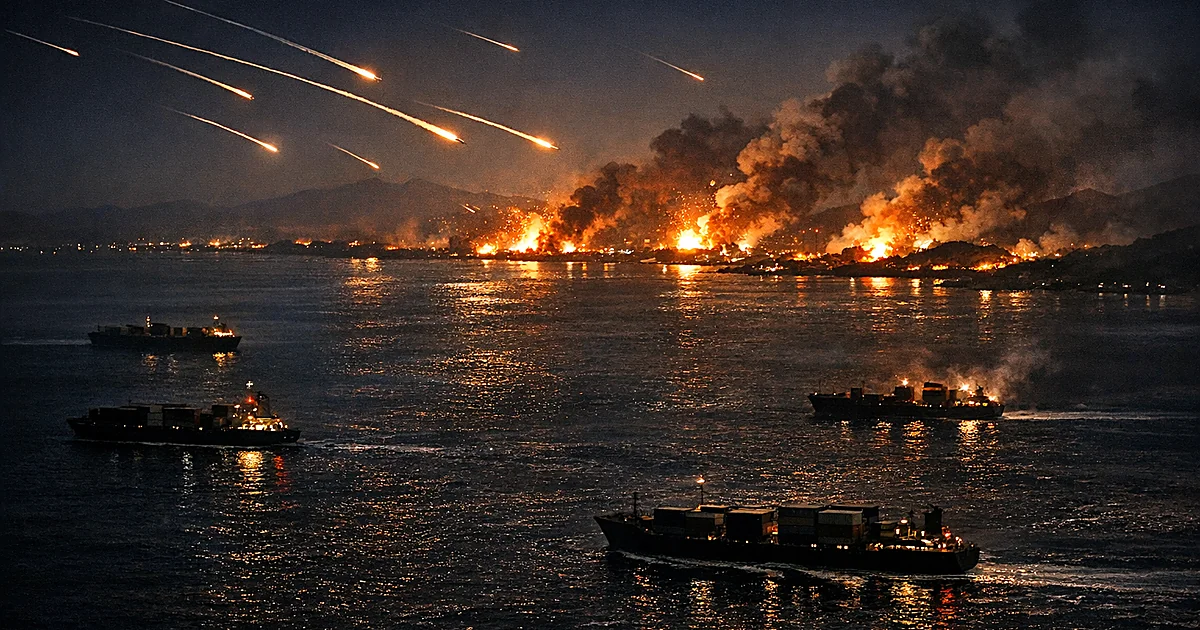
President Trump approved and ordered a broad strike on Iran’s Islamic Revolutionary Guard Corps while at the NATO summit in Ankara, responding to a series of attacks on commercial vessels in the Strait of Hormuz; U.S. Central Command reported hitting more than 80 targets, including over 60 IRGC small boats and multiple coastal and air defense sites.
President Trump gave the order for a large-scale military operation against the IRGC while attending the NATO summit in Ankara after three separate Iranian attacks on commercial shipping shattered a fragile ceasefire. The move came after days of failed diplomacy and renewed strikes on merchant vessels moving through one of the world’s most critical sea lanes. The administration characterized the action as a direct response to threats against innocent civilian mariners.
CENTCOM said U.S. forces struck more than 80 targets overnight using precision munitions, aiming at Iranian air defense systems, command-and-control networks, coastal radar sites, anti-ship missile capabilities, and more than 60 IRGC small boats in and near the strait. The list of systems targeted makes clear the operation was designed to degrade Tehran’s ability to harass international commerce. Those kinetic hits were paired with economic measures meant to squeeze Iran’s capacity to bankroll further provocations.
Diplomacy had been the first track. A memorandum of understanding signed on June 17 between the United States and Iran was supposed to reopen safe passage through the Hormuz corridor and set the table for nuclear talks. Negotiations in Doha produced no breakthrough, and subsequent attacks on commercial vessels left the administration with limited room to maneuver.
“US forces struck Iranian air defense systems, command and control networks, coastal radar sites, anti-ship missile capabilities, and more than 60 Islamic Revolutionary Guard Corps small boats in and near the strait to degrade Iran’s ability to continue attacking international commerce flowing through the international trade corridor.”
CENTCOM framed the strikes as intended to impose “heavy costs for targeting and attacking commercial shipping crewed by innocent civilians in an international waterway.” The command called Iran’s attacks on commercial vessels “unwarranted, dangerous, and a clear violation of the ceasefire.” At the time CENTCOM released its statement, casualty figures—American, Iranian, or civilian—were not available.
An unnamed U.S. official said it remained unclear how long the strikes would continue, adding, “We’ll get the assessment about the results of the strikes and make decisions after,” the official said. That line underscores the administration’s deliberate posture: act decisively, then evaluate. The open-ended nature of the response keeps diplomatic and military options on the table.
Reporting indicates President Trump approved the strike plan on July 7 while in Turkey. He met in Ankara with Defence Secretary Pete Hegseth, Secretary of State Marco Rubio, Treasury Secretary Scott Bessent, and Chairman of the Joint Chiefs of Staff Dan Caine, with Rubio and Bessent traveling aboard Air Force One. The presence of senior cabinet and military leaders speaks to the operation’s political and strategic calculation.
The strike decision followed a clear pattern of Iranian provocations. Tehran signed the June 17 MOU, then the IRGC struck commercial shipping in the Strait of Hormuz shortly after, and later attacks unfolded again over a two-day span. That sequence made the central question obvious: when does restraint become permissive?
The MOU was meant to restore safe passage through a crucial oil chokepoint and to open the door to further talks. A majority of voters backed Trump’s Iran agreement even as his overall approval numbers lagged, a political reality that helped justify pursuing both diplomacy and deterrence. But an agreement depends on both sides honoring their commitments, and Iranian actions showed they were not prepared to do that.
Shortly before the military response, the U.S. Treasury Department revoked sanctions waivers that had permitted Iran to sell oil, signaling the administration was done waiting for Tehran to change course. The combination of economic pressure and military force is the dual-track approach the administration believes will compel Tehran to stop jeopardizing global commerce.
Defence Secretary Hegseth was expected to travel to Israel to meet Prime Minister Benjamin Netanyahu and Defence Minister Israel Katz, a move that underlines the regional stakes. Discussions between U.S. and Israeli leaders often touch on force posture, arms sales, and the security implications of any U.S. moves in the eastern Mediterranean and Gulf. Moving from a NATO summit to consultations with America’s closest Middle Eastern ally illustrates how interconnected the strategy is.
Many details remain unknown: no public damage assessment has been released, the unnamed U.S. official who confirmed Trump’s approval has not been identified, and the specific commercial vessels attacked—names, flags, crew nationalities, and extent of damage—have not been detailed. Those gaps will matter for accountability, insurance claims, and any legal or diplomatic follow-ups. For now, the administration has sent a message that attacking civilian shipping has direct consequences.
The Strait of Hormuz carries roughly a fifth of the world’s oil supply, so attacks there are more than regional provocations; they threaten the global economy and the principle of open international shipping lanes. Markets reacted strongly in past episodes when strikes were canceled or called off, showing how tightly global finance and security are linked to events in the strait. The Treasury move to revoke oil-sale waivers further tightens the squeeze on Tehran’s revenue streams while the military pressure degrades its capability to strike again.
The administration’s line has been straightforward: the United States offered diplomacy, signed an agreement, pursued talks, and when Iran attacked civilian shipping the United States answered with force against military targets. That is not escalation for its own sake. That is the enforcement of a deal the other side chose to break.

