

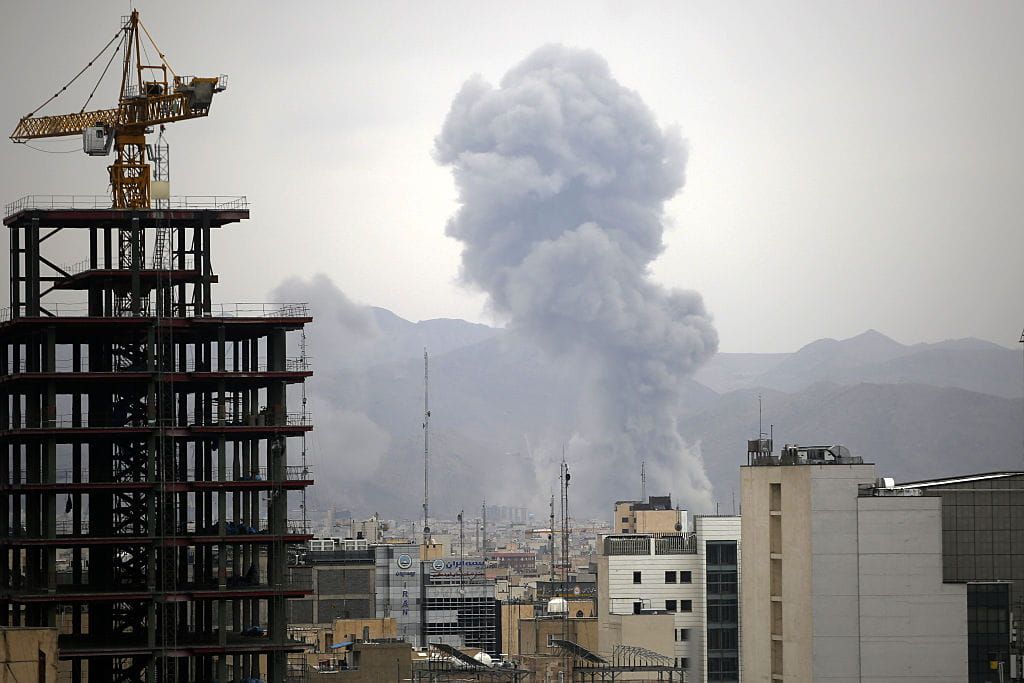
The ceasefire with Iran has collapsed and the United States has resumed air strikes after Tehran launched missiles, drones, and attacks on commercial shipping and regional bases, prompting a broad campaign against Iranian military and maritime capabilities and sparking additional, mysterious strikes whose origin remains uncertain.
The Biden era is over in this conflict; President Trump ordered US forces to restart strikes on Iranian military and infrastructure complexes after Tehran violated the truce. The resumption began on July 7 and rapidly escalated into two nights of concentrated bombardment aimed at degrading Iran’s ability to threaten shipping and regional partners. This is not mere posturing — the strikes were calibrated to blunt Iran’s capacity to harass vessels transiting the Strait of Hormuz.
Iran’s claim that it controls movement through the Strait of Hormuz was flatly rejected by US Central Command, which noted commercial traffic has continued under US protection. Since early May, United States forces helped facilitate the transit of more than 800 commercial vessels carrying about 380 million barrels of crude oil through the corridor. Tehran’s attempts to assert control included drone and projectile strikes on two crude oil tankers and one LNG vessel, plus attacks on US-aligned bases in Kuwait, Oman, and Bahrain.
Washington answered with significant force. Over July 7 and 8, US forces struck some 170 targets across Iran, hitting air defense systems, command-and-control networks, coastal radar sites, missile launchers, and anti-ship missile capabilities. Central Command said about 90 targets were hit on July 8 alone, with footage showing strikes on what appeared to be a runway and missile launchers. These blows were meant to further degrade Iran’s ability to threaten freedom of navigation through the strait.
“The U.S. military’s Central Command said it hit some 90 targets across Iran [on July 8], releasing black-and-white footage of what appeared to be strikes on an airport runway and missile launchers. The US says the strikes were intended to ‘further degrade’ Iran’s ability ‘to threaten freedom of navigation’ in the strait, through which a fifth of the world’s traded oil and natural gas passed before the war began with US and Israeli attacks on Feb. 28.”
One especially useful tactical result was the neutralization of more than 60 Islamic Revolutionary Guard Corps small boats patrolling near the strait. Those Boston Whaler–type craft are ideal for swarm attacks, mounting rockets, machine guns, anti-ship missiles, and even mines. Taking those platforms out reduces the immediate threat to commercial transits and to coalition ships operating in the area.
These strikes were more than tit-for-tat. The scale and scope went beyond proportional retaliation, signaling a willingness to impose sustained cost on Tehran. President Trump put it plainly in a Truth Social post: “This is in retribution for yesterday’s bombing of ships by Iran. If it happens again, it will get much worse!” That direct message reflects a posture that prioritizes deterrence and clear punishment for attacks on maritime commerce and partners.
After US officials announced the campaign had concluded, reports emerged of additional airstrikes of unknown origin striking targets inside Iran. Those mysterious hits raised questions about whether allied or third-party actors were also engaging Tehran. Iran then launched a wider volley of strikes across the Middle East, reporting strikes that touched Bahrain, Jordan, Kuwait, and Qatar, with at least one reported injury from those reprisals.
The collapse of the ceasefire leaves few easy diplomatic options. Iran has shown it will attack commercial shipping to assert influence and will strike regional partners when it perceives advantage. The United States has demonstrated willingness to strike back heavily, and the dynamic now risks further escalation if Tehran continues seizure tactics in the Hormuz corridor. At the recent NATO summit in Ankara, the president was blunt: “I don’t want to deal with them anymore — they’re scum. You know what scum is? They’re scum. They’re sick people. They’re led by sick people. And they’re vicious, violent people. And if they had a nuclear weapon, they’d use it. As far as I’m concerned, it’s over.”
That language is raw and intentional; it signals a policy choice to move from restraint to pressure. The operational aim is clear: deny Iran the tools to threaten freedom of navigation, protect allied bases, and raise the costs of further aggression. If Tehran persists in using drones, missiles, and small craft to menace shipping and partners, the United States has signaled it will respond decisively and at scale.

