

The National Museum of American History’s director, Dr. Anthea Hartig, faced a House Oversight subcommittee on July 21 over how the Smithsonian frames U.S. history, the presence of sexually explicit displays and materials, and the institution’s promotion of activist toolkits, all following the White House Domestic Policy Council’s July 4 report titled Saving America’s Story.
Dr. Anthea Hartig testified as lawmakers pressed the National Museum of American History about exhibit choices and messaging aimed at young visitors. The hearing, called “Rewriting American History: Examining the Smithsonian’s Efforts to Reshape the Past,” put museum curation and public trust squarely on the table.
The hearing was prompted by the White House Domestic Policy Council’s July 4 report, Saving America’s Story, which leveled a sharp charge against current leadership. That report concluded: “By the intention and at the direction of current Museum and Smithsonian leadership, NMAH has become subject to institutional capture by a radical, activist ideology that is fundamentally opposed to telling the noble, honest story of the great country we know and love.”
Representative Tim Burchett (R-TN) opened with a video montage of Hartig’s public remarks and asked pointed questions about land acknowledgments and displays. He noted Hartig’s repeated encouragement to audiences to “give thanks to the first peoples on whose land we’re honored to live, love, struggle, and work.”
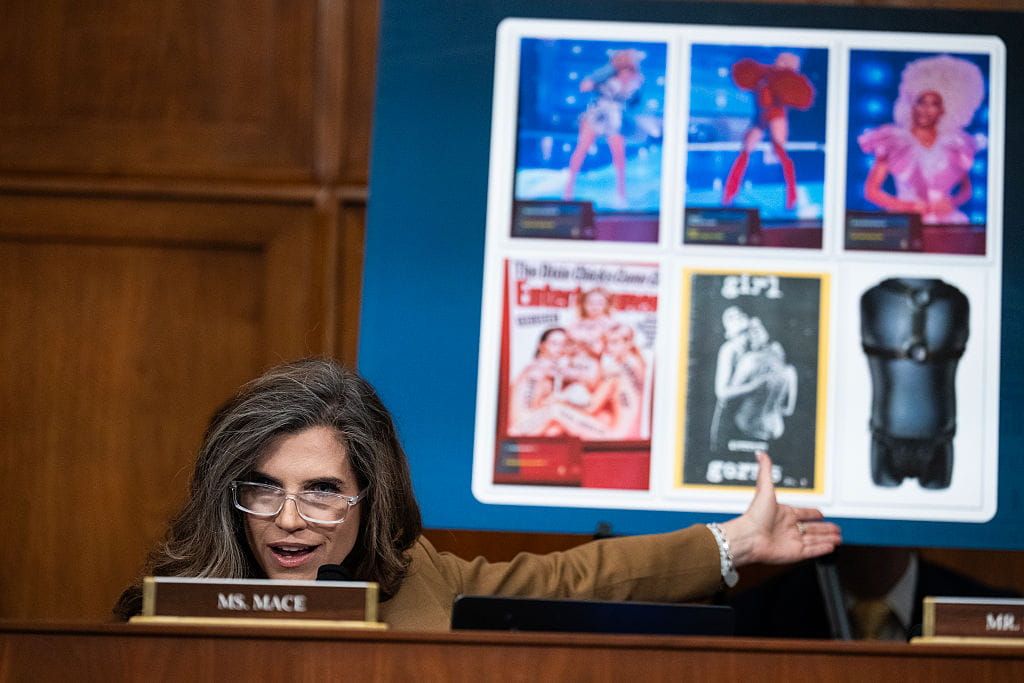
Burchett then pressed whether the museum’s displays were appropriate for children after citing a poster showing sexual images tied to an Entertainment Nation exhibit. He asked Hartig bluntly about content geared toward minors and insisted on an answer: “Do you really think that content is appropriate for children?” She declined to give a direct response despite multiple follow-ups.
Representative Michael Cloud (R-TX) pivoted to the museum’s sense of historical priority and literature stocked for young readers. When Hartig could not name a most influential book on American history, Cloud said, “The Founders quoted one book more than any other book. And that book would have been the Bible. Secondly would have been Common Sense by Thomas Paine.” He also highlighted a sexually explicit passage from George Takei’s It Rhymes With Takei that appeared in the children’s section of the museum bookstore and asked who authorized that placement.
Representative Nancy Mace (R-SC) confronted Hartig on provocative imagery and its message to children, citing BDSM visuals in an exhibit and demanding clarity about the museum’s intentions. Mace asked, “What kind of message are you trying to send to kids with BDSM imagery?” Hartig answered with a smile and said, “So, at the museum, we strive to represent and not categorize all Americans.”
Lawmakers also focused on the museum’s relationship with broader museum reform movements and resources labeled as toolkits. The American Alliance of Museums describes one such effort this way: “MASS Action — Museum as Site for Social Action — is a collaborative project that launched in 2016, centering on the question: How do you transform museums from the inside out? Through a series of public convenings and the creation of a toolkit of resources, the project’s intention is to share strategies and frameworks needed to align museums with more equitable and inclusive practices.”
“One of your goals is objectivity and your mass action toolkit references ‘objectivity’ as a defining characteristic of white supremacy culture’
“Hartig responded: ‘It’s not our toolkit.’
“Gill said: ‘It is your toolkit. You’ve been promoting it for quite some time.’”
Representative Brandon Gill (R-TX) raised concerns about whether the museum’s practices amount to promoting an ideology, asking bluntly, “Are you promoting a white supremacy culture at the Smithsonian?” Hartig denied the charge and pointed back to materials and partnerships when pressed.
Critics at the hearing warned that the Smithsonian’s narrative is shifting away from a traditional account of America toward ideologically driven frameworks. Dr. Matthew Spalding testified that current trends reflect “one defined by abstract post-modern theories that see history as nothing more than an oppressive power struggle and so uses history as a tool in that struggle to encourage social change … it shouldn’t be the rubric for a Smithsonian Museum.”
Heritage Foundation senior fellow Mike Gonzalez urged wholesale leadership changes, arguing reform under current managers would be ineffective. He said, “I don’t think trying to reform with present leadership is going to do anything … We only have to listen to what they say and look at the evidence of what they produced.”
The Smithsonian receives substantial federal support, with roughly 62% of its funding coming from annual congressional appropriations, federal grants, and contracts, and reports place the current federal appropriation at more than $1 billion. That level of taxpayer backing sharpened lawmakers’ impatience, as many demanded clearer answers about how public money is used for exhibits and programming aimed at children and whether those choices reflect objective stewardship of national history.

