

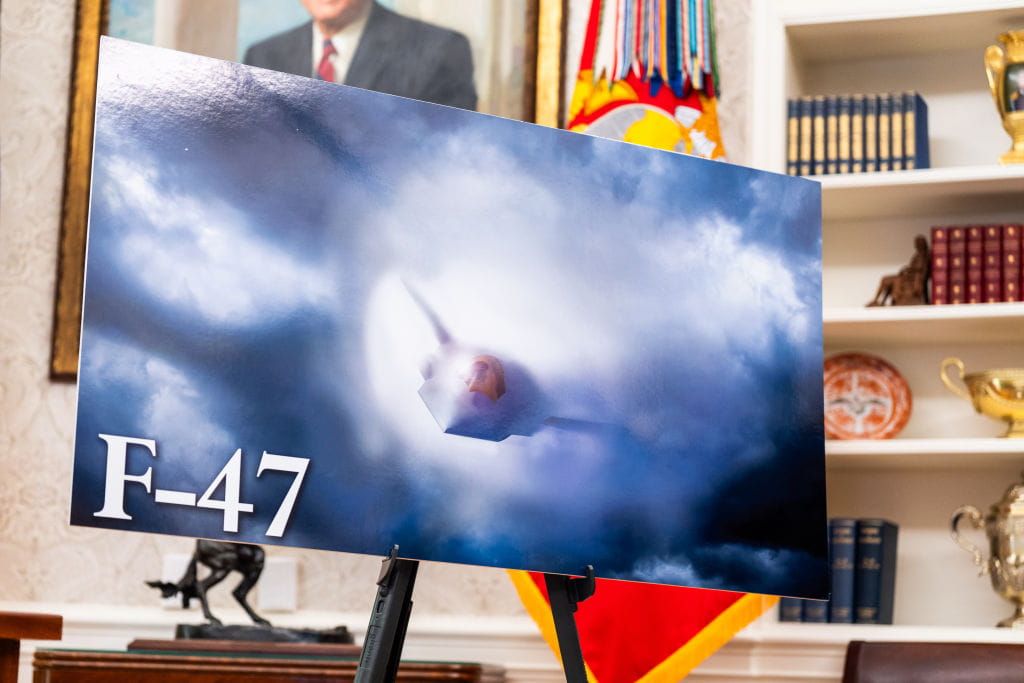
The Boeing F-47 program is moving quickly from design to production, with engineering and manufacturing development underway, funding ramping up, and a first flight targeted for 2028.
The F-47 is a crewed, sixth-generation fighter built to anchor the Next Generation Air Dominance family and eventually replace the F-22 Raptor fleet. Its design emphasizes long-range reach, advanced stealth, and the ability to operate in highly contested airspaces against peer competitors. Development has been pushed hard to field capability much faster than prior fighter programs.
Boeing won the engineering and development contract for the F-47 on March 21, 2025, and the first airframe is now under construction at Boeing’s St. Louis plant. Program leadership has stressed rapid acquisition and close industry cooperation, and public comments from senior officials have reflected that urgency. Coverage of General Dale White’s remarks included the exact language: “by ‘extreme teaming’ with industry partners; the F-47 program has entered its engineering and manufacturing development phase with unprecedented maturity. ‘The F-47 will fly in this administration,’ White declared.”
Congressional and program budget documents show clearly ramping investment to match that tempo, with developmental funding reported as $2.3 billion in FY2025, $3.4 billion in FY2026, and $5.0 billion in FY2027. Spending is projected to peak near $5.25 billion in FY2028 before tapering as the effort shifts from development into production and sustainment. Program planners estimate an F-47 unit cost near $300 million based on a modeling figure for a fleet of 185 aircraft at a total program cost of $55 billion.
Part of the speed comes from early technology work completed under DARPA and Air Force coordination during 2019–2020, which produced multiple X-planes and experimental prototypes. Those demonstrators reduced technical risk and compressed a development timeline that otherwise would have taken many more years. With first flight projected in 2028 and a contract awarded in 2025, the F-47 schedule is significantly faster than the timelines for the F-22 or F-35 programs.
Design choices reflect anticipated Pacific theater demands, where long distances and logistics will drive requirements. The F-47 is reported to have a combat radius greater than 1,000 nautical miles, roughly twice the F-22’s range, and that reach can be extended with aerial refueling. Endurance and range were prioritized to allow crewed platforms to operate from distant bases while maintaining a robust presence over contested areas.
The F-47 is intended to operate as the crewed center of a distributed force that includes Collaborative Combat Aircraft, semi-autonomous unmanned systems meant to fly ahead and expand the battlespace. CCA concepts emphasize lower cost and expendability with extended standoff ranges; the CCA design goal is a range of 700+ nautical miles. Reports have noted the service “plans to acquire more than 1,000 of them,” to provide mass and depth to future air operations.
Operational concepts picture the F-47 as a command node coordinating sensors, weapons, and unmanned teammates — a kind of “mother hen and her lethal chicks” approach that multiplies force effect. Initial operational estimates for both the crewed F-47 and its CCA companions cluster around 2029, reflecting parallel development and fielding timelines. The Air Force has also described the F-47’s signature as “stealth++,” indicating improvements over previous fighters in reducing detection and increasing survivability.
The program’s combination of range, stealth, networking, and manned-unmanned teaming aims to deliver persistent, long-range air dominance at an intensity current fighters cannot sustain. Production activity has already begun, and the schedule to first flight in 2028, if met, will show how compressing early risk and concentrating resources changes acquisition results. How well the program executes beyond initial milestones will shape whether the United States retains an edge against peer competitors in demanding, high-end conflicts.
~
The views expressed are those of the author and not of any other affiliate.

