

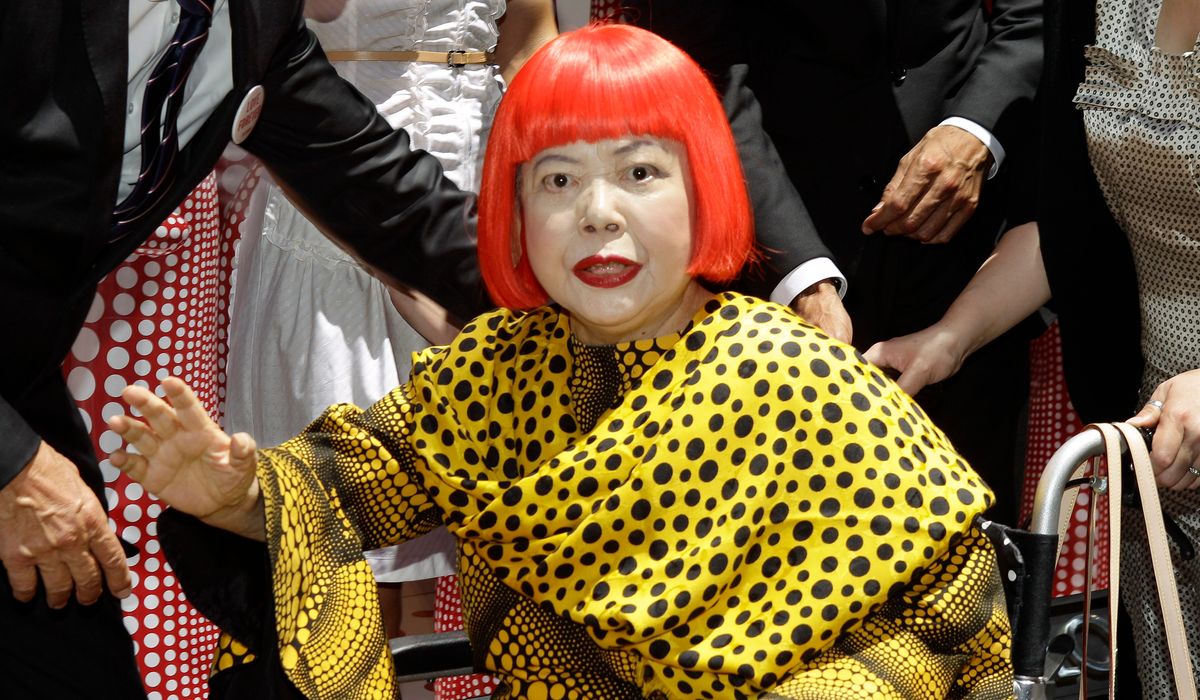
Japanese artist Yayoi Kusama, who splashed her signature polka dots on paintings, sculptures and museum installations around the world, has died, her studio said Thursday. She was 97. Her work reshaped how museums and the public think about scale, spectacle and the language of repetition.
Yayoi Kusama built a practice out of obsessive repetition and bold patterning, using polka dots and mirrored spaces to invite viewers into immersive experiences that felt equal parts intimate and vast. Her installations often removed the usual distance between artwork and audience, turning museums into environments that absorbed visitors rather than simply displayed objects. Across decades she worked in multiple media — painting, sculpture and room-scale installations — keeping a recognizable visual vocabulary while experimenting with new materials and formats.
The polka dot motif became a global signature, showing up on canvases, sculpted forms and expansive installations that traveled to major cultural institutions and public spaces. Kusama’s Infinity Mirror Rooms in particular became cultural moments, drawing long lines and widespread attention and turning simple optical ideas into viral phenomena. That attention helped shift how museums programmed contemporary art and how the public engaged with large-scale installation work.
Critics and fans pointed to the emotional intensity behind the surface fun of dots and mirrors, seeing in her repetition a serious investigation of perception, memory and identity. Her work has often been read through themes of obsession and dissolution of the self, with repetition functioning as both method and metaphor. Those readings gave Kusama a distinct position in the history of postwar art, balancing accessible visual strategies with deeper, sometimes unsettling, psychological stakes.
Kusama’s reach extended beyond museums into fashion, design and popular culture, where her motifs were adopted in collaborations and public projects that amplified her visibility to new audiences. Those partnerships made her imagery ubiquitous in city spaces, product design and exhibition merchandising, broadening the public’s relationship to contemporary art. This broader exposure did not dilute the core of her practice, which remained focused on controlled repetition, sensory overload and the transformation of space.
Throughout her long career Kusama navigated the gallery system, museum retrospectives and blockbuster shows that introduced her to generations who had not encountered her work before. Major exhibitions often emphasized the experiential side of her art, inviting visitors to move, reflect and sometimes become part of the installation themselves. That democratic element — art that asked you to step in rather than stand back — was a key reason her projects attracted both serious collectors and casual museumgoers.
Her sculptural objects and room installations also prompted institutional conversations about how to display, conserve and interpret immersive contemporary work, because these pieces demand different approaches than static paintings. Curators developed new protocols for crowd flow, lighting and maintenance to preserve fragile elements while keeping the visitor experience intact. Museums that staged Kusama projects learned to balance accessibility with preservation, a challenge that has become central to exhibiting contemporary installation art.
Collectors and auction houses took notice as well, and Kusama’s presence in the secondary market reflected a growing appetite for work that combined strong visual identity with experiential appeal. Market attention often translated into expanded museum programming and more touring exhibitions, which in turn introduced her work to wider and more diverse audiences. That cycle between institutional exposure and market interest helped cement Kusama’s place in both public memory and the art ecosystem.
Artists and younger practitioners often cite her as an influence for how she made pattern, repetition and scale part of a personal language that could be deployed across media without losing coherence. Her approach showed that a single motif, handled persistently and inventively, could support a whole career and a wide range of projects. That lesson has resonated with creators who want to build recognizable practices that also allow for experimentation.
Public reaction to her death has been immediate in museums, galleries and on social platforms, where images of her work serve as shorthand for a moment in late 20th and early 21st century art when spectacle and intimacy collided. Institutions that house her work will continue to show and study pieces that provoked new thinking about space and audience participation. Her artistic language — whether described as playful, confrontational or meditative — will remain part of how contemporary art talks to the public and to itself.

