

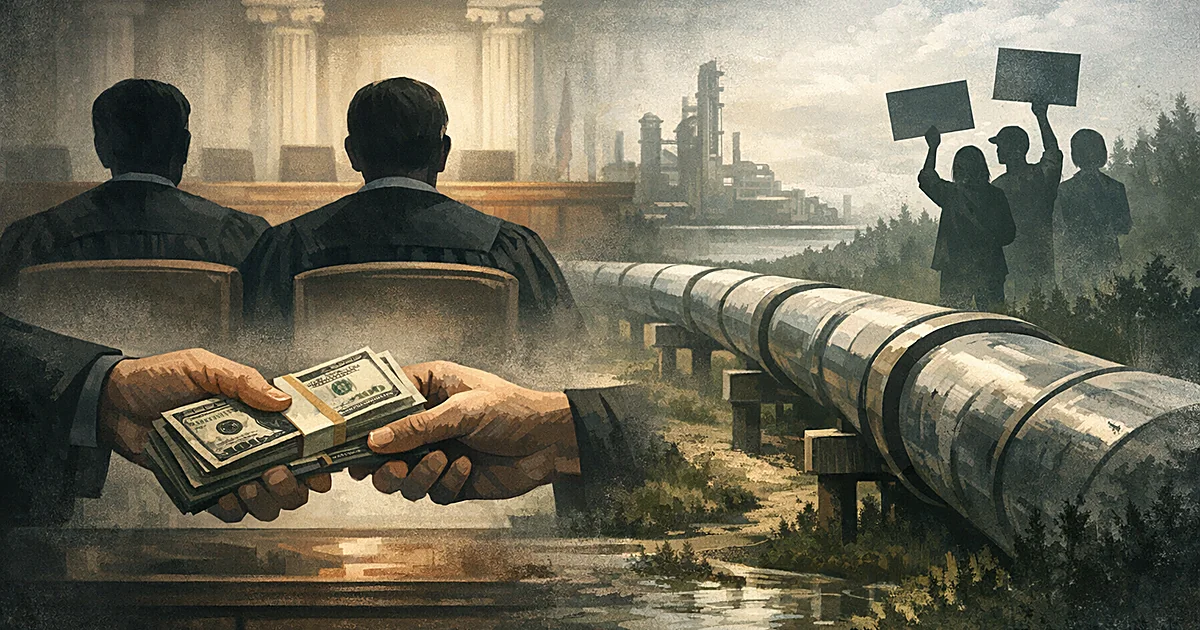
Two Michigan Supreme Court justices received $5,000 donations from the Jane Fonda Climate PAC weeks before joining a majority decision that vacated approval for Enbridge’s Line 5 tunnel project, raising questions about outside political influence on judicial rulings.
The timeline is simple and sharp: the PAC gave $5,000 each to Chief Justice Megan Cavanagh and Justice Noah Hood about six weeks before the court’s July 31 decision that sent the Line 5 tunnel approval back to the Michigan Public Service Commission. That ruling vacated the Commission’s December 2023 sign-off and ordered a renewed environmental review, pausing a high-profile energy project in the Great Lakes region. The donations and the vote happened close enough that watchdogs and energy supporters see cause for concern about impartiality.
Federal campaign-finance filings show the PAC’s contributions arrived while both justices were running for full terms this November, and the group publicly endorsed their campaigns. The Michigan League of Conservation Voters also publicly backed them and praised their “strong commitment” to issues including rights, resources, environment and democracy. The PAC, the justices, and those endorsements have been publicly noted even as official comment remained scarce.
Enbridge’s plan targeted a four-mile relocation of Line 5 into a concrete-lined tunnel beneath the Straits of Mackinac, part of a 645-mile pipeline network that delivers roughly 540,000 barrels of oil per day. Enbridge and supporters say the tunnel would improve safety and secure energy deliveries, while opponents argue the move doesn’t eliminate risk to the Great Lakes. The Michigan Supreme Court focused on what it called an insufficient environmental review and sent the permitting decision back to regulators.
That mix of cash, endorsements, and a consequential ruling drew immediate pushback from conservative groups and energy advocates. Critics argue the sequence looks like political dollars nudging judicial outcomes on cases that have major economic consequences. Attorney Jason Torchinsky of the Patriots Foundation framed the spending bluntly as “one more tool the anti-energy left is using to go after anybody that wants to provide low-cost energy to Americans.”
The Jane Fonda Climate PAC has been active across Michigan this cycle, with federal records showing roughly $81,000 in contributions to state candidates. Among the reported recipients are Democratic attorney general nominee Eli Savit at $12,500 and multiple state and federal candidates receiving $5,000 each, including the contributions to Cavanagh and Hood. That pattern fits a strategy of targeting elections where legal and regulatory outcomes matter to climate activists.
Jane Fonda herself has been vocal against Line 5 and publicly supportive of Democratic leaders in Michigan, while environmental groups have pursued the pipeline in court and at the ballot box. Attorney General Dana Nessel brought a 2019 suit against Enbridge and characterized the pipeline as an “unacceptable risk.” Those legal and political moves have kept Line 5 in the spotlight for years and made the issue a flashpoint in the state’s broader energy debate.
The pipeline’s history includes incidents that feed the controversy: a major rupture on a different Enbridge line in 2010 and an anchor strike that damaged infrastructure in 2018. Regulators in 2023 approved a new 30-inch line inside a tunnel 60 to 370 feet beneath the lakebed, pitching it as a way to lower environmental risk while keeping energy flowing. Still, the conflict over easements, shutdowns, and court fights has made any technical fix politically charged.
Governor Gretchen Whitmer’s administration moved in 2020 to revoke the easement that allowed Line 5 to cross the Straits, while Nessel’s litigation sought permanent decommissioning. A federal court blocked Michigan’s shutdown push in December 2025, citing federal pipeline-safety law and concerns about international energy supply, and the U.S. Supreme Court later ruled Enbridge had waited too long to shift the dispute to federal court. Those procedural moves have shuffled the case between federal and state venues as the legal fight continues.
The Michigan Supreme Court’s recent decision adds another layer of delay and uncertainty, and it fuels a broader argument from conservatives that judicial races infused with ideological money risk eroding public trust. Watchdogs and transparency groups are demanding clearer lines between campaign spending and judicial behavior, arguing that the appearance of influence is damaging even if no direct quid pro quo is proven. Silence from the justices and the PAC on whether donations affected votes only stiffens those concerns.
Neither Justice Cavanagh nor Justice Hood answered requests about whether the PAC contributions played any role in their participation or votes, and the PAC did not comment. That quiet leaves the public to weigh the optics alongside the legal rationale offered by the court, and it invites deeper scrutiny of how political money flows into judicial contests that decide infrastructure and energy policy. For many voters and industry stakeholders, the episode underlines a worry that rulings may reflect political pressure as much as neutral law.
The Line 5 fight sits at the crossroads of environmental activism, energy security, and the politicization of courts, and it shows how contested infrastructure decisions can become proxy battles for larger ideological fights. As candidates and judges continue to operate in an era of heavy outside spending and targeted endorsements, the pressure on institutions to prove they remain evenhanded only grows. When political cash meets courtroom power, confidence in fair outcomes is what’s most at stake for everyday Americans relying on affordable energy.

