

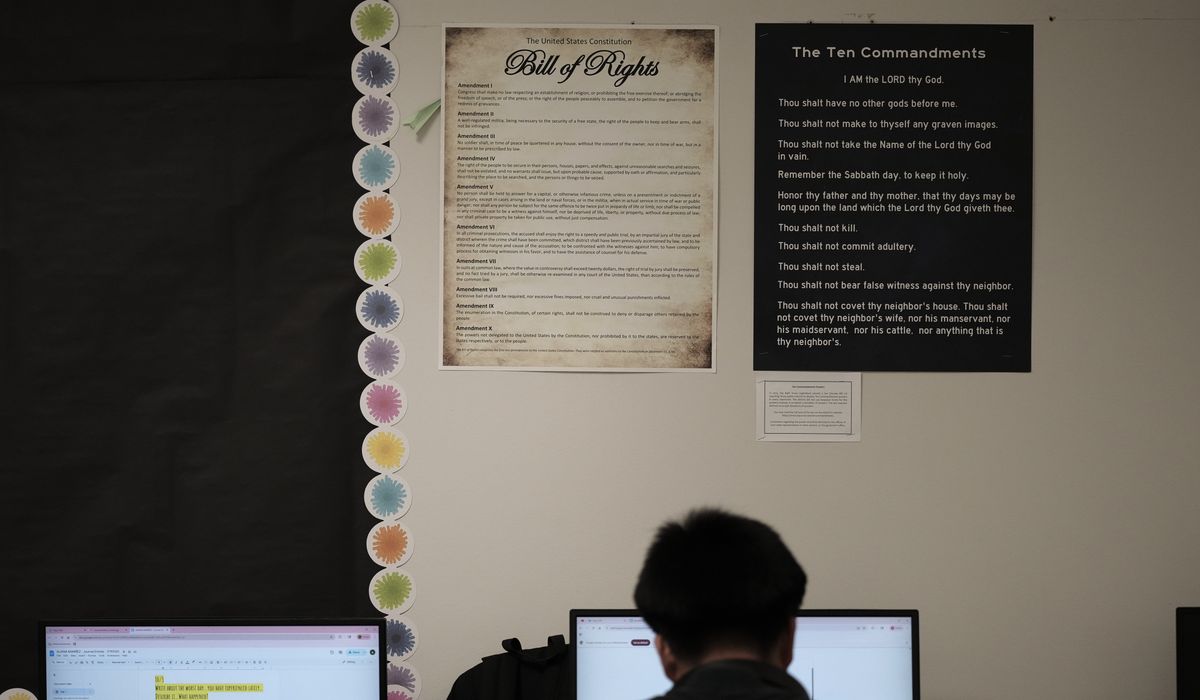
Texas’s law requiring public schools to have a copy of the Ten Commandments posted in classrooms does not violate the Constitution, a federal appeals court ruled, and this decision spotlights questions about religious liberty, judicial restraint, and local control over education.
The court’s ruling affirms a simple proposition: schools can display a historical and moral document without automatically crossing a constitutional line. From a Republican view, this is a win for common sense and a check on federal courts that too quickly erase public life’s moral foundations. The decision lets local communities decide what belongs on classroom walls instead of letting distant judges impose one-size-fits-all rules.
Supporters argue the Ten Commandments have deep historical influence on Western legal traditions and public morals, so acknowledging that legacy is appropriate in a public school setting. Critics see any posting as government endorsement of religion, but the appeals court pushed back against that broad interpretation. The ruling reflects a narrower test that distinguishes acknowledgement from coercion, a distinction Republicans have long defended.
Parents and teachers in many districts welcomed the clarity, saying it restores balance in schools that have felt pressured to remove any reference to religious history. Schools are places for learning about the roots of our laws, and displaying the Ten Commandments can be framed as educational context rather than devotional practice. Republicans argue this approach respects both free exercise and free exercise limits by avoiding forced religious activity.
Judicial restraint matters here because courts should not automatically substitute their own views for local judgment calls about education and community standards. The appeals court’s decision signals a willingness to interpret the Constitution in a way that preserves space for religion in public life. That position responds to years of decisions that many conservatives saw as unnecessarily hostile to faith traditions visible in civic life.
Practical concerns also factored into the debate, including how schools present the document and what accompanies it to make clear the posting is instructional. Reasonable presentation policies can reduce claims of endorsement while still allowing acknowledgment of historical influence. Republicans favor policies that protect religious expression without compelling belief, keeping the focus on context and clarity.
Opponents warned the ruling could open doors to more religious displays in classrooms beyond the Ten Commandments, urging caution about where to draw the line. The appeals court, however, emphasized limits and context, not blanket permission for all religious symbols. That measured stance matches a conservative emphasis on principled boundaries rather than unchecked expansion.
Lawmakers in some states reacted by considering or reaffirming similar measures to protect displays that reflect cultural and legal heritage. These moves are consistent with a larger Republican agenda to return education decisions to parents and local boards. Advocates say this shifts power away from unelected judges and back to communities who live with the consequences of those choices.
Ultimately, the decision is about balance: preserving religious freedom and historical recognition without coercion, and keeping judges from micromanaging local schooling. For Republicans, the ruling favors common-sense governance, parental authority, and a modest role for courts. The result leaves room for schools to teach history honestly while protecting students from compelled religious practice.

