

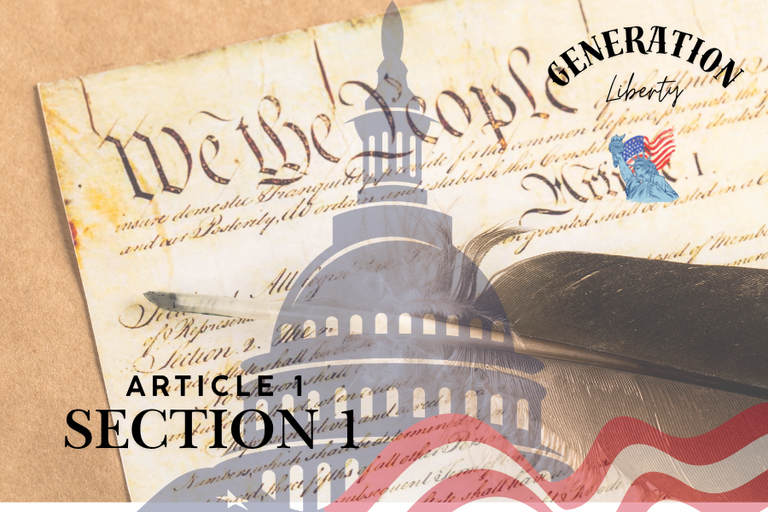
A clear look at Article I, Section 1 and what it does for congressional power, why it matters in practice, and how it shapes the balance between lawmakers and the executive.
Digging deep into the Founding documents helps us see how the Constitution assigns roles and limits authority. This piece traces the simple but powerful language that establishes who gets to make federal law and why that matters for stability and accountability. The date associated with this discussion is Jul 16, 2026, a reminder that these lines remain central to modern debates about governance.
Article. I. Section. 1. reads as a compact declaration of responsibility in the federal government. It uses plain language to say where legislative power belongs, and that clarity was intentional from the start. The framers meant to identify a definite body with the authority to write statutes for the United States.
All legislative Powers herein granted shall be vested in a Congress of the United States, which shall consist of a Senate and House of Representatives.
That quoted sentence is the heart of the Legislative Vesting Clause, and it names Congress as the institution entrusted with federal lawmaking. The clause also specifies the structure Congress must have: two chambers, the Senate and the House of Representatives, each with distinct roles and procedures. By design, that bicameral arrangement forces deliberation and compromise before a measure becomes law.
In practice, laws passed by both chambers have more permanence than something issued by a single president acting alone. Presidential actions, such as executive orders, can be reversed by later administrations or struck down by courts when they exceed statutory or constitutional bounds. Statutes that survive the full legislative process carry the weight of collective judgment and typically require another Congress and president to undo them.
The clause is often called the Legislative Vesting Clause because it vests, or assigns, legislative authority in a defined body rather than dispersing it across branches. That placement matters for separation of powers: when Congress writes laws, executives implement them and courts interpret them, but the starting point for policy creation remains the legislature. This arrangement was intended to check impulses toward unilateral rule and to anchor national policy in representative institutions.
Scholars and judges have long debated how broadly “legislative Powers” should be read, and those arguments shape everyday governance from regulation to funding. Courts sometimes step in when an action looks like lawmaking but lacks congressional authorization, while Congress can also choose to delegate certain tasks to agencies when it provides an intelligible principle. Still, the baseline stays the same: Congress holds the primary authority to make binding national rules.
Understanding Article I, Section 1 is useful not just for scholars but for any citizen who wants to follow policy fights and legal skirmishes. When disputes erupt over who gets to decide—Congress, the president, or independent bodies—the text of this clause is a first stop for clarifying where power was placed. It remains a short passage with long implications for how our system operates and how change is constructed within it.

