


Cory Mills’ Bronze Star Under Scrutiny as GOP Voices Demand Clarity
Rep. Cory Mills is back in a storm of questions about his military record, and this time the friction is coming from inside his own party. Colleagues say documents and timelines don’t line up, and a fellow Republican has directly challenged the authenticity of the Bronze Star claim. The debate is now as much about evidence as it is about reputation.
Mills has repeatedly highlighted his service as a reason he belongs in Congress, and some campaign materials even declared, “Cory Mills is a decorated U.S. Army combat Veteran, and recipient of the Bronze Star,” which helped shape his public image. That line has been repeated in interviews and bios, and supporters point to it as a sign of his service. Critics counter that claims need clear, verifiable records.
This might be my favorite Cory Mills stolen valor quote yet:
“I guess you don’t care I got a TBI” – Cory
“You got a TBI????”
“Well, actually, no.” – Cory pic.twitter.com/K7dj0vTmMI— Rep. Nancy Mace (@RepNancyMace) September 22, 2025
Allegations have hardened into accusations, with one GOP colleague saying Mills engaged in “,” a charge others who served with him have also voiced. Those accusations have pushed a debate about verification and standards for public servants who lean heavily on their military histories. For Republicans who value both patriotism and integrity, the fault lines are obvious and uncomfortable.
As recently as , Mills repeated the “Bronze Star recipient” boast, keeping the claim central to his identity. That recurrence has frustrated skeptics who want the paperwork or an authoritative confirmation. When a claim becomes central to a brand, any gap in documentation becomes a political liability.
‘All this could be put to bed with real, verified documents, and he doesn’t have them or refuses to share them.’
What the records and recordings show
Questions focus on a DA Form 638 that surfaced online, the official paperwork used to recommend someone for a Bronze Star. The form circulated showing a recommendation for Mills tied to Operation Iraqi Freedom and bearing what appears to be a signature attributed to now-retired Brig. Gen. Arnold Bray.
Representative Nancy Mace has publicly stated that the form was completed and signed by someone other than Gen. Bray, a claim that escalated the story beyond gossip. On a recorded call, a man identifying himself as Bray said he had authorized the award via an email to a staff member and that he did not personally sign the document, but would treat his email as authorization.
“I spoke to General Bray over the weekend,” Mace told hosts Matthew Peterson and Jill Savage. “… Well, come to find out the general whose name is on that form didn’t even sign it and didn’t actually see the document before his signature was placed on it.”
The recording reportedly backs up Bray’s account that the form was incomplete when he saw it and that his approval was given by email to a woman he thought was a Mills staffer. That detail raises plain questions about how the signature landed where it did and whether standard processes were followed. A visible signature still appears on the circulated form, even as the man who authorized it says he did not sign it himself.
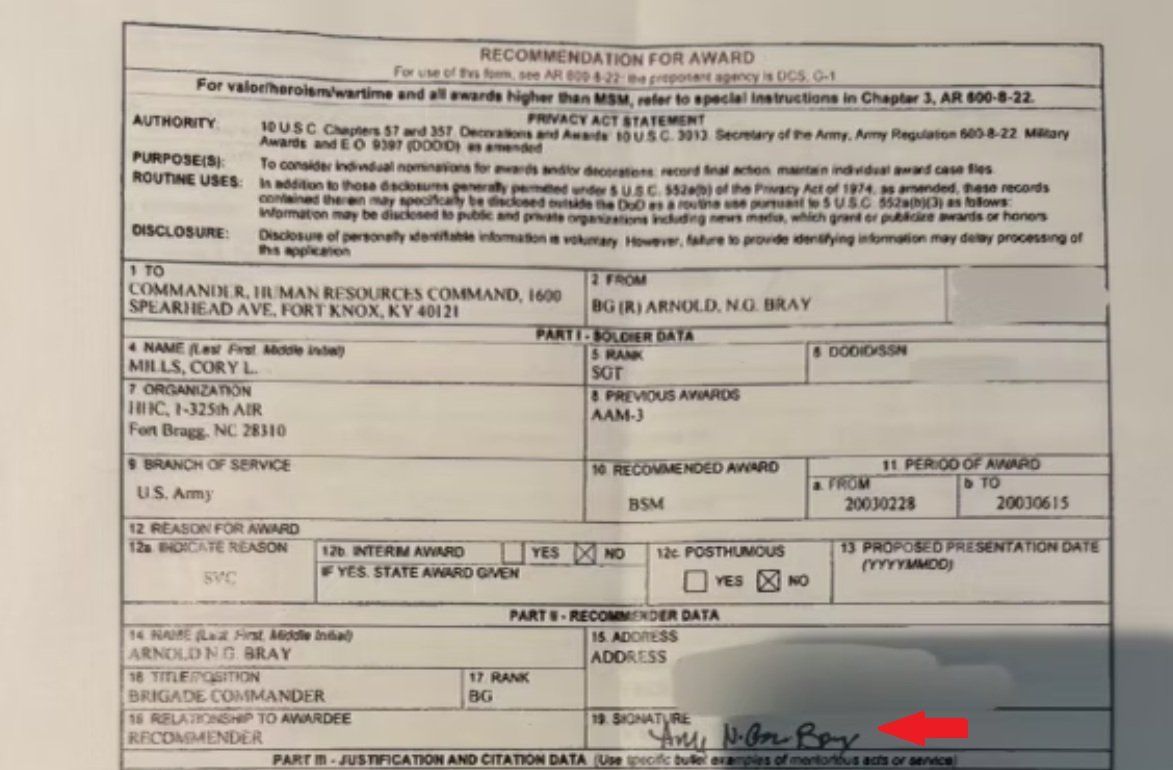
Screenshot of corymillswatch.com
Another wrinkle is the paperwork itself: the DA Form referenced was issued in an April 2021 version even though the award is claimed for service in Iraq from February to June 2003. That gap in timing is not typical for routine records and has led to confusion about whether the Bronze Star was an upgrade, a late recognition, or something else entirely.
Mace, who says she is not a veteran, explained that upgrades happen but usually with clear new evidence or witnesses that justify changing an award years later. She stressed that suddenly moving someone from no award to a Bronze Star decades after the fact is unusual unless it’s an upgrade scenario with a clear paper trail. Republicans who want to protect veterans’ honors see a need for paperwork that answers these exact questions.
It also matters which Bronze Star is being claimed. A Bronze Star with a valor device recognizes conspicuous bravery in combat, while a Bronze Star for merit recognizes commendable service without the valor distinction. Sources told reporters that Bray emphasized the award he authorized for Mills was for merit and did not include a valor device, and that he recommended Bronze Stars for multiple platoon sergeants.

Tom Williams/CQ-Roll Call Inc. via Getty Images
The dispute has fed into a broader narrative about Mills that includes other allegations about behavior and judgment, some of which have been bandied about in conservative circles and media. Mace has argued that a pattern of exaggeration or misrepresentation makes him a liability, especially given his committee assignments that touch on foreign policy and defense. For Republicans, the stakes are not just personal; they are about trust in those who represent national security interests.
Mace was blunt about the political consequences, saying the negative press and alleged behavior could put Mills’ seat at risk. She warned that accusations of questionable dealings and unverified claims of valor complicate how the party should handle a member who sits on sensitive committees. The GOP faces a choice between defending a colleague and demanding a full accounting that restores public confidence.
Supporters of Mills insist inquiries should be fair and rooted in facts, not headlines, while critics insist fairness requires transparency and documents. That tension underlies much of the debate: give a benefit of the doubt until proven wrong, or insist on immediate proof before accepting a public claim. Either way, Republicans who care about both national defense and accountability want the same thing: clarity.
Mills’ spokesperson did not respond to a request for comment, leaving the record and the claims to speak loudly in the interim. At this point, answers from the congressman and clear military records would cut through the noise faster than partisan back-and-forth. For now, the party and the public are watching how a mix of old paperwork and new recordings will shape a lawmaker’s profile and the GOP’s internal handling of contested military claims.

