

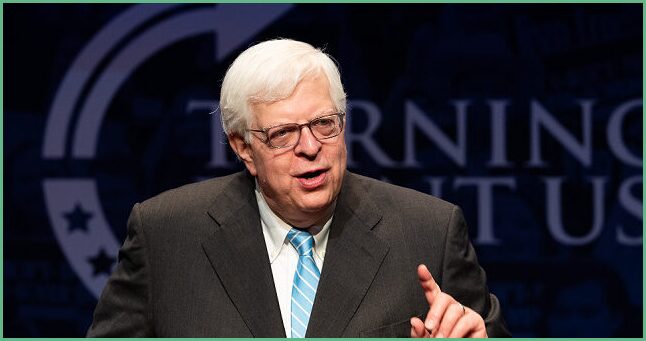
Dennis Prager made his first on-camera appearance since the November 2024 injury, and he said he is “thrilled to be alive.” His short statement was calm and unvarnished, the kind of clarity people expect from a lifetime of speaking plainly. There was an immediate sense of relief among listeners who have followed him for decades.
<p”He has always spoken a language conservatives understand,” is how many longtime supporters put it, and his return only reinforced that. He did not offer a political sermon in that first sighting, but his presence alone felt like a reminder that ideas outlast setbacks. Conservatives value resilience, and Prager’s composure illustrated that point vividly.
Prager also shared that he had been, for years, “philosophically prepared” for “this terrible thing that I have encountered.” Those words landed like a testament, not a lament, and they invite reflection on how ideology shapes our response to crisis. For many on the right, this was a teachable moment about the importance of thinking ahead and holding fast to principles.
The reaction from conservative media and listeners was immediate and heartfelt. Callers, colleagues, and fellow commentators praised his courage and the example he set by facing a difficult situation with frankness. Rather than turning inward, his appearance galvanized support and conversation about big ideas.
Prager’s message also nodded to a broader Republican theme: take responsibility and meet hardship with a sound mind. His public composure aligns with a worldview that prizes self-reliance and moral clarity. That tone resonates with an audience tired of spin and snark.
In his brief camera time he did not dwell on medical minutiae or personal pity, and that was intentional. He focused instead on gratitude and purpose, two words that carry weight in conservative circles. Americans of all stripes respect someone who turns pain into a platform for meaning.
There is a lesson here about how conservatives handle public suffering differently. Where other voices might dramatize every development for attention, Prager put emphasis on conviction and continuity. That steadiness is a message conservatives can amplify when cultural chaos threatens to overwhelm debate.
Political opponents will chronicle his medical journey and debate its causes, but Prager’s own framing cut through that noise. He offered a spiritual and philosophical lens, which sidesteps partisan point-scoring and points toward human dignity. For the conservative base, that was refreshing and strategically sound.
Supporters also noted that Prager’s approach helps preserve his intellectual legacy. He remains, in many minds, more than a radio host; he is a teacher and a steward of certain ideas about liberty, faith, and responsibility. A dignified comeback only solidifies that role.
At the same time, the moment stirred conversation about the fragility of public voices in a media economy that rewards sensation. Prager’s calm return was a corrective to the epidemic of outrage-driven coverage that defines so much of modern news. It showed that seriousness still matters.
Friends and listeners reported relief but also a renewed sense of purpose. Many promised to tune in more consistently, contribute to causes he champions, and defend the ideas he articulates. That mobilization is a familiar pattern in conservative activism: a rally around principles when a leading voice is tested.
Beyond politics, there is a human story of support and love from family and colleagues that surfaced around his recovery. Those private networks matter as much as public applause, and they reflect values conservatives often foreground. Community and responsibility are not abstract terms when someone you respect faces hardship.
The episode also highlights an underappreciated conservative strength: endurance under pressure. Ideas that endure are not those that survive headlines but those that sustain people in the hard times between them. Prager’s composure modeled that endurance in real time.
Media reactions varied, but many conservative outlets focused on the bigger picture he offered. They emphasized the combination of gratitude, philosophical readiness, and refusal to be defined by injury alone. In a crowded information environment, that clarity was valuable political communication.
There is a practical takeaway for conservatives who want to influence culture and politics: maintain credibility by habitually practicing what you preach. Prager’s return made that instruction immediate and memorable. Living your philosophy is a stronger political move than empty rhetoric.
Critics will always dissect moments like this for inconsistencies, but the core takeaway remains simple and strong. A public figure who survives trauma and speaks plainly about it earns trust from those who share his worldview. That trust translates into influence, donations, and a steady audience.
Prager’s appearance was short but effective, a reminder that conservative voices can recover from hardship without losing their edge. He presented a model for how to face suffering with thoughtfulness rather than spectacle. For those who value conviction and clarity, it was a welcome homecoming.

