

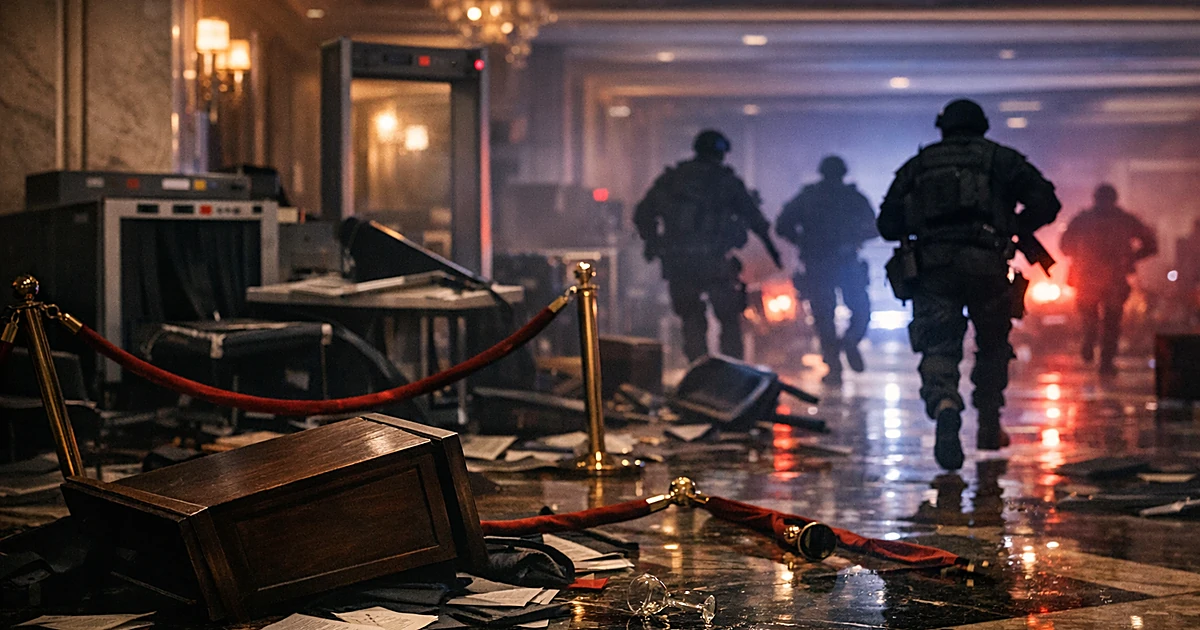
President Trump and other officials were rushed out of a Washington Hilton ballroom after a gunman breached a checkpoint at the White House Correspondents’ Association dinner, prompting House Speaker Mike Johnson to publicly demand tougher Secret Service screening and signaling that Congress will press for answers while the White House defends the agents’ rapid response.
The breach at a ticketed black-tie event sent a shock through Washington when a suspect made it past a checkpoint and moved toward the main ballroom before law enforcement stopped him. Shots were reportedly fired near a security screening area and at least one officer was struck in a bullet-resistant vest but is expected to recover. The president and vice president were not harmed, but the incident exposed a gap between perimeter screening and rapid response.
Speaker Mike Johnson, who attended the dinner, did not mince words on what he saw and heard about how guests were processed at the venue. He noted that senior officials, including himself, entered through a separate back entrance with dedicated security teams, so his firsthand experience of the front-of-house screening was limited. Still, what he learned from others at the scene convinced him the initial screening failed to meet the standard expected when the president is present.
“From a layman’s perspective, it looked a little lax in terms of getting into the building. I didn’t see the magnetometers, but it doesn’t sound like it was sufficient.”
Johnson’s criticism carries weight because he controls the chamber’s oversight authority and budget leverage in Congress, and he signaled that investigators on Capitol Hill will take a close look. He made clear that Congress should not be passive and that the Secret Service leadership needs to reassess protocols. His stance frames this as a systemic problem rather than a one-off mistake that can be smoothed over with talking points.
“We’ll do what we can in Congress, but we need leaders of the Secret Service to tighten up and reevaluate these things.”
When pressed about whether criticism was warranted, Johnson offered a blunt assessment: “That critique is right,” he said. That kind of direct language from a Republican leader signals a readiness to push for hearings and accountability, not just press releases. For Johnson, this is less about political theater and more about preventing the next breach before it happens.
The White House offered a different but compatible view, praising the agents who secured the president and vice president and neutralized the shooter. Karoline Leavitt, the White House press secretary, emphasized that the response teams communicated and acted quickly to move officials to safety and stop the threat. That distinction matters: a strong response after an incident is necessary, but it does not replace effective screening that keeps weapons out in the first place.
“The president has said, he believes the protocols worked. Secret Service did their jobs well. They communicated with one another to remove the president and the vice president to safety as quickly as they could and, obviously, to neutralize the shooter.”
Johnson has followed similar lines before, pressing security officials after previous threats at events tied to the president. Past episodes produced high-level resignations and promises of reform, yet the pattern often reverted to complacency. That track record informs why Johnson is treating this breach as more than a headline and why he is warning against a quick return to business as usual.
Federal investigators are still sorting through key details: how many shots were fired, which agency physically stopped the gunman, and what specific screening measures were in place at the venue’s main entrance. The suspect is expected to appear in court, but not all facts are public yet, and Johnson’s push for congressional oversight increases the likelihood that those answers will be forced into the open. That oversight could translate into changes in how events with high-profile attendees are secured moving forward.
Three apparent threats against a sitting president in recent years are not a pattern to accept without action, Johnson argued, and he framed the issue bluntly for the public record. He said the president is “the most attacked, maligned political figure in history. He’s very resilient, but he needs greater protection.” Those words underline the political urgency Johnson sees in tightening perimeter controls and vetting procedures.
This episode highlights the difference between perimeter prevention and crisis response: one keeps a threat from ever approaching, the other deals with it after it appears. Johnson insists the Secret Service must deliver both, and he is prepared to use Congress to press for structural fixes rather than symbolic moves. If meaningful reforms follow, they will come from legislative pressure paired with agency-level change.
“This can’t go on.” That simple, stark judgment from the Speaker captures why Republican leaders are unlikely to let the matter fade. The question now is whether the agency and lawmakers will treat this as a turning point or another moment that prompts temporary attention before procedures slide back into old habits. Until the front end is secured, no amount of praise for rapid response should be accepted as a substitute for prevention.

