

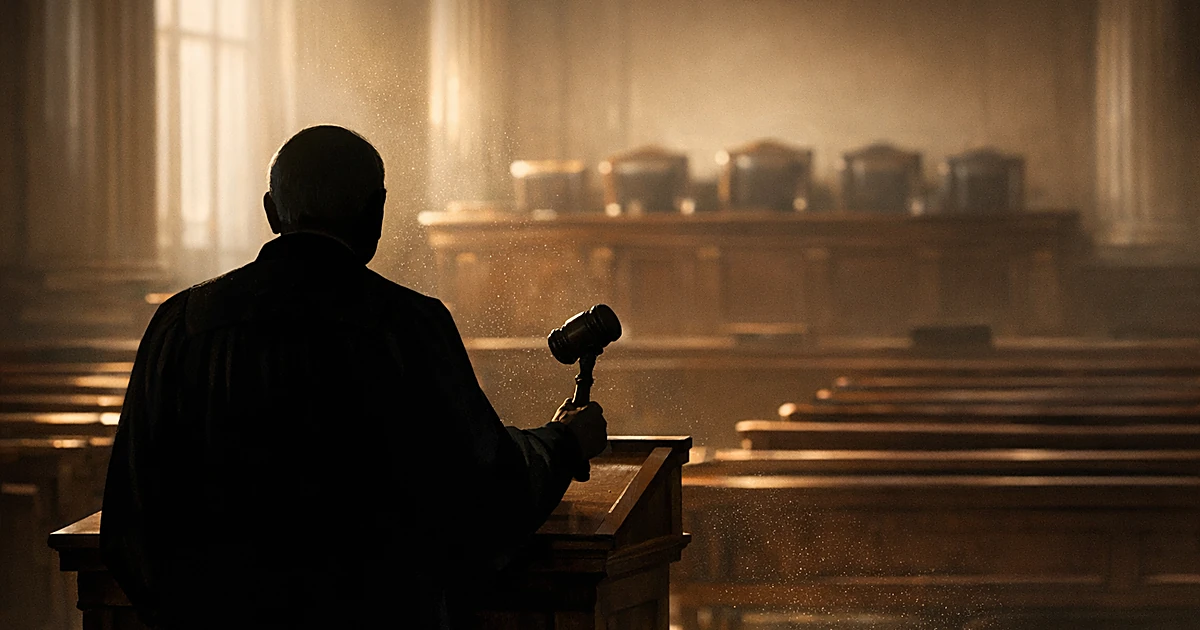
George Hutchinson, who announced the justices and called the Court to order with “Oyez, oyez, oyez,” served as the Supreme Court’s last standalone crier from 1952 to 1962 and died at 102, leaving behind a quiet but unmistakable link to centuries of legal ritual and the institutional authority it signals.
George Hutchinson’s voice opened nearly every Supreme Court session for a decade, and his passing at 102 closes a chapter in the Court’s ceremonial life. He was present when the Court decided cases that reshaped the nation, most famously Brown v. Board of Education. Saying “Oyez, oyez, oyez,” he did more than begin a hearing; he marked the shift from noise to law.
Hutchinson served as the Court’s crier for virtually every case heard between 1952 and 1962, according to contemporary reporting. His duty was simple to describe and weighty in practice: announce the justices’ arrival and giveel the chamber to order. That role grew out of long legal tradition and later merged into other duties at the Court.
He was the last person to hold that title as a distinct office, which gives his death the feel of an institutional endpoint. Ceremony can seem trivial until you realize what it does: it sets expectations for behavior and respect inside a room where the nation’s highest law will be spoken. Without those moments, proceedings risk being mistaken for political theater.
The era when Hutchinson served was anything but quiet for constitutional law, and the Court issued rulings that altered American life. Brown v. Board of Education toppled state-sanctioned segregation in public schools and provoked fierce, sometimes violent, backlash. Hutchinson never argued or wrote those opinions, but his role underscored that the argument was happening under formal, legal authority.
Every ritual exists to give structure and meaning, and the Court’s opening cry has deep roots. “Oyez” comes from Anglo-Norman practice, a phrase that once called citizens to listen in medieval courts. The term carried across the Atlantic and stuck because it signaled that a different kind of judgment was about to take place.
Today the cry still announces the Court, but the task falls to the Marshal of the Court rather than to a dedicated crier. That administrative shift reflects broader changes in how institutions organize themselves, yet the effect on the bench and the gallery is the same. The moment when silence is demanded remains a moment when law, not rhetoric, takes command.
There is a political moment to this that matters to conservatives who believe in ordered liberty and the rule of law. When elected officials treat Supreme Court rulings as optional or as mere talking points, they chip away at the very authority the Founders intended for an independent judiciary. The people in charge of keeping order in the room, even if only ceremonially, remind everyone that the Court is the final interpreter of the Constitution.
Recent years have shown a willingness among some public officials to flout or ignore court decisions they dislike, turning defiance into political virtue. That attitude threatens the distinction between governance under law and governance by preference. Hutchinson’s steady formality stood against that trend by insisting, every morning the Court met, that law commands attention.
Details about Hutchinson’s life outside the Court are sparse, but his tenure speaks for him. He did the job with consistent professionalism and stayed in place through a turbulent decade. The institutional staff who do these quiet jobs often escape headlines, yet they are crucial to ensuring that the Court operates as a court.
The backlash after Brown proved how fragile institutional legitimacy can be when public leaders choose resistance over compliance. Southern states resisted with manifestos, school districts delayed, and the nation wrestled with enforcement. Those clashes remind us that legitimacy does not come from rhetoric alone but from practice and the steady application of law.
Rituals, then, are part of the practice that preserves legitimacy; they are not mere flourishes. A simple call to order turns a room of powerful people into a courtroom where arguments are heard and decided. Lose those rituals, and you risk treating the Court like another political forum where the loudest voices prevail.
Hutchinson outlived every justice he announced and outlived the separate office he held. That longevity gives his life a symbolic weight for anyone who cares about institutions that outlast political cycles. His passing reminds conservatives that institutions are sustained by everyday acts of duty, not just by landmark opinions.
The Court continues to issue decisions that provoke debate and resistance, and the institution will continue to be tested. Those debates are necessary in a republic, but they must occur in a framework where the rule of law has priority. Every time the Court is called to order, the country gets a brief, clear reminder of that framework.
When Hutchinson rose, gaveled the chamber to silence, and intoned “Oyez, oyez, oyez,” he did something no press release or social media post can replicate. He asked a room full of powerful people to be quiet and listen because the law was about to speak. That was a modest obligation, and it mattered.

