

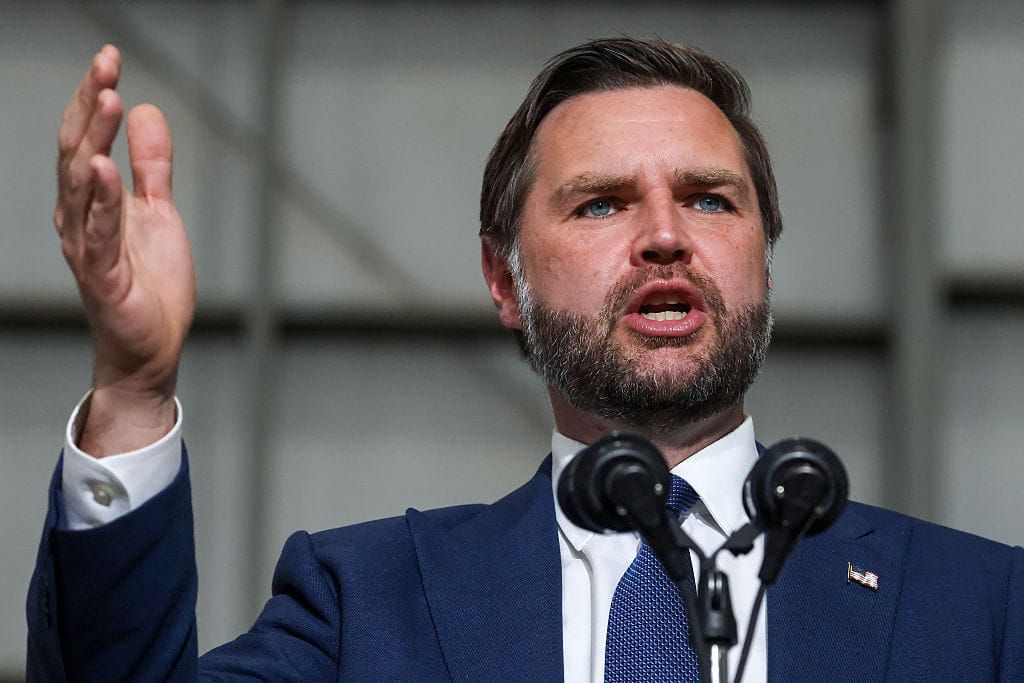
Vice President JD Vance’s recent remarks on economics and faith have set off sharp debate within conservative circles and handed opponents fresh lines of attack that could matter in a 2028 presidential contest.
JD Vance stunned many Republicans by questioning the ongoing relevance of Milton Friedman and by arguing for a return to stronger Christian cultural foundations. He said, “Milton Friedman’s ideas made more sense in the 1980s,” and added, “American economic policy on the right is now much more Alexander Hamilton than it is Milton Friedman. I think that’s obviously a good thing.” Those lines immediately reshaped how allies and rivals evaluate his economic instincts.
Republicans who believe in free markets hear alarm bells when a leading GOP figure elevates Hamiltonian approaches over Friedman’s market-first prescriptions. Vance’s comments cut two ways: they invite intraparty skepticism about his commitment to capitalism and they give Democrats and the media a ready-made narrative to weaponize against him in the general election.
Political reality matters. Independents make up about 40% of the electorate, and voters outside the conservative base will scrutinize any talk of Christian revival framed in political terms. Calling openly for a return to the nation’s Christian heritage risks feeding a perception, fostered by opponents, that a candidate stands for something exclusionary rather than for universal liberty.
There is also a class angle in Vance’s work and remarks that complicates his appeal to traditional Republican voters. He wrote, “Pretending that everyone can fill the void left by community and family and faith with a job is a way of taking the preferences of a small number of rich people and projecting them on everyone else. … Work has supplanted religion as a core source of meaning.” Those lines resonate emotionally, but they can be portrayed as skepticism about capitalism itself, which is toxic in GOP primaries.
Conservative strategists will note that Donald Trump admires Milton Friedman and that many Republican voters revere free-market champions. If a presidential hopeful signals a shift toward Hamiltonian statecraft and cultural prescriptions, rivals can and will paint him as soft on markets and prone to statist solutions. Andrew Moran put it bluntly: “Vance’s remarks are not entirely surprising, as his political career has been reliant on advancing the tenets of right-wing populism, mainly in the form of Hamiltonian protectionism.”
If Vance faces challengers in a 2028 Republican primary, those rivals will exploit any ambiguity about his economic philosophy. Attacking a rival as anti-capitalist lands hard in Republican politics, and a sustained intra-party debate about fundamentals would weaken his standing with donors, activists, and voters who prize free enterprise above all.
Even without a primary fight, a general election would spotlight these comments. Left-leaning opponents and the media will amplify lines about Christian nationalism and economic retrenchment to mobilize opposition and to persuade swing voters that a Vance presidency would shift the country in the wrong direction. Political branding is decisive, and these remarks hand branding opportunities to the other side.
That is the danger: a candidate can be personally sincere and still make politically damaging statements. Vance’s emphasis on virtue, religion, and community taps into legitimate policy debates, but in electoral terms, perception is reality. Republicans who want to hold the White House must weigh the cost of cultural candor when it can be reframed as exclusionary or economically unorthodox.
The road to the presidency runs through both the primary and the general electorate, and every public line matters. JD Vance has sharpened the debate over how the GOP defines its economic creed and cultural posture, and those choices will shape how voters — and rivals — respond to any 2028 bid for the White House.

