

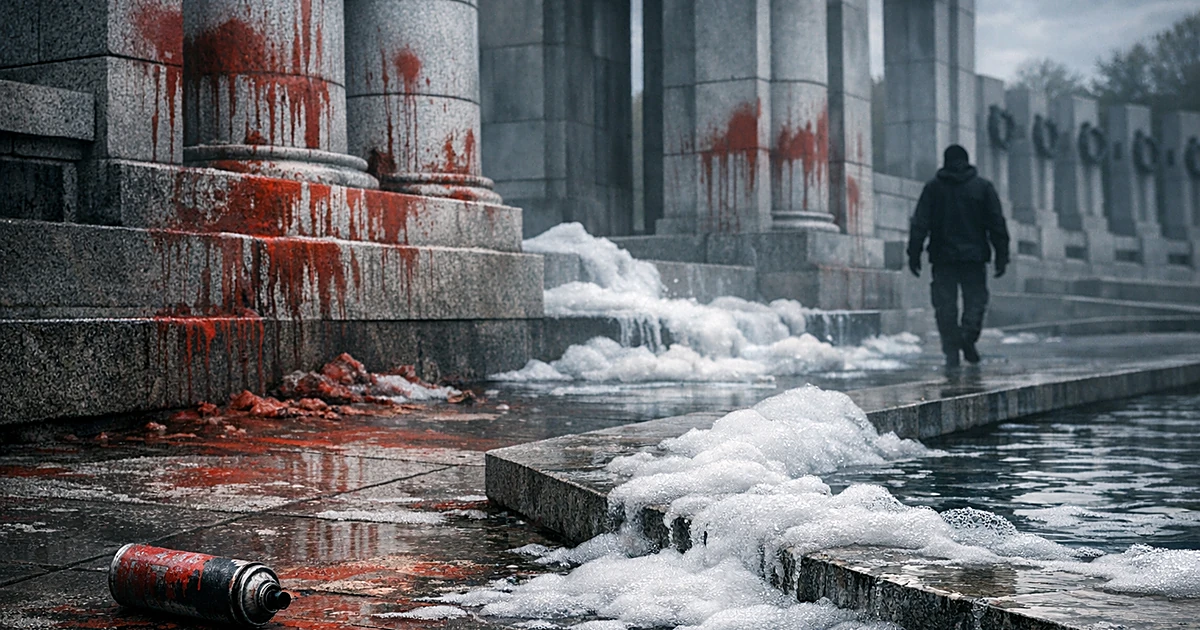
The Justice Department charged a Kentucky woman with two felonies after spray-paint and bubble soap defaced the World War II Memorial, a case that has drawn swift law enforcement action and political attention.
U.S. Attorney Jeanine Pirro announced federal felony charges against Melissa L. Farris, 41, of Elizabethtown, Kentucky, after damage to the Atlantic pavilion of the WWII Memorial on the National Mall. The indictment lists depredation against property of the United States and destruction of a veterans’ memorial, each count carrying a maximum sentence of ten years in prison. Farris is in custody following court proceedings.
The vandalism left red paint across walls and floors and the phrase “Clean hands dirty $” spray-painted on the monument’s stone, while bubble soap was poured into the fountain, producing suds and risking damage to mechanical pumps. The memorial had completed a $3 million, four-month renovation just months earlier, making the timing and damage especially galling. Park Police and federal investigators responded quickly to assess the cleanup and mechanical concerns.
Investigators tied Farris to the scene within hours after a witness photographed the act and handed images to officers on site. A U.S. Park Police officer recognized the woman from a recent arrest on August 10 for unlawfully camping on federal property a few blocks from the memorial. Those prior contacts narrowed the inquiry and helped lead to Farris’s identification and custody.
Social media material under a pseudonym appeared to corroborate authorities’ evidence, including a livestream recorded before the alleged vandalism and a second video in which she appeared to acknowledge the act. In the livestream, Farris said she would wait at the scene to be arrested, and she later turned herself in at federal district court. Court filings include the recorded statements as part of the investigative record.
Per court records, Farris said in one video:
“Why the [expletive] didn’t I get arrested? You don’t think that’s weird…”
The charged actions prompted a clear public stance from the U.S. Attorney’s office, and the language used left no doubt about how federal prosecutors viewed the incident. Pirro described the vandalism as a direct assault on a monument that honors those who fought and died for the nation’s freedom. She emphasized that such desecration would not be tolerated and vowed accountability for anyone who defaces veterans’ memorials.
Pirro stated plainly: “Vandalizing our World War II Memorial is a despicable attack on a sacred monument honoring the Americans who fought and died for our freedom. Those Americans include my father and grandfather.” She added a forceful enforcement line: “We will not tolerate this kind of criminal activism, and we will ensure that anyone who desecrates a veterans’ memorial is held fully accountable.” The Department of the Interior called the act “an utter disgrace.”
Preservation advocates also spoke out, stressing that national memorials are not places for protest canvases and belong to the memory of the fallen. “There are many places in our country for expression, debate, and disagreement. A national memorial honoring those who served and those who never returned home should never be used as a canvas for vandalism.” Those words underscored a shared view that the site must be protected and respected.
The political reaction was swift, with former President Trump publicly condemning the vandalism and framing it as an insult to World War II veterans. “Our beautiful World War II Memorial was just hit by Spray Painting Vandals,” he wrote. “THERE CAN BE NO GREATER INSULT TO THOSE AMERICAN HEROES WHO DIED IN WORLD WAR II.” The next morning, National Guard troops were deployed to patrol the memorial grounds to deter further incidents.
The case has carried implications for Jeanine Pirro beyond this single indictment, coming after criticisms earlier in the year when her office dropped a felony charge in a separate monument incident. That episode had drawn public scrutiny and raised questions about her stewardship as the U.S. Attorney in D.C. The Farris prosecution offered a chance to demonstrate decisive federal action on monument vandalism.
Pirro has been involved in several high-profile prosecutions during her tenure, including pursuing capital charges in other serious cases and handling matters with broad public interest. The memorial case is another high-visibility matter under her watch and is likely to be seen as a test of enforcement priorities in the nation’s capital. How the courts handle the charges will shape perceptions of federal resolve on protecting national symbols.
The timeline of events adds to the case’s clarity: an August 10 arrest for unlawful camping occurred just days before the alleged return to the Mall and the subsequent defacement. The sequence raises questions about intent and planning, and prosecutors will present evidence to courts that aim to establish the facts. Farris’s attorney did not immediately offer a public response to media inquiries.
Beyond potential criminal penalties, authorities highlighted the risk to the memorial’s infrastructure, noting that soap in the fountain could harm pumps and increase restoration costs. The recent multimillion-dollar renovation intensified concern about lasting damage to a site meant to honor more than 400,000 Americans who died in World War II. Officials and veterans’ groups insist that respect for these national places must be enforced through the law.

