

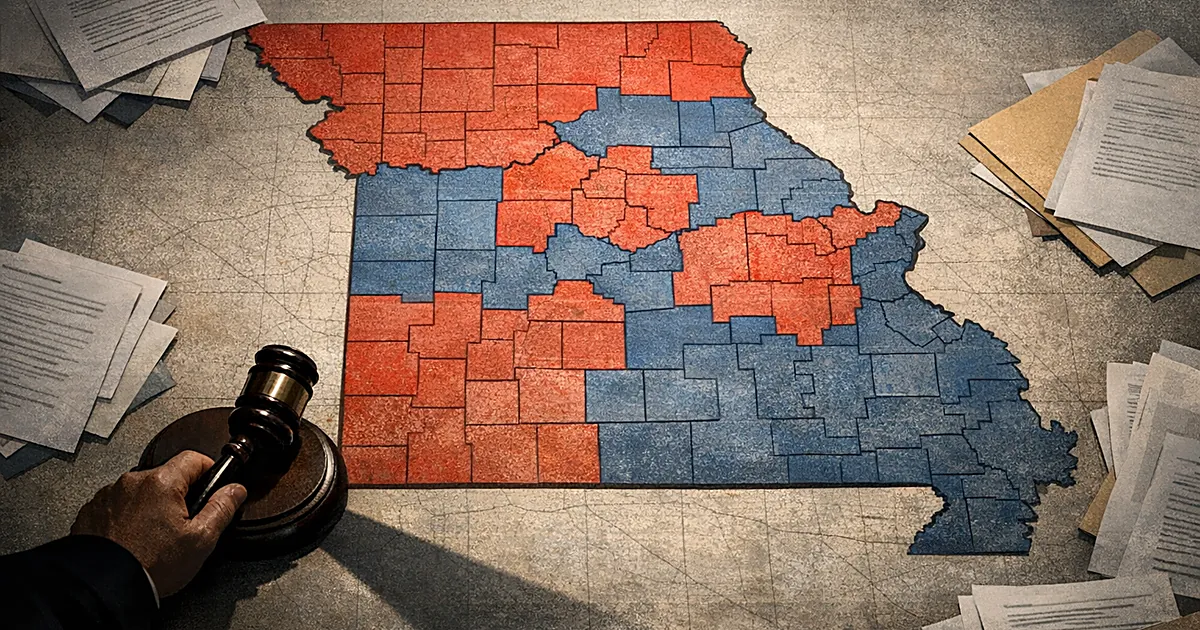
Missouri’s courts have cleared Republican-drawn congressional lines for use in the 2026 election, and the decision tightens GOP control over the state’s U.S. House delegation while closing off a referendum route that Democrats had pursued.
A Cole County judge has ruled that Missouri voters may not use a statewide referendum to override congressional redistricting, siding with Secretary of State Denny Hoskins and the Republican-controlled legislature. The ruling leaves in place a map that shifts Missouri from six Republicans and two Democrats toward a likely seven-to-one GOP advantage. The judge found the petition effort legally defective under the state constitution.
The petition drive was led by People Not Politicians and sought to force a public vote on the new lines, but the court concluded the effort ran afoul of the single-subject rule. The judge wrote that the petition attempted “sweeping reforms affecting multiple provisions of the Missouri Constitution” rather than addressing a single subject tied to one article. Green ordered the new map to remain “in full force and effect for the 2026 general election.”
“The Missouri Constitution does not supply any statement, let alone a clear one, reallocating authority over congressional redistricting away from the General Assembly to a referendum process.”
The new configuration carves up parts of Kansas City in a way that makes Rep. Emanuel Cleaver’s seat substantially less safe, moving roughly 59 percent of voters into a reshaped district. That sort of surgical redraw is exactly how legislatures protect constituents and political interests when they control the pen, and Missouri’s GOP moved aggressively to lock in advantages. If the map stands, St. Louis-based Rep. Wesley Bell would likely remain the only Democrat in the eight-member delegation.
The redistricting came after Gov. Mike Kehoe called a special session, following pressure from national GOP leaders to redraw boundaries mid-decade. Missouri joined Texas as a state that used a midterm map change to respond to political realities rather than waiting for the next census cycle. The result is a more secure baseline for Republicans heading into a midterm where incumbency and map shape matter a lot.
From a legal perspective, courts are the last line of review and they have been trending toward deference to state legislatures on these questions. Recent rulings in several states, including a string of decisions that allowed competitive Black-majority districts to be redrawn in ways courts once blocked, have given GOP mapmakers room to push harder. The Supreme Court’s earlier decisions in this area signaled a willingness to let legislatures set the rules with less federal interference.
Nationally, Republicans are targeting similar opportunities in other states, aiming to convert mid-decade maps into as many as 16 additional House seats across eight states. For a party defending a narrow majority, those gains can change campaign strategy, resource allocation, and the math of control. The campaign to secure structural advantages through state law is deliberate and coordinated.
State-level dynamics in Missouri are worth noting: the Missouri Supreme Court has already ruled against earlier challenges to these lines, and five of the court’s seven justices were appointed by Republican governors. That composition and earlier rulings make an appeal less likely to overturn the circuit court’s order, and the May 12 decision from the high court already found the legislature may redraw congressional boundaries at any time.
Rep. Bob Onder described the Cole County ruling as straightforward and warned of the chaos that would follow if referendum maps could be used to overturn legislative lines. He said, “It was clearly the correct decision. Otherwise, referendum maps by the party out of power could become a free-for-all, and we’d never have new maps.” His comment reflects a Republican argument for predictable, legislatively driven redistricting rather than constant ballot fights.
People Not Politicians signaled it will press the case higher, and executive director Richard von Glahn said the group would take the issue to the state’s highest court. He stated, “Everyone knows that Cole County is not the final decision here. After months of delay, we are pleased to be moving forward to the Missouri Supreme Court to enforce our constitutional rights.” Still, the political and judicial arithmetic on the bench complicates that path.
Outside the redistricting fights, other legal fronts are reinforcing the broader GOP policy agenda. Federal courts recently declined to block the Trump administration’s work requirement for Medicaid in a case brought by multiple Democrat-led states, signaling that many Democratic legal challenges are losing traction. The pattern favors states and the administration when policies are defended through conservative-friendly courts.
For Missouri Democrats the options are narrowing as the calendar moves toward November: the circuit court has ruled against the referendum and the state supreme court has already denied an earlier challenge. The map that splits Kansas City and reshapes Cleaver’s district is currently the law, and that reality will shape how both parties allocate resources and candidates plan campaigns in the months ahead.

