

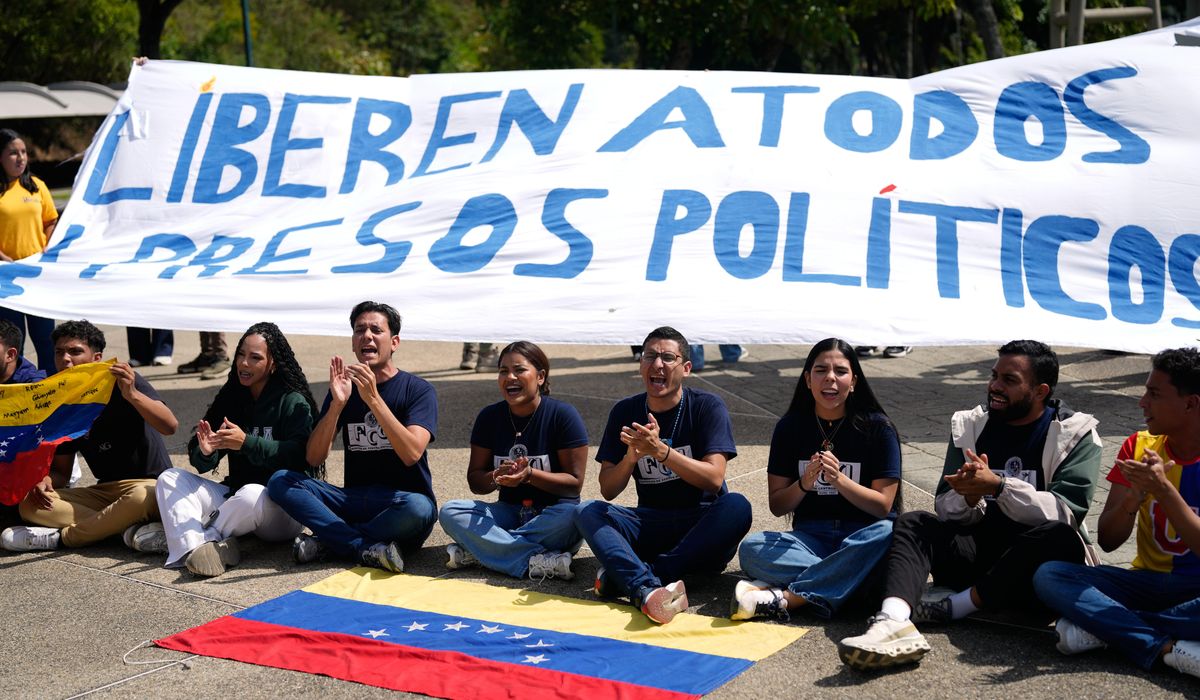
Families of jailed Venezuelan opposition figures gathered at a notorious Caracas prison to demand justice, while the situation highlights broader concerns about political repression and the rule of law under the current government.
Dozens of relatives and friends of Venezuelan opposition leaders, human rights defenders and others detained for their political activities protested Saturday outside a notorious prison in the capital. The scene on the prison grounds was tense but orderly, with family members calling attention to legal irregularities and the lack of basic due process. Their presence put a spotlight on the men and women held for political reasons, and on a justice system critics say is weaponized against dissent.
Behind the protest are years of complaints about selective prosecutions and politically motivated detentions. From a Republican perspective, the case illustrates how authoritarian regimes use the legal system to silence opponents, undermine independent institutions, and keep power at the expense of liberty. These are not abstract problems, they are real people with families who want clear answers and fair trials.
The families who gathered demanded access to reliable information about their loved ones, including medical care and lawful visits. They described obstacles to communication and abrupt transfers between facilities that make legal defense difficult. Public demonstrations like this one are often the last recourse for relatives who see domestic options exhausted and international scrutiny as their only hope.
Human rights organizations have repeatedly documented cases where political critics end up detained on vague or broadly defined charges. Observers point to a pattern: arrests after public criticism, long pretrial detentions, and courts that rarely rule independently. For many Venezuelans this pattern confirms a long-standing fear that the judicial branch no longer operates as a neutral arbiter.
The protest also forced local media and foreign outlets to cover the human side of the crackdown. Visuals of grieving relatives and placards calling for justice bring tangible pressure, even if governments with power to act remain reluctant. For conservative observers, these scenes are a reminder that freedom requires not just elections but institutions that protect dissent and hold power accountable.
U.S. policymakers and lawmakers who favor a tough line on Caracas will see these events as validation of continued pressure. Sanctions, diplomatic isolation, and support for independent civil society are tools Republicans have favored to avoid direct military entanglement while still pushing back. At the same time, supporters argue that well-targeted measures can increase cost for those who abuse power and provide breathing room for civilian voices.
International courts and human rights bodies often face limits in enforcement, but documentation matters. Every protest, every testimony and every legal filing creates a record that can be used in future proceedings or in applying pressure through international forums. The families who gather outside that prison understand this: their protest is both an appeal to conscience and a strategic move to keep the cases visible.
For observers watching Venezuela’s next moves, these protests are a reminder that domestic unrest and international criticism feed into each other. The detained opposition figures are not only a legal question, they are a political symbol for those who hope to restore democratic norms. If accountability mechanisms remain absent, the cycle of detention and protest will likely continue, with real human costs.

