

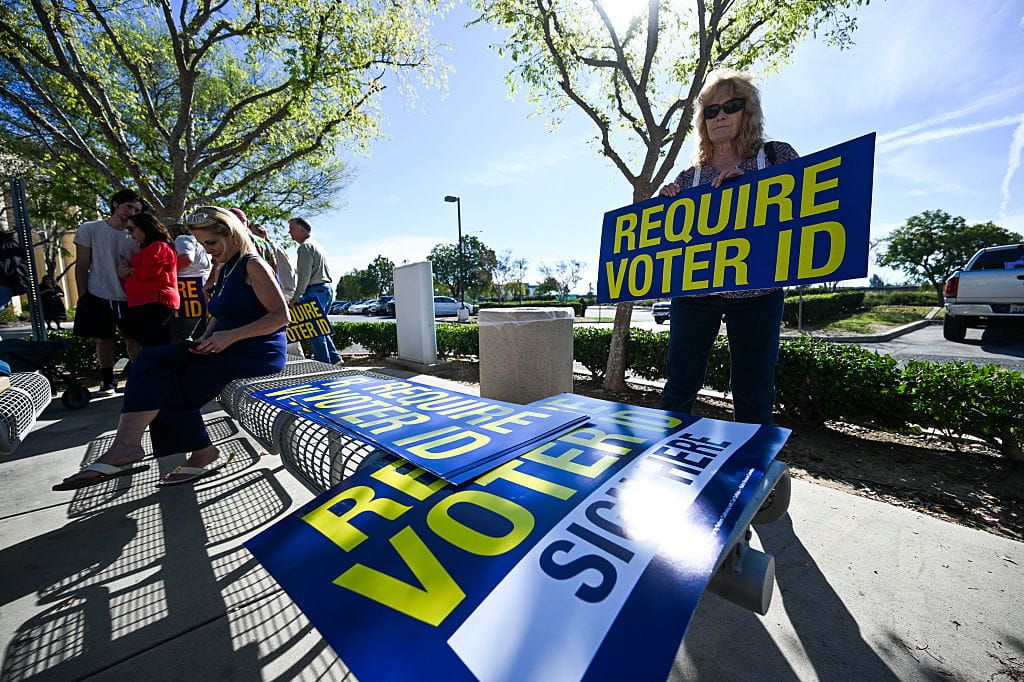
Republicans pushed the SAVE Act through the House, but the Senate blocked it, so conservative states moved on their own with proof-of-citizenship and voter ID measures while the national fight over federal incentives and filibuster rules grinds on.
Congressional Republicans managed several wins this term, yet the SAVE America Act remains stuck. The House passed versions of the bill in April 2025 and again as the SAVE America Act in February, but the Senate’s 60-vote filibuster threshold stopped it cold. With the federal route stalled, GOP leaders shifted to using federal grant incentives to prod states instead.
That pivot aims to offer $10 billion in federal grants to states that adopt election-integrity measures on their own. It is a familiar federal playbook: use money as leverage to change state behavior. Conservatives see it as practical politics; opponents call it coercion.
“Back in 1987, the government bribed states to mandate seat belts by withholding a percentage of federal highway funding for any state that refused. The feds did the same – using the same funding, in fact – to coerce states to raise the drinking age to 21 in the ‘80s and to drop the speed limit to 55 MPH in the ‘70s. And those are just three examples of many.”
Call the grant plan incentives, rewards, or even bribery if you like; historically it works. Republican governors and legislatures in several states didn’t wait for Washington. They passed measures requiring documentary proof of citizenship at registration or allowing officials to demand proof when federal databases fail to verify citizenship.
Florida, Utah, South Dakota, Mississippi, and Tennessee all moved to tighten registration rules, and Wyoming adopted similar measures in 2025. Louisiana acted in 2024, and New Hampshire adopted requirements that year too, despite its more purple profile in national elections. These moves show state-level appetite for tighter verification even without a federal mandate.
Arizona’s approach is instructive: the state uses a two-form registration system so people can register for federal elections without proving citizenship but must provide proof to vote in state contests. Arizona had required documentary proof years earlier, lost in a 2013 Supreme Court decision, and then reworked its system to split state and federal registration. That compromise highlights how states can navigate legal limits while still tightening integrity measures.
Other states have a patchwork of history on this front. Ohio passed proof-of-citizenship rules in 2022, and Alabama has relied on driver’s license and Social Security checks for eligibility since 2009. Alabama and Kansas enacted DPOC laws in 2011, though Kansas’s law was later struck down by a court in 2018 and Alabama never fully implemented its statute.
Most of these states already require some form of voter ID at the polls, but the specifics vary. Utah, Arizona, and Wyoming, for example, do not always require a photo ID under their recent rules. That variation shows the policy space state lawmakers use when aiming to prevent ineligible voting without creating unnecessary barriers to legitimate voters.
The national debate centers on whether state actions move the needle for election security overall. The Department of Homeland Security recently reported finding more than 250,000 non-citizen registered voters in California, Nevada, New Jersey, and Pennsylvania, a figure that triggered alarm and pushback. Officials in three of the four states questioned the methodology, so the raw number is contested even as it sparks serious concern about registration accuracy.
New Jersey had its own registration snafu when the Motor Vehicle Commission mistakenly registered roughly 6,600 applicants who had indicated they were not citizens on their driver’s license forms. The error fed a public argument over whether voter rolls are reliable and who is responsible for cleaning them up. Even a Democratic governor in a mixed-state legislature called for changes while criticizing the federal bill, arguing the national proposal was politically motivated and “just a tool of voter suppression.”
Democrats in Congress often profess support for fair ID laws while opposing a federal mandate, which frustrates Republicans. GOP leaders say they have repeatedly offered straightforward voter ID and documentary-proof bills only to see Democrats vote them down. That pattern underscores the partisan impasse in Washington over nationwide standards.
Without the SAVE America Act at the federal level, blue states are unlikely to adopt stricter documentary requirements on their own. That leaves the country with an uneven patchwork of rules and enforcement, and it hands the initiative back to state governments to decide how seriously to pursue registration integrity. For those focused on securing elections, the state-by-state route is messy but real progress compared with a blocked Senate effort.
What happens next depends on the politics of incentives and litigation. If federal grants become part of a reconciliation package, more states might accept the funding and the conditions that come with it. If litigation continues to strip back state measures, lawmakers will keep trying different strategies to tighten registration without running afoul of courts.
The broader point is clear: when the federal process stalls, states pick up the slack. Conservative states are already moving, and the national debate over how to balance access and integrity will keep both the courts and legislatures busy. The fight over who decides voter rules is far from over, and the next steps will shape how Americans trust the system that runs their elections.

