

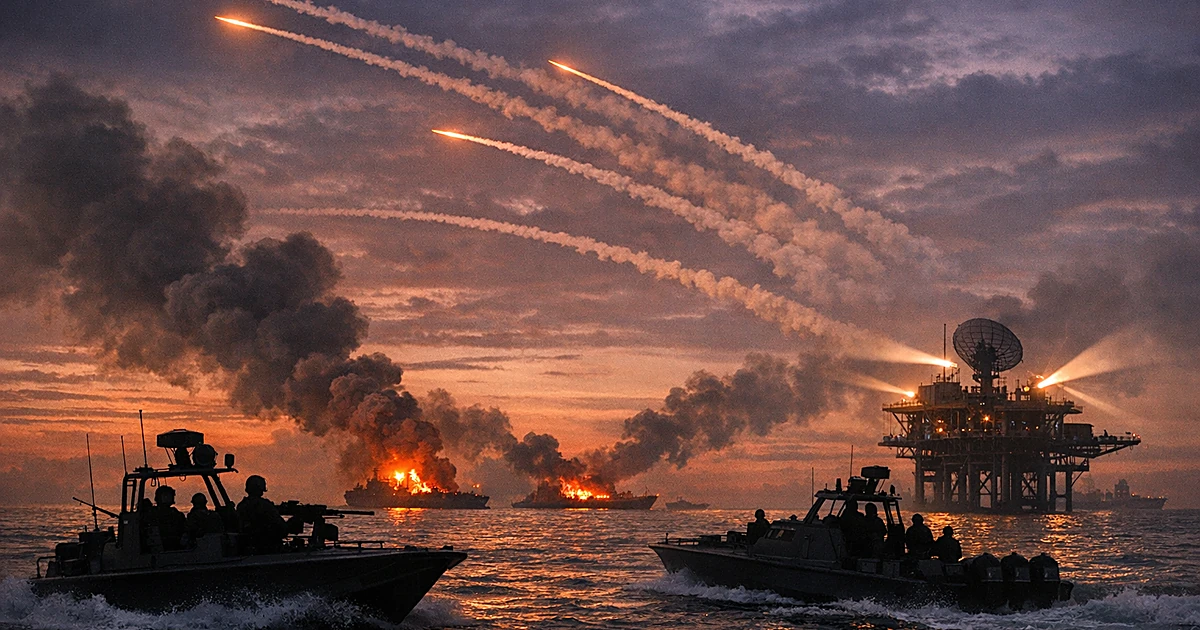
President Trump declared the interim ceasefire with Iran “over” after Tehran’s Revolutionary Guard struck American bases in Bahrain and Kuwait and the U.S. responded with strikes inside Iran, ending the fragile arrangement meant to keep the Strait of Hormuz open and reopen limited oil sales.
President Donald Trump told reporters at a NATO summit in Ankara, Turkey, “For me, I think it’s over,” and added, “They can talk, but I think they’re wasting their time.” His comment came hours after Iran launched ballistic missiles and drones at U.S. installations and the United States retaliated, a clear sign the temporary diplomatic framework has collapsed. The break marks the sharpest deterioration in a process that had already been fraying for weeks.
Iran’s Revolutionary Guard acknowledged targeting American military installations in Bahrain and Kuwait, the two Gulf states that host U.S. naval and army forces. Kuwait reported intercepting two ballistic missiles and thirteen drones, though shrapnel from those intercepts still damaged electricity lines. The attacks on host nations that shelter U.S. forces changed the dynamic from localized skirmishes to a broader regional crisis.
U.S. Central Command said its strikes hit Iranian air defense systems, radars, and more than sixty Revolutionary Guard fast-attack boats used to menace commercial shipping. CENTCOM framed the operation as meant “to impose heavy costs for targeting and attacking commercial shipping crewed by innocent civilians in an international waterway.” One Guard member was reported killed in Bandar Mahshahr, and strikes struck areas near Bushehr, where Iran’s nuclear power plant complex is located.
The interim bargain had two central pillars: a sixty-day ceiling letting ships transit the Strait of Hormuz without charges and a U.S. license that allowed Iran to sell oil in U.S. dollars. Both pillars are now gone after the U.S. revoked the oil-sale license and reinstated sanctions, and indirect negotiations that had been underway ended without progress. The window for a negotiated solution narrowed dramatically in a single day.
The flare-up followed attacks on commercial shipping the day before, including a tanker carrying Qatari natural gas that was hit and caught fire, while two other ships were damaged. The vessels were traveling close to Oman’s coast rather than the corridor Tehran insisted should be used, and Iranian state media blamed the tanker for ignoring warnings without directly claiming responsibility. That pattern of deniable aggression has defined months of provocations in the strait.
Qatar’s Foreign Ministry spokesperson Majed al-Ansari called the tanker incident an “unacceptable attack” on international navigation and global energy security and said Qatar holds Iran “fully legally responsible.” When a mediator like Qatar begins using legal language and threats, it is a clear sign the diplomatic architecture is breaking down. Regional patience with Tehran’s tactics has been wearing thin.
Gulf leaders voiced growing skepticism. Senior UAE diplomat Anwar Gargash said Iran’s strikes on Bahrain and Kuwait show Tehran “remains incapable of committing to the requirements of de-escalation and turning the page on war.” That view reflects a broader hardening among Gulf states that once tried quieter diplomacy with Tehran but now see those channels as failing. The consequences of that shift are strategic and immediate.
On social media, Iran’s parliament speaker Mohammad Bagher Qalibaf posted: “The era of bullying and extortion is over. It leads nowhere. We don’t fold.” The bravado sits awkwardly next to the facts on the ground: more than sixty Guard boats destroyed, degraded air defenses, a dead Guard member, and an oil-sale lifeline revoked. Those tangible losses undercut the rhetoric coming from Tehran.
The political picture inside Iran looks chaotic. Supreme Leader Ayatollah Ali Khamenei was killed February 28 in what some described as the war’s opening moments, and his son and successor Ayatollah Mojtaba Khamenei is reported to be wounded and out of public view. Funeral events have drawn regional figures, but the leadership vacuum raises a core question the ceasefire never answered: who in Tehran can actually make and keep a deal?
Markets reacted fast. Brent crude jumped more than five percent after President Trump’s remarks, pricing in a riskier Strait of Hormuz and a collapsed ceasefire framework. Planned talks that were to follow Khamenei’s funeral now face deep uncertainty, and political battles at home over war powers between the White House and Senate Republicans will complicate any future U.S. response.
For Republicans skeptical of the ceasefire, the collapse confirms what many argued all along: temporary pauses will not bind an adversary determined to press regional control. Declaring the arrangement dead is presented here less as a failure than as facing the facts about Iranian behavior and resetting expectations for any future negotiations.


1 Comment
The only thing Iran will understand is the complete and total destruction of their country, and that should start now