

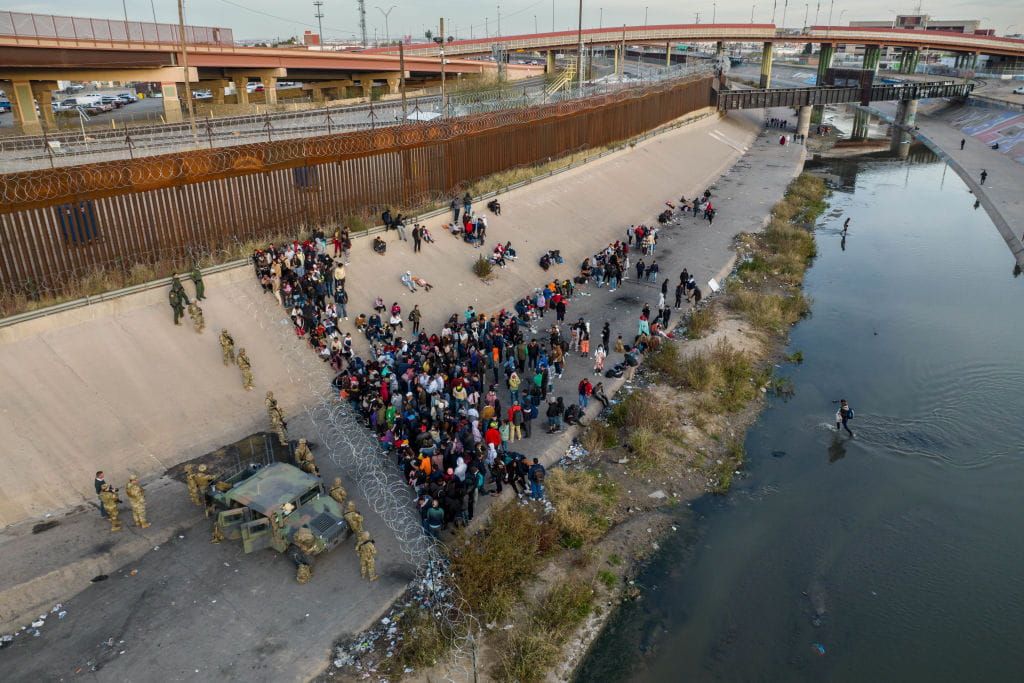
The Migration Policy Institute’s recent analysis finds the unauthorized population climbed to 15.8 million by mid‑2024, driven by record border crossings and expanded humanitarian parole programs, shifting the demographic mix away from a long-standing Mexican majority toward more Central and South American arrivals.
The Migration Policy Institute released a report titled “Following Years of High Border Arrivals, the U.S. Unauthorized Immigrant Population Hits New Peak,” estimating undocumented populations “reached a new peak of 15.8 million as of mid-2024, after holding steady at around 11 million throughout the 2010s.” “This increase was driven largely by record border arrivals and expanded Biden-era humanitarian parole programs.” Those numbers underline how recent policy choices and enforcement lapses changed the flows into the country.
MPI points to several concrete drivers: record border arrivals, new humanitarian parole pathways created during the Biden administration, policies that let many migrants remain in the country while awaiting immigration court dates, and visa overstays. Taken together, those factors produced a sharp uptick in a matter of months rather than the slow, steady trends seen in prior decades. The result was a headline figure that directly ties policy to population shifts.
Looking back, the decade from 2010 to 2019 showed far smaller net growth because large inflows were partially offset by deaths, emigration, and legal status adjustments. MPI estimated that nearly 6.1 million people crossed a border illegally or overstayed a visa during that period while 5.7 million unauthorized immigrants died, emigrated, or obtained legal status, yielding a net increase of just 394,000. That math helps explain how enforcement and administrative processing shape long‑term totals.
The state breakdown in 2024 concentrated the population in familiar places but with notable scale. California led with 2.6 million undocumented residents, followed by Texas at 2.3 million, Florida at 1.4 million, and New York at 920,000. Other states with large figures included New Jersey, Illinois, Georgia, North Carolina, Washington, and Virginia, each with substantial numbers that carry local impacts on services and budgets.
Origins are shifting too. Mexican nationals remain the largest origin group, but their share fell to 35% in 2024 compared with roughly 62% in the 1980s and 1990s. Growth has been concentrated among migrants from Central America — especially Honduras and Guatemala — and from South American countries such as Brazil, Colombia, Ecuador, and Venezuela. That change alters regional settlement patterns and the kinds of humanitarian and legal issues policymakers must address.
“Increases were also driven by Biden administration policies that allowed most border migrants who reached U.S. soil to stay in the United States pending the outcome of removal proceedings in immigration court. Growth was further driven by the creation of new humanitarian parole programs that allowed legal entry and temporary stay for migrants from Afghanistan, Ukraine, Cuba, Haiti, Nicaragua, and Venezuela, as well as those from all around the world who reached northern Mexico and made appointments via the CBP One app to be screened for entry. And growth also came from sizable numbers of Europeans and others who overstayed their temporary visa.”
The MPI quote above lays out how administrative choices intersected with border operations to change outcomes quickly. From a Republican perspective, the plain lesson is that policy settings matter: when programs and processes make it easier to stay or to enter temporarily, numbers respond. That is not abstract; it plays out at hospitals, schools, and local budgets immediately.
Counting these populations is inherently difficult because many people avoid official counts or interactions with government officials for fear of consequences. MPI cautioned that accurate measurement is complicated by nonresponse and concealment, which can mask true totals and distribution. Those measurement limits should make policymakers cautious about relying on single estimates without corroborating data.
The broader implication is clear: border policy produces measurable effects on the size and composition of the undocumented population. Shifts in origin countries, state concentrations, and the role of parole and court processing all point to the same reality — enforcement strategy and administrative rules shape migration flows. Communities and leaders will continue to see the consequences in local services and public finances as the data from MPI demonstrates.

